

MFA Sunday School (Nine: Finishing Self-Editing by Understanding Writing Mistakes)
 Welcome to MFA Sunday School, a once-a-week, free, online writing workshop. MFA Sunday School posts are uploaded on Sunday mornings, though you can read them or participate any time — the comment section is always open for people to post a link to their work or ask a question. You can subscribe to blog posts via the RSS feed, or look for them under the category heading “MFA Sunday School.” If this is your first time in “class,” you may want to jump back to the first post in the series in order to understand how things work, or peruse all of the past lessons as well as a glossary of terms by reading the MFA Sunday School Glossary and Course Archives.
Last week, we started looking for your writing accent, the small quirks that you use in your writing which make it undeniably yours. It goes beyond your writing voice; it is about the tiny inflections you pepper into your writing that people respond to on an emotional level without realizing it. Sometimes within your writing accent, we’ll also find your writing mistakes. The goal is to clean up the mistakes without cleaning up the accent. What you want to look at is intent: why are you utilizing that writing quirk/error? Does it enhance or detract from your writing?
We’re going to define mistakes as anything that doesn’t bring the reader into the poem, post, or story. That serves as the vinegar to their oil. In other words, these things pretty much only detract from your writing.
Let’s begin with the most concrete ones that are easy to see and fix.
Concrete Mistakes
- Passive Voice Instead of Active Voice: active voice is simply more interesting than passive voice. From Alexicographer below: “Passive: She was run over by a car. Active: A car ran over her. Ooh, that sounds really bad. Let’s change it: Her umbrella was run over by a car. OR A car ran over her umbrella. Did the subject of the sentence perform the action? Active. Or was the action performed on the subject? Passive.”
- Past Tense Instead of Present Tense: present tense is a little more interesting than past tense because it places the reader into the story. The story is unfolding around them and they respond accordingly. It’s not always possible to play with tense, but past tense keeps the reader on the outskirts of the story at times. At the same time, I see this as a minor point that I bring up simply to challenge you to look at your writing. There are plenty of engaging stories — Harry Potter comes to mind — that are written in past tense.
- Boring Sentence Structure: do all your sentences begin the same way or close to the same way? Mix it up in terms of structure and length. Read the first paragraph in this post underneath the weekly opening (the paragraph that begins, “Last week…”). Every sentence begins in a different way, and they all vary slightly in length (though I could have done better with that too).
- Too Many Rhetorical Questions: your reader can’t actually answer your questions; plus, the reality is your reader is approaching your work to get information or a story. A few questions that make them think are fine. Too many becomes a chore.
- Incorrect Words, Grammar, or Punctuation: quick fix once you familiarize yourself with the three billion grammar and punctuation rules in English… But you get my point; incorrectly-used words, grammar mistakes, and punctuation errors take the reader out of the story because they create confusion.
- Too Many Analogies or Metaphors: this is another one of my common mistakes. It’s about trusting that your reader “gets it,” and using analogies sparingly. Which leads us to…
- Don’t Overwrite: don’t use more words or more sentences than you need to use in order to make your point. This isn’t Dickens’ time period, and you’re not paid by the word (he wasn’t actually paid by the word, but since that myth exists, I thought I’d exploit it). Sometimes it helps to strip out every unnecessary word, and then tuck back in colourful words that add to the idea. But at the same time…
- Don’t Underwrite: your storytelling capabilities are the doorway through which readers walk into your imagination. Have you left that door wide enough open for them to fit through? Do they understand the story? Too many times, writers expect us to know what is inside their head (and makes perfect sense to them) without giving us access to the content of their brains. Make sure your mind doesn’t fill in what is missing on the page, but instead note what parts seem confusing and explain them better.
- Go Easy on Modifiers: make your word choice do the work of modifiers which are a quick (and albeit lazy) way to tell your reader how to read something. Sometimes they’re necessary, but see if you can rework your word choice to clearly convey whatever is contained in the modifier.
- Transitions: are you transitioning well between ideas, characters, scenes? Take a look at your transitional moments because you need flow instead of jarring movement.
- Repetitive Words: this applies both to using the same word too many times too close together as well as using an unusual word or phrase or metaphor too many times in the same piece.
Less Concrete
- Focus: are you keeping a close focus on the subject matter or story; or is your reader being dragged away on too many tangents? Tangents should only exist if they add to the understanding of the main story.
- Foundation: you can’t build a house without a strong foundation because it will collapse in on itself, and you can’t build a story without a strong foundation and structure. Do you clearly know your storyline and characters? Have you clearly set the time and place?
- Pace: you want your poem, post, or story to read at a good clip. Not too fast so that the reader is confused and can’t process what is happening, and not too slow that the reader feels as if they’re plodding along.
- Exhaustion: some long pieces — especially novels — are coated in writing exhaustion. It’s clear to the reader that while the author started out confident with the story and characters, he/she lost focus somewhere in the middle and didn’t know how to get the story from Point A to Point Z.
- Hollow Dialogue: make sure your conversations ring true. That they sound like something someone would say. By which I mean that they contain the meat of the conversation, not the piddly extras we throw into real conversations.
- Show, Don’t Tell: oy… this one needs more than a sentence or two explanation. We’ll have a whole lesson soon on show, don’t tell, but I wanted to put it in this editing list so you remember to check for it.
Things You May Have Been Told are Mistakes But are Probably Just Part of Your Writing Accent
- Fragments: nothing wrong with a little fragment when used well. Especially for impact. (A ha! Like that fragment! Or this one!)
- Prepositions: I try not to end sentences in prepositions, but sometimes it works depending on where you’re coming from.
- Splitting Infinitives: to unabashedly split your infinitives, place a word such as “unabashedly” between the “to” and the “verb” in the sentence. Be a bad-ass. Splitting them can have an impact.
- Conjuction-led Sentences: yet there are so many good reasons to begin a sentence with a conjunction.
- Or peruse this list of non-errors.
Homework: Choose something brief — perhaps a blog post — to practice self-editing. Look at the information above and apply it to your piece, and then examine the before and after side-by-side. What writing mistakes keep cropping up in your pieces? Does it feel easier to stop yourself from doing them in the first place, or would that stilt your writing and is it better to edit them out later? Are you starting to see your writing accent?
June 10, 2012 3 Comments
The Facebook Conversation Test
In a new window, go open your Facebook account and bring up the news feed that contains people’s status updates. And now let’s do a little test with the top 10 statuses. Taking into account your relationship with the person, is their current status update an appropriate first line to a conversation? If you bumped into them face-to-face and they led with this news because it was in the forefront of their mind, would it be something where you’d nod in understanding (as in, “yes, it is totally fun to get dinner with your grandma and grandpa!”) or would it be something that would make you inwardly cringe and flounder around for an appropriate answer? (For instance, how does one respond if someone starts the conversation with “my boobs are so damn itchy!”)
No, really, go open a new window and do this. What is your score? I want to know.
In a perfect world, you should have a score of 10 out of 10.
This, of course, doesn’t take into account the fact that people lump all of their family members, friends, acquaintances, and coworkers into a single account, therefore, what is understandable to one group is a head scratcher for another. Still, though people may have status updates that make you feel on the outside of an inside joke, everyone should feel as if status updates are something they want to read vs. something that make them cringe in horror.
My Facebook news feed doesn’t always follow this simple rule. My feed at the moment of writing this scored an 8 out of 10.
Which is a problem because the point of Facebook is communication; to know what is happening in each other’s world. And if I am moved to hide status updates because the ones you are posting are so unbelievably inappropriate or offensive, it begs the question: why are we connected in the first place? And yet I cannot tell you how many people have told me that they filter and hide people’s status updates when I’ve commented to them about my personal Facebook Conversation Test.
“Oh, just hide their status updates,” they tell me when I comment that I really didn’t need to hear the intimate details of their last yeast infection. Nor do I want to hear about how I’m going to hell because I haven’t found Jesus. Nor do I want to hear their favourite sexual position. And while that is obviously a solution, it sort of leads to that deeper question: why are we connected? Why not just remove the person from your feed entirely? What is the purpose of being connected on Facebook if you’re not reading what the other person is saying?
Since I’m here, throwing stones, I checked my own Facebook feed to see the last 10 updates. There were a few random quotes from the kids, snarky commentary on Mother’s Day and fast-moving yoga instructors, and an admission that I just watched the Zapruder film for the first time. Perhaps they’re not the usual things I’d use as a conversation starter, but certainly within the limits of good taste on information I could share with most people, the outliers who hate children, people who do yoga, or adults who wait to see the Zapruder film notwithstanding. My point, of course, is to make people want to read my thoughts rather than have them run horrified from the information that drops into my Facebook status updates since it’s the way I comport myself in the face-to-face world. After all, how often do we go to our co-worker and casually announce that we just took the biggest dump? You do? Perhaps that’s fodder for a different post…
Should Facebook be a recording of the random thoughts that pass through our brain without any regard to who is on the receiving end of our words? Or should we look at our words as the first line in a conversation and tailor it accordingly based on the majority of our friend list?
Or… even more importantly, do you see Facebook as a conversation or a platform for multiple monologues?
June 8, 2012 20 Comments
396th Friday Blog Roundup
Thank you for the birthday wishes last week. I’d love to tell you all about seeing the amusement park pieces, and show you all my lovely photos… but we didn’t go. The day before, we headed up to the actual old park grounds (most of which was now a shopping mall) to see the ruins. The only thing that remained in good shape was the entrance castle. We walked around the fence, peeking in at the forest growing over the ruins, and I felt in that moment that I had my peace even though it didn’t look like the Enchanted Forest at all.
The next day, the day we were supposed to go to Elioak, the Wolvog had his baseball game postponed due to weather, and we spent the day in the house, waiting to hear when he’d be playing. At one point, we could have slipped out to the farm, but I sort of didn’t feel like it was where I was supposed to be in that moment. We stuck around the house, and I got everyone to clean for three straight hours. And then the Wolvog’s baseball team won their game, and we screamed our heads off.
The next day, we went to Nationals Park to celebrate my birthday again, and Lombardozzi and Harper kicked off the game with back-to-back home runs as the first two hits. Literally, first two hits of the game were both home runs. In the same vein as not needing to go see the restored pieces of the amusement park after seeing the ruins, I sort of didn’t need the Nats to win after that opening. It was that good. Oh, and they didn’t win. But what I’m saying was that it didn’t really matter because that opening was so spectacular; just as seeing the ruins of the amusement park were enough in the moment.
So, all in all, a great birthday.
*******
Josh and I don’t really do gifts on birthdays or holidays. We just give gifts whenever we feel like giving a gift. I made a joke on my birthday that he should trot downstairs and get my gift, and he said, “okay” and left the room. I thought he was joking too, but he came back in with something behind his back, which ended up being one of the best presents ever.
Back in graduate school, I translated a story by Etgar Keret that appeared in Rechov as part of my translation project. In it, there was a word that I CLEARLY did not know: kalashnikov. I couldn’t find it in any dictionary, nor did any of the people I asked know it (granted, they were all peaceniks… which might have been the problem). But time was running out on turning in the project so I left the word in pencil all over the draft of the translation. Untranslated. And not spelled correctly either because I was sounding it out from the Hebrew.
My professor sat me down and mashed his lips together and finally said, “Melissa, do you not know what a kalashnikov is?” So I admitted that I could tell it was a noun, and it was clearly important to understanding the character, but I had no idea what this thing was. And finally he said, “seriously? It’s a gun, Melissa. It’s a gun.” And this became a big joke amongst my friends.
And then, early on in my relationship with Josh, we went to hear Nathan Englander read from For the Relief of Unbearable Urges, which is this fantastic book, and the whole evening made me fall in love with Josh a little more.
So for my birthday, Josh got me copies of Etgar Keret and Nathan Englander’s newest books, and had the men sign them for me.
So… yeah… he hit it out of the park with a kalashnikov with that one.
*******
I went back to the White House on Thursday for their Women’s Health Townhall, which was thought-provoking. I need to pull my pictures from the camera and organize my thoughts on it. But it raised some really interesting questions about infertility specifically in looking at women’s health in general. More on that soon.
*******
And now the blogs…
But first, second helpings of the posts that appeared in the open comment thread last week as well as the week before. In order to read the description before clicking over, please return to the open thread:
- “Anatomy of a Hater” (Searching for Our Silver Lining)
- “Right When” (Mrs. Spit)
- “Somebody’s Baby” (Baby, Interrupted)
- “A New Day” (Freckled Citizen)
- “94 Days” (The Koob Triplets)
Okay, now my choices this week.
Dragondreamer’s Lair has a post about her unseen scars; the ones caused by infertility. It caused her to doubt her body, to be able to trust in statistics, and to feel unburdened joy over someone else’s pregnancy announcement. It’s a beautiful post about the far-reaching effects of infertility.
Doping for Baby has a post about moving in and out of being affected by infertility. She writes, “It’s funny, just when I think I am centered and in a place of acceptance about our currently infertile situation, I become overwhelmed with it all.” It’s the unknowns that undo her, that get through the armour of calm. Such an honest, raw post.
Write Mind Open Heart provides a release for her shame, and counsels, “It’s time to neutralize by shining light. Often, in the light, the things we are most embarrassed by or even ashamed of suddenly seem not so dark, so charged, so burdensome.” It’s a great reminder, and her comment section is also becoming a dumping ground for other people to release their hidden shame.
There were two great graduation-from-the-clinic posts — one last week and one this week. Waiting for Little Feet has a post about that final ultrasound at the RE’s office. It Is What It Is (Or Is It?) also has a post about that final appointment. Both posts capture that bittersweet wonder of leaving a place that you both love and hate at the same time. It’s the place where your child originated, and it’s also a place that no one wants to be. But still, saying goodbye can be so damn hard.
Lastly, Holly’s Narrative Dream has a post about letting go of all her old baby things and accepting the future for what it is. She writes, “My daughter won’t field calls from her sibling when she’s older and counsel him or her on their love life or job. She won’t be able to bitch about her aging parents and how stubborn we are or deaf we are becoming. She’ll stand on her own. She’s stronger than me, and I handle everything. She’ll be fine.” It’s a lovely, brief post.
The roundup to the Roundup: How I spent my birthday. Josh’s fantastic gift. And thoughts from what I realized about infertility from the Women’s Health Townhall soon. And lots of great posts to read. So what did you find this week? Please use a permalink to the blog post (written between June 1st and June 8th) and not the blog’s main url. Not understanding why I’m asking you what you found this week? Read the original open thread post here.
June 8, 2012 8 Comments
Human Harbour
A few weeks ago, the Wolvog was playing catcher and he got a bit banged up. It’s normally one of his favourite positions, but the ball was being thrown fast and hard, and a few times, he turned his body and ended up getting hit. He left the game bruised, but seemed fine emotionally. We had a good talk as we walked to the car that the worst had happened — he had been hit by the ball — and he survived. Fears Be Gone.
He’s a great fielder, so the coach normally places him at base, especially since we’re now in the championship games and he can use each child in their best position twice in one game. In the last game, the Wolvog was also set to play catcher again. He donned the gear and stepped to home plate and crouched into position, but when the first ball was thrown, instead of staying down and catching it, he popped up and away from the ball. The coach reminded him to stay down, and another pitch was thrown, and again, he jumped out of the way.
It was so hard to watch because he was obviously terrified. I heard him telling one of the assistant coaches that he couldn’t do it, he was too scared. And that man crouched down over the Wolvog, becoming a human harbour for his body, and he gently talked him through each pitch, making sure he knew he was protected while also encouraging him to catch the ball. That man remained crouched over the Wolvog for the entire inning, giving him the ability to play the position and feel safe.
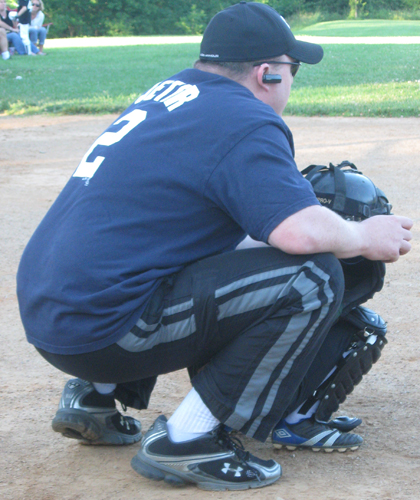
I’m not sure if I was more touched that an adult did that for my son — saw him terrified and made sure that he felt safe so the Wolvog could play his position — or if it was more seeing my son overcome all the fears that rushed back at him when he found himself crouching at home plate again.
His team won the game, rallying when they were six runs down. Because of coaches like that.
Has someone ever created a human harbour for you — either in actuality or figuratively — so you had the emotional strength to do what you needed to do?
June 7, 2012 26 Comments
The Unshy Introvert, or Blogging is Interaction Once Removed

Ann and I have been having an interesting conversation (hi, Ann!) about introversion vs. extroversion and shyness vs. boldness. I am definitely an introvert, but I’m not shy. Back when I taught at university, I had no problem getting up in front of 400 students and lecturing. I also have no problem doing a panel at BlogHer. I may prefer to have Josh speak for me sometimes (ordering food comes to mind…) but if we look at the definition of shyness, I don’t really fit it. I’m not very inhibited, and I only feel social discomfort when it seems like I’m not connecting with others. If I’m at a social event and I have friends there, I don’t feel that anxious.
Whereas I’m definitely introverted, and I see it as how deeply I let people in who haven’t already passed the gate to my inner circle (close friends, family, partner, twins). I’m not extroverted, drawing people close immediately. I turn inward more than I turn outward. I think we tend to think of all bloggers as extroverted because they’re putting their innermost thoughts out there, but there are two things about blogging that defy introversion or extroversion:
- Blogging is interaction once removed. We send out thoughts out there, but via an indirect system. There’s a big difference between speaking to anyone (any maybe no one) and speaking directly to a person. I think of blogging in the same way I think of Halloween costumes and how they sometimes change the way we interact with others, making us bolder because they remove us from our norm and place something between ourselves and the person we’re facing. Same with masquerade masks. I’m not Melissa anymore directly interacting with the person in front of me. I’m Melissa with a layer between myself and others, and that to me dissolves shyness and boldness, introversion and extroversion. We’re interacting with people, but we’re also holding them at a distance just based on the medium.
- It’s not blogging itself we need to look at to see introversion or extroversion, but how you respond to other people reaching out to you. To writing about you, for instance. Extroverts may enjoy having people write about them more than introverts because writing about someone enters their personal space. Some people enjoy having people enter their space, and others fear it. For me, the act of sending my words out there vs. having someone write about me invoke two very different sensations. I like the first one. I don’t really like the second.
So I can be an introvert and send my thoughts out there because I’m sort of like a turtle crawling back into her shell after my thoughts are released. I like the conversation because it helps me to define my own thoughts, and I’m also always interested in what other people think; especially if they disagree. I like to see the world from new angles, places I couldn’t have gotten to on my own. But I like just hanging out in my shell and listening until I’m ready to come out again.
I am consistently turtle-like all over my life: slow and steady wins the race definitely rings true (though my version may be more like, “it’s good to be slow and steady, but I don’t really care about the race”) and I don’t get drawn into changing myself to fit new trends. This should probably be fairly obvious by my clothing choices which have remained consistent and comfortable since 1992 (am I the only person who still wears overalls and stripey shirts?), but it also takes me a long time to see the point of taking on new technology or trying out a new site, and even then, I’ll only utilize them if it doesn’t mean a great deal of change. And I’m turtle-like in my interactions; peek out of shell, go back into shell.
But turtles aren’t shy. They don’t pull into their shell due to social anxiety. They pull into their shell because they like to cocoon until they determine whether something is safe. I don’t spend a lot of time around turtles, but I’d be willing to bet that they don’t pull themselves into their shells when they’re just chilling with their turtle significant other. Once I’ve determine that the person feels emotionally safe, I keep my head out of my shell.
But when people write about me, it’s as if they are reaching into my hard shell with their fingers and dragging my head out for others to see. It’s one thing for me to stick out my neck; it’s another to suddenly feel virtual fingers gripping me. Though I know there are people who never need to pull their neck into a shell; perhaps they’re more like a different animal, one who is a little more cuddly and cute. Sometimes I wish I were more cuddly and cute. But I comfort myself with accepting that I am a turtle by reminding myself that at least I’m not a crab. Or a bivalve. Or a millipede. People do keep turtles as pets, even if they aren’t the most exciting creatures to love.
And don’t even get me started on the third layer which is wanting attention or the lack of desire for attention since I also separate out my desire for attention on me vs. attention on my words/thoughts.
So I’m a non-shy introverted. What are you?
Photo Credit: LabyrinthX via Flickr.
June 6, 2012 24 Comments