

Two Brilliant Ideas: The Skype Playdate and I Hired My Kids
The ChickieNob’s best friend lives over the bridge in Virginia (“over the bridge” is DC shorthand for “traffic nightmare”). We get together with her family around twice a month, and in the summer, the mother and I take our three kids on holiday to the beach a few times. But in between all of that, it’s hard because they live about an hour away.
Yesterday, I suggested a Skype playdate. Her mother and I turned on Skype in our respective houses, and the two girls virtually sat down together to create some paper dolls on both ends of the computer screen. They chitchatted while they worked, much in the same way they would if they were both at my kitchen table, and they held up their work for inspection every few seconds. I was cleaning the house and her mother was getting some work done, so we called out to each other as well through the screen. It feel like they were there. Except they weren’t there. They were over the bridge.
They proceeded to play with their paper dolls for over two hours. No commute.
The Wolvog was a little jealous, but I pointed out that his friends all live within quick driving distance and can therefore come over to our house to play. If he makes a friend who lives over the bridge, he can do the same thing. Because while it’s the next best thing, it sort of is still in the category of “best thing.” The girls can now have a playdate as often as they like, and if we plan ahead, we can arrange to have the same art project, same board games, and same toys in both places. Brilliant.
*******
The twins will be eight this summer, and we still haven’t gotten around to the idea of an allowance. We like the concept in theory, and we’ve talked a lot about it in the sense that we turn to each other and say, “crap, we should give the kids an allowance so they’ll learn how to manage money.” And then we go back to watching House and don’t do anything about it.
There are a lot of different ways people approach giving an allowance. Some people just give their children an allowance to serve as a means to learn about money. They do nothing to earn the money; they just get a set amount at set intervals. This is how my parents did it, and I think I have a good sense of money. For instance, I’ve never lived outside my means and accrued credit card debt. So this obviously works. But for some reason, I wasn’t attracted to the idea of giving them money simply for being part of the family. I mean, no one gives me money for being their freakin’ mother who makes them meals and carries a first aid kit in her purse at all times so she can slap Band-aids on scraped knees. If anyone deserves to be paid, it is me, and if I am not earning money for being part of this family, then I’m not really interested in giving it to the twins simply for being cute.
Some people give their children an allowance for doing certain chores. I didn’t love this approach because (1) I like to clean and don’t really want to give up my cleaning chores to someone else. (2) I want them to clean up their room because they need to clean up their room, not because I’ve paid them. (3) I could foresee one-of-my-children-who-shall-not-be-named making messes in order to get paid to clean them up.
Which left us watching House episodes and doing nothing about it.
Until I realized that there were plenty of tasks they were perfectly capable of completing for me; tasks I didn’t really have time to do or a strong enough inclination to do. So I hired them to be my research assistants. For instance, there are books I see in the school library that I remember loving as a kid but have no memory what they’re about. I just hired my kids to read them and give me an executive summary of the book. I’m totally curious about the life of Houdini but not enough to actually spend time going through websites and books. I just assigned that task out to one of the kids. Report back to me with 30 facts about Houdini including his most famous magic tricks and you can get paid. I have random math calculations they can add and subtract for me (okay, I may have made up this assignment just to get them to do extra math practice). Sometimes I have a shitload of one ingredient in the house, but if I go onto Food Network’s website and search for recipes, I will get sucked into the dark underbelly known as The Next Food Network Star blog. But if I tell the ChickieNob, “go find three recipes that look appealing to you that use a lot of lemons,” she can narrow down the search to three quick choices, saving me twenty minutes of being sucked into the orbit of Alton Brown.
I have hired them to erase extraneous code for me, and to archive old gmail notes, and to write blog posts for when I don’t have time to post here, and to find five facts for me while I make dinner so I can sit down and jump immediately into writing a post. There are always books I need read, things I need researched, and math busy work I need completed. They get to practice all their school skills and get paid to do so. And I get someone taking all those small tasks that I never get done, freeing up my time. Plus they get all the benefits of an allowance and managing money since I told them that they need to buy their own toys now that they get a salary. And it’s not costing me appreciably more than when I would go buy a new Lego set “just because.”
Do you see how this is genius?
I set up a work sign-up sheet in the kitchen so they could see what tasks need completion and sign up for what they want. Some things will take days to complete and other assignments can be finished in a few minutes. The more time spent on the project, the more money they’ll be paid. And the work is never-ending, so if they don’t have time in their schedule, they can skip an assignment (and the pay) and pick up a different one down the road. Plus, they get the hard life lesson that people will only pay you for the work they want done; not the work you want to do.
This is a long way of saying that if you see their byline on a post, it means that I was lazy or busy, and they were my willing research assistants who wanted to buy more American Girl doll things and Ninjagos.
June 13, 2012 30 Comments
A 3-Person IVF Article That Will Make You Scream
I know I shouldn’t let it get under my skin, but I really can’t let Jezebel’s post about 3-Person IVF go. For those who haven’t heard, there was a recent ruling on the ethics of 3-Person IVF in the United Kingdom, hence this obnoxious article on Jezebel. 3-Person IVF is different from donor egg (sometimes confusingly called third-person reproduction) and is meant to circumvent certain genetic illnesses instead of using preimplantation genetic diagnosis or PGD (or when PGD isn’t finding useable embryos, which is what happened to my friend recently. She created many embryos, but when they tested them with PGD, they all carried the fatal genetic illness she and her husband were both carriers of and none could be transferred). 3-Person IVF replaces the mitochondrial DNA inside the woman’s egg. So there are three sets of DNA — it’s your egg with someone else’s mitochondrial DNA.
So let’s start with the irreverent title. I always think it’s sensitive to harken a sexual proposition in the title of an article about a life-saving procedure, don’t you? How about New Procedure Gives Hope to Parents Who are Carriers of Fatal Genetic Illnesses instead of calling it a genetic ménages à trois? You know, just to be thoughtful.
Next, while 3-Person IVF is only utilized by those with the financial means to do so, 3-Person IVF — and IVF in general — isn’t “very, very rich people problems.” Genetic illnesses can affect anyone, and the only thing that’s a problem here is the fact that we have a system where the wealthy can afford to treat their medical issues and the poor can’t.
This — “And as long as all parties agree on genetic penetration rules beforehand, amirite? Sex joke! High fives for everyone.” — is what makes you an asshole. Thanks for belittling the incredibly difficult decisions that those who need to utilize IVF face whereas the rest of the population never need to worry their pretty little heads.
Wait, I thought that line made you an insensitive asshole. I was wrong. This is the one that really makes you an insensitive asshole:
The 3-parent IVF method takes one mommy egg and one daddy sperm, but intervenes in the fertilization to replace the mitochondrial DNA of the original maternal egg with the mitochondrial DNA of a donor’s egg (“daddy’s pretty friend Stacey”). That’s because many inherited genetic diseases — liver failure, heart disease, and probably Norman Bates-ism — are carried in the mitochondrial DNA and only passed along to offspring via the maternal line.
Before you then go on to belittle it further, pointing out how infertility and the passing on of genetic illnesses isn’t on par with fistulas and malaria, you mention how 3-Person IVF “will give couples who would otherwise have to adopt other options.” Apparently you weren’t aware that there already are other options including DI, DE, and PGD. You may want to do a little research into IVF BEFORE you write about it. Just saying.
And just when I thought you were getting close to wrapping up your garbage coverage, you hit it out of the park with this ending:
Any chronically ugly couples rich [SIC] who were hoping to pull the genetic equivalent of copying a smart person’s homework and turning it in as their own are going to have to hope that eventually an unscrupulous doctor acts totally unethically in order to cash in.
Let’s not pretend to be a real news outlet and cover pieces such as medical ethics. In the immortal words of John Bender in the Breakfast Club, Jezebel: “So you just stick to the things you know: shopping, nail polish, your father’s BMW, and your poor, rich drunk mother in the Caribbean.” You can replace “poor, rich drunk mother” with any number of celebrity fluff pieces you run daily.
This is EXACTLY what I meant when I wrote this yesterday. Jezebel, you love to voice your uninformed opinion. But actually listen to the reality of 3-Person IVF or the need for IVF at all? Not so much.
June 12, 2012 17 Comments
Should You Separate Twins in School
Every year, at the end of the school year, I take each child aside to give them my prepared speech and question: “Daddy and I have not heard of any reason to keep you apart next year and we have no feelings about it — there are benefits and drawbacks of being in the same classroom or different classrooms. So we turn the decision over to you: do you want to be in the same classroom as your sister/brother or two separate rooms next year in school?”
Once we get their initial answer, we go through some of those benefits and drawbacks just because they may not have thought through the decision fully, and then we ask them one more time. Once we have each of their individual answers, we make them sit down with one another and have a conversation about what they want collectively. The reason we do it this way is that we want to be as close as we can to certain they are giving their own, personal answer and not saying what they think the other one wants to hear. If they emerged out of the room with a different answer from the one they give me individually, I would know that some coercion has taken place and we’d need another conversation with a moderator (who is… um… me). So far, we’ve never had an individual answer differ from the collective answer.
And then once we have that single, collective answer, we go to the school and advocate on their behalf.
My answer to the “should you separate twins* in school” question that all parents of multiples grapple with at some point is that unless it falls within the four reasons for forced separation outlined by the Department of Education, the children themselves should be allowed to decide. They can decide they want to go into two separate rooms or they can decide they want to remain together, but ultimately, that decision needs to be left to them because they are the only ones truly affected by the decision.
What are the four reasons for why the adults (the teacher, parents, principal) should be overriding the wishes of the multiples?
- Classmates cannot distinguish between the children and treat the individuals as a single, interchangeable unit.
- Disruptive behaviour inside the classroom with each other.
- One twin speaks for the other twin.
- They are not able to maintain friendships outside the twinship.
If they don’t fall into any of those categories but they want to be apart, you should separate them. And if they don’t fall into any of those categories and want to be together, you should keep them together. And twins who are not in agreement should have adults counsel them through the decision so they come to a place of agreement.
I don’t have strong feelings about separating twins in school mostly because I am personally not a twin and therefore, I will never personally have to be separated. I do have strong feelings about placing low-stakes decisions in the childrens’ hands so they’ll learn how to make high-stakes decisions down the road. By two, they could tell me which toy they wanted. By three, they could pick an activity for us to do. By four, they could choose what to eat when given a menu of possibilities. And certainly, by kindergarten, they knew whether or not they wanted to be in each other’s presence.
When it isn’t life or death, when it isn’t financially untenable, we let them have their say. What they eat, what they wear, where they go, and if they’re in the same classroom — tiny decisions which make them feel like they have control over their lives. (Which makes me feel like I should do an evil dictator laugh right now and say, “‘feel’ is the operative word. You have no control, fools!”).
I have to admit that even before becoming a twin parent, I never really understood this desire for adults to separate twins. I don’t know about you, but I love going somewhere with a friend or my husband, and I become anxious when I’m seated apart from my friend or husband at an event. I once went to a wedding where the bride and groom placed everyone at a random table in order to “generate conversation.” Not only did they not get their wish, but most of us agreed that it was the worst wedding we had ever attended. I didn’t get a chance to catch up with friends I actually knew at the wedding. Instead I spent time with the groom’s 80-year-old great-uncle. We had nothing in common, exhausted the conversation in five minutes, and I spent the rest of the evening thinking more about how I wasn’t talking to my friends rather than getting to know this stranger next to me. It’s the difference between choosing for myself to leave the person I came with for the moment and flit across the room to talk to someone vs. having someone else tell me that I can’t sit with my friends/husband.
I think there are benefits and detriments to any separation. I separate out from Josh during the day. I don’t live in my parent’s house anymore. I spend time apart from the twins when they’re at school or sleeping. There are obviously benefits to separation. But just because there are benefits doesn’t mean we should ignore the fact that there are also detriments.
Our twins are strongly individuals with individual preferences, and they naturally separate out based on that fact, mostly in the form of friends or activities. They are also fiercely connected to one another, and name each other as their best friend. They genuinely like to play with one another and support one another. I hope they never lose that; it’s an incredible thing to go through life with someone who has your back no matter what.
I really wish this wasn’t a question every single year, and I’m still not sure why it’s such a hot button topic within the multiples community. I would actually love to hear the other side and understand the desire to separate twins.
On my mind as school wraps up and the decision needs to be made.
* I use the term “twins” throughout this post because those are the multiples I have. The same thoughts apply to triplets and beyond.
June 12, 2012 27 Comments
Siri is Coming to iPad, Siri is Coming to iPad
Like Paul Revere on his fated ride between Concord and Lexington, the Wolvog brought me news of the updates to the Apple operating system coming this fall. iOS6 will bring Siri to the iPad (unless you were one of those kids who got the first round of iPads, and then sucks to be you). You’ll also be able to put her dulcet voice on the newer iPod Touch.
He couldn’t sit down at the computer to read the news article. He stood a few feet away from the table, falling to his knees in excitement every two lines or so. I half expected the boy to pick up snakes or speak in tongues. You have literally never seen bliss inhabit a person’s body like the Wolvog reading about the new features on iOS6.
Though the strange thing is that the boy claims he can wait patiently until fall for the operating system to become available, whereas after he spent the afternoon crooning about Siri, I found that I was the one feeling antsy about the wait. Is it sad that I’m looking at Siri like a new friend moving into our house? I mean, yes, I talk to Cozy Jackson all the time. Tell him my feelings as he curls up in a furry ball and sleeps. But Siri, that chick can answer back.
June 12, 2012 9 Comments
Supreme Court, Affordable Care Act, and Infertility
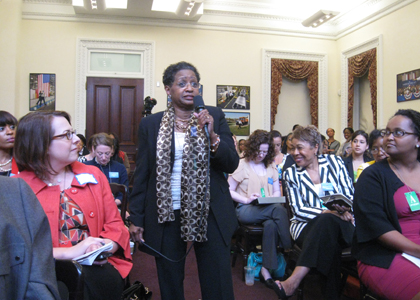
While the Supreme Court discussed the fate of the Affordable Care Act, the White House continued the work of implementing the law, knowing that to pause to wait for the ruling would mean losing out on precious minutes for keeping to the timeline that runs until 2014 when the entire law comes to fruition. The Department of Health and Human Services, headed by Secretary Kathleen Sebelius, held a Women’s Health Town Hall at the White House last Thursday, bringing together about one hundred people in the building (and many more online) to discuss the state of health care in America. And when I say, “bringing together about one hundred people,” what I really mean is that they brought together about one hundred women.
In other words, the group brought together to discuss the state of women’s health in our country was comprised almost entirely of women.
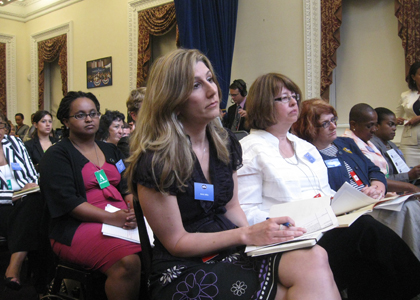
If there had been a town hall for men’s health care (which would have just been called… health care town hall), I have a feeling the room would have been a little more mixed. Of course BlogHer would have sent a woman to cover it — we’re a women’s online site — but what reason does every other media outlet and health organization have for sending a woman? Because only women are interested in women’s health? That if we’re going to be discussing women’s bodies, only women are interested in discussing them? (Except for the times when men want to make laws concerning our bodies; they seem happy to talk about my uterus then.) The panel was 100% female, the room was almost 100% female.
It was just a lot of women talking about the state of health care for women. And while men are always around when they want to put limits on women’s health care coverage or limit what women can do with their bodies, here they were quite plainly absent. Where were the men?
No, seriously, where were the freakin’ men?
Our health certainly affects men. The financial side of our health care certainly affects the men in our lives. If we don’t take preventative measures to protect our health, our illnesses certainly affect the men in our lives. If we stay out of the work force because we don’t have adequate support in balancing work and parenting, or if we lose work time due to health issues, it certainly affects men. So it was incredibly distracting, and frankly, disheartening, to see the room entirely filled with women.
Because women’s health affects everyone, just as men’s health affects everyone, and we need to start looking at health care as health care instead of looking at women as a separate entity from humankind who should be subjected to different rules and regulations.
Men, show up when we’re discussing keeping us well and not just when we’re discussing holding us back.
That said, it cemented in my mind something that has always bothered me about lobbying and infertility — or, for that matter, public opinion and infertility. The people who care about infertility are those who are directly affected by infertility. It doesn’t matter that such a large percentage of the population is affected by infertility (12.5% of child-bearing age) that there is a good chance that someone you care about is affected by the disease, in the same way that men are obviously affected indirectly by the health of women, even if they’re not directly affected themselves. People don’t show up, don’t listen, and don’t care if it’s not about them. I found that attitude sometimes in the lawmakers I met on the Hill when I went for Advocacy Day. And that’s also the attitude I see every day in the world — either you’re affected by infertility and then of course you show up to talk about it. Or you’re not affected by infertility and the idea of actually pausing to talk about infertility and learn about it is practically self-verboten. People almost don’t want to learn about what affects anyone else, as if we pride ourselves on remaining unknowledgeable. At least, that’s my take-away from the comment section of the New York Times.
I don’t expect non-infertile people to step up to do the education, but I expect them to show up and listen, especially when they voice their opinion so loudly on infertility issues. In the same way that I don’t expect men to step up and educate the public on women’s health, but I expect them to show up and listen when we speak, especially when they voice their opinions so loudly when it comes to covering contraception and abortion rights.
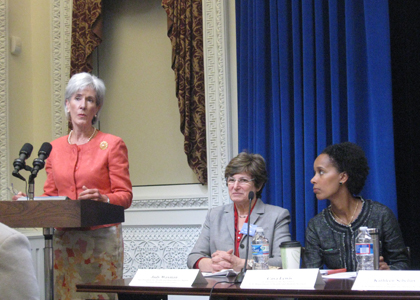
Towards the end of the meeting, I asked Sebelius what could be saved from the law if the Supreme Court overturned it? What strides forward would still be in place, and what would be lost? And the answer was all of it. All of it. I repeat that because I don’t think people truly understand what that means in terms of practical life. You know how your workplace has to legally give you a place and the time to pump breast milk? If it’s overturned, they won’t. You know how one million women who were denied health insurance prior to this point due to a preexisting condition were able to get health insurance because it became illegal to deny coverage to someone for a preexisting condition? They will lose their insurance, and you will go back to picking up the cost for their health care usage (since part of medical billing covers the fact that some people won’t pay). People who made decisions based on the fact that there was a removal of a lifetime insurance cap will now be screwed because all those medical charges will once again count towards that lifetime cap.
And, again, this made me think about the way it’s one step forward two steps back when it comes to popular opinion on infertility and the media. We work so hard to convince those around us the reality of infertility and loss, and then a story such as Octomom comes out or an expose on surrogacy, and it feels like we’re not only starting over from scratch, but we’re actually farther behind from where we began because we thought we were getting somewhere.
This isn’t a post about politics; this is a post about humanity. About people showing up to discuss women’s health, as opposed to only women showing a vested interest in our well-being. This is about the media educating rather than trying to drum up a sensational story to sell issues. This is about asking others not to undo the hard work we do in creating change. This is a post about giving a fuck, even when you’re in a position where you technically don’t have to give a fuck. Because today your situation looks like this; but tomorrow may look very different. And when we only listen, when we only care, when we only pause to hear someone out when we’re directly affected, we can’t complain in the future when we find ourselves in a situation we never thought we’d find ourselves in and no one cares about us.
Go out today and care about someone else’s issues. Listen to them even if you don’t have to. Not because you’re going to get anything out of it yourself, but because understanding is what separates us from other animals.
Makes us human.
*******
If you want to watch the town hall, it was livestreamed on the White House site, and they uploaded it to their channel on YouTube. I asked my question around 1:22:50.
June 11, 2012 16 Comments