

Blogger Keeps Eating My Comments
Updated with Clues!
Like a hungry beast who can never be satiated, the Blogger comment box opens its giant maw and swallows everything I try to post lately. And it seems to just be me unless you all start chiming in that it’s you too, and if you do, I will feel less like Blogger’s Chosen One, destined to fight the comment box alone (for neither can live while the other survives), and more like part of a Fellowship of the Blog, trying to take the mighty Blogger comment box back to Mordor.
No, seriously, every comment I’m leaving lately on Blogger blogs is being eaten.
And I think it’s only me because I am seeing comments on some of these posts. Some comments are getting through; just not mine. At first I thought they were being held for moderation, but I asked a few people to check their spam filters, and the comments aren’t there. So you may be missing a lot of comments that people think you’re getting.
First I couldn’t leave comments on WordPress and had to set up a new email account so I could leave comments since my old one was associated with an unused WordPress account that I set up years ago so I could read someone’s blog. (I’m sort of hating that person right now because right after she asked all of us to sign up, she stopped writing the damn blog so it was for nothing.) And now I literally can’t leave comments on Blogger. At all.
In a time period when comments are going down simply because people are reading on devices not conducive to comment leaving, you would think that blogging software would make it easier to leave a comment, more encouraging of comment leaving. Instead, it is getting harder and harder to leave a comment.
So, this is to (1) ask if I’m the only person with this problem and (2) let you know that I am trying to comment on your blogs. But my comments keep getting eaten by various platforms. And that is really frustrating because some of those comments were gems. I mean, yeah, some weren’t that great, but a few of them?… they were brilliant.
Okay, maybe they weren’t brilliant. But I like my comments. And I want them out there and not sucked into a black hole of the Internet.
Update:
I’ve tried the different browser trick, and that hasn’t solved my problem. But one thing I have noticed is the blogs I can’t comment on have comment boxes that look different from the ones that I can comment on.
Can’t:
Can:
What do the “can’ts” have in common? And what does the “can” have different from the “can’ts?”
I think if we figure this out, we will determine which commenting option you don’t want to have if you want to receive comments.
June 5, 2012 36 Comments
Facebook Privacy Notice and Building a Dream Social Media Site
A friend sent me the text from a status update that is making its way around Facebook which is being referred to as the Facebook Privacy Notice:
PRIVACY NOTICE: Warning – any person and/or institution and/or Agent and/or Agency of any governmental structure including but not limited to the United States Federal Government also using or monitoring/using this website or any of its associated websites, you do NOT have my permission to utilize any of my profile information nor any of the content contained herein including, but not limited to my photos, and/or the comments made about my photos or any other “picture” art posted on my profile.
You are hereby notified that you are strictly prohibited from disclosing, copying, distributing, disseminating, or taking any other action against me with regard to this profile and the contents herein. The foregoing prohibitions also apply to your employee , agent , student or any personnel under your direction or control.
The contents of this profile are private and legally privileged and confidential information, and the violation of my personal privacy is punishable by law. UCC 1-103 1-308 ALL RIGHTS RESERVED WITHOUT PREJUDICE
Snopes, of course, debunked this immediately. You can’t post something on your Facebook status that negates the TOS of the site and have it be legally binding any more than you can change the wording in a paper contract, sign it, and have your wording supersede the contract’s wording without agreement for your wording from the contract’s creator. When you sign up for a Facebook account, you accept their terms of service, and nothing you can do (beyond bringing a lawsuit against Facebook) can alter that contract. Joining Facebook, in and of itself, means giving up a bit of your privacy. And Mark Zuckerberg isn’t allowing you to change the contract to fit your needs.
I’m not surprised that a status update has made the rounds on Facebook; but what I am surprised at is that no one is saying, “this is what we want, so let’s create it.” People obviously don’t trust Facebook if they’re posting this since it stems from a belief that there were untold privacy changes now that Facebook is a publicly-traded company. The notice also contains:
Facebook is now a publicly traded entity.
Unless you state otherwise, anyone can infringe on your right to privacy once you post to this site. It is recommended that you and other members post a similar notice as this, or you may copy and paste this version.
If you do not post such a statement once, then you are indirectly allowing public use of items such as your photos and the information contained in your status updates.
Privacy is obviously an important point for so many people, ranging from social media to the airports and TSA. And yet we also utilize these sites that compromise our privacy in a way that actually compromises our privacy. Meaning, if you don’t post something you want private on Facebook, you don’t have your privacy violated. But people do post things they’d like to have remain private on Facebook, which is this very possibly public forum.
Why isn’t someone stepping up and creating the dream site? Do we actually care about privacy or do we just like to grumble? (I’ll admit, I like to grumble.) How do we keep a social media social while putting a lot of restrictions in place, since we all know that private blogs are not as social as public blogs; don’t receive the same traffic, the same amount of comments. And how does one keep a site running and being a financially feasible entity without invading people’s privacy in the form of tracking for advertising or creating assets?
But moreover, what sort of TOS would that dream site have to have for you to leave Facebook and Twitter behind in order to join your friends in this new space? Would you be willing to give up your Facebook and Twitter accounts if someone created this fantasy TOS space, or would you continue to hold onto your old social media accounts, cross-posting the same material on all sites? That, to me, is the most interesting discussion of all.
June 5, 2012 11 Comments
DWYNTD Parenting (or Yes, I Just Learned about Natural Parenting)
Some people believe I’m a great parent. They even leave comments telling me such, usually after I write a post where I’ve described a parenting moment where they thought I did a good job navigating the twins’ batshit insane questions or heart-stopping commentary, such as this recent post on the ChickieNob’s desire for a Baby Alive doll and our subsequent conversation about pregnancy and infant loss. I mostly agree with them; I think parenting is a place I excel, especially explaining the world in age-appropriate ways. I have relatively easy charges, but I still think I put in a good days’ work to warrant my usage of the World’s Best Mother mug in the cabinet.
I am also pretty much as far as you can get from being a natural parent.*
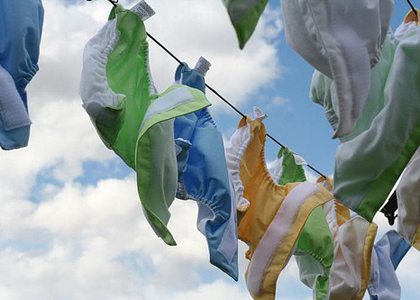
We never considered a midwife or doula or homebirth, even though we knew those options existed. I delivered the twins in an operating room with an emergency epidural in my back, and it not only didn’t bother me, but I thought the hospital’s protocol made perfect sense. We formula fed the twins with bottles. We used disposable diapers. They spent about two nights in our room in a pack-n-play, but their heart monitors were so loud that we quickly moved them into their room so no group bed. I used a baby carrier from time to time, but not mindfully. It was for me; not for them. (I also didn’t use a stroller from the second they could walk and beyond. I was not going to throw out my back lugging a double stroller in and out of the car when the Lord gave them four perfectly acceptable toddler legs. Two each, I mean.) We don’t homeschool, we don’t unschool, we don’t free range parent. We have a penchant for plastic toys. We vaccinate. And — this might be the icing on the non-natural cake — I gave into their request for Capri Sun this summer. I’m sure if I kept writing this paragraph, I could think of more things to add.**
On the other hand, I also made all of their baby food. And practice sustainable living. And let them make all of their own decisions unless it comes down to safety or sanity. And they keep kosher, which is a mindful, cruelty-reducing way of eating. And they do volunteer work and recycle, not because we tell them but because it’s self-led and what they want to do. And I think we’ve established that I am overly respectful of their autonomy down to not posting their picture online and clearing subject matter with them.
The point:
We can look at one person — for instance, me — and see that I embody some things that people admire and other things that the very same people would never want to emulate. I do a fine job explaining terrorism to small children, but now you also know that even though my friends were all into cloth diapering, I purchased disposable ones. I knew and had support for all the options out there, and these were the ones I chose. I can be both a “great” mum and a “terrible” mum in the same breath because human beings are complex, and with few exceptions, we don’t fall neatly into categories such as completely fantastic or completely awful. Most of us exist in this middle ground of admirable and despicable qualities, by which I mean that they are admirable or despicable to the outsider. (I obviously think all of my choices were good-enough to good choices.)
Outsiders judge, but insiders know that sometimes our decisions aren’t even really decisions at all. I mean, I didn’t decide not to buy a Mercedes; I didn’t buy a Mercedes because we don’t have the money for that particular car. And I didn’t decide to deliver in an operating room; that was the option given to me by the hospital where I was brought to deliver because we had an emergency situation. But in the end, I’m happy with the car we got because we own a car; and I’m happy with the delivery we had because it brought me to these two little people (who I happen to think are amazing and wonderful) who eat at my breakfast table every morning. Knowing the otherwise that so many of my friends in the blogosphere live every day, I don’t think I have a right to complain even if I wanted to. But the point is that our choices sometimes have limits and those limits are our circumstances. And sometimes those circumstances are the children we get — they don’t neatly fold themselves into the parenting philosophies we wish to follow — or the people we are — as much as we’d like to be the type who engages in babywearing, our back or work schedule precludes it.
And when that occurs, we can either feel guilty or we can laugh.
*******
One of my yoga teachers calls me the Laugher. (The unfortunate consequence is that no one in class knows my name, and I guess they feel awkward calling me Laugher outside of class because when they see me, they throw out a completely random woman’s name as if I’m Rumpelstiltskin and they’re trying to guess my secret name so I don’t run off with their children.) When she calls out a position in class that I know I can’t do or don’t feel like trying, I sit down on my mat and laugh. I’m not laughing at her, nor am I even laughing at myself. It’s just a reaction instead of calling out, “oh well.” I sit on my mat and take it as an opportunity to have a drink of water and watch everyone else fold themselves into these amazing binds and inversions.
I guess I choose to meet the concept of the Mommy Wars with laughter. The only place I encounter the anger is here online, but that could be because I surround myself in the face-to-face world with people who support my decisions even if they wouldn’t choose them for themselves. So I am being upfront by telling you that I not only won’t engage in arguing in my comment section, but I choose to read posts or comments denouncing certain parenting options with laughter. Not a mean-spirited snort, but a reaction instead of calling out a happy-with-myself-and-sure-in-my-decision “oh well.” There were choices I chose not to explore; birthing options, intactivism, cloth diapering. And there were parenting choices that were removed as an option due to circumstances — they were Mercedes, as it were, and we didn’t have the cash. For those, I feel sadness about the loss of experience, but no sadness over the choices we made. I have well-mannered, happy, healthy seven-year-old twins. I would be insane to ignore that fact in order to reach backwards.
So in the proverbial Mommy Wars, I’m meeting angry comments or self-satisfied sanctimony with kind laughter.
*******
I don’t have a name for my brand of parenting. And I’m going to be honest since this is simply my truth (as it should be since this is my blog). I don’t believe in parenting philosophies with names. At all. Period. I don’t believe that parenting ideas should be akin to religion and that we should worship at the altar of parenting deities. I don’t believe that parenting books are Bibles. That is what works for me, though maybe this eschewing of parenting movements doesn’t work for you. And that is fine; I fully support other people buying into full, prix fixe ideas rather than approaching parenting a la carte. Neither way is better than the other, though my heart can only feel comfortable on one of those two paths.
When people attempt to convince me otherwise, I meet them with kind laughter since the only person whose opinion about my parenting matters in my life is my own (the twins and Josh are a close second and third); I am the only person who knows whether she feels like she can hold her head high and drink from the World’s Best Mother mug.
And yeah, most days I think I can drink from the World’s Best Mother mug without the ground opening up to swallow me for my hubris.
If you made me summarize my method of a la carte parenting, I would probably label it: Do What You Need to Do parenting (DWYNTD). And I would describe what I do as such:
- It’s an a la carte approach where you look at the multitude of options before you; weigh them against your emotional capital, financial reality, support system, physical landscape, time allotment, and actual child in hand; and then make a decision that works for you and your family.
- You remove all labels, all external pressure, all judgment, and simply parent.
- You look to parenting books for advice and then shut them the moment you find something that resonates with you.
- You do things because they work for you and not because they work for someone else.
- You think before you act, and you turn inward instead of outward to check your parenting compass.
- And you do all of this without guilt knowing full well that the majority of life is outside your control and that so much of prix fixe parenting philosophies is simply about trying to believe there is a way to control a chaotic world. That there is anything we can do to guarantee that our child will not only grow up to do something amazing and be healthy and bright, but they will still want to hang out with us when they’re adults. DWYNTD parents make the best decisions they can make and try not to fuck-up enormously, and trust that if they build a happy home, their kids will probably want to return to it. But nothing in life is a guarantee.
- Worrying about the future is totally acceptable in DWYNTD parenting, but regrets about the past should be kept to a minimum. We make the best decisions we can make in the moment and move on.
- And absolutely, without a doubt, DWYNTD parenting is not the best for all children, though it’s definitely the best for mine and it could be the best for yours too. But I wouldn’t know about your kid because the only kids I know are the ones that live in my house.
Why don’t I believe in parenting philosophies with names? Because they create as many problems as they solve.
I know that some people need to label things in order to bond together, to find their niche or support. And while I think that is well and good on one hand (and it can certainly be beneficial), it can be dangerous on the other when people stop asking themselves what parts of a certain parenting philosophy work for the family and the children they have, and change it to be what more can they do to fit a certain parenting philosophy. I think this is especially dangerous when you have a child who doesn’t fit with the average child who could benefit from that parenting idea. Children — like the adults they become — are not one size fits all.
I spend a lot of time reading blog posts where people are stressed beyond belief over an aspect or two of a parenting philosophy, and I don’t understand why they continue on a path that isn’t working for them or their child except the constant refrain comes back to the idea that this is something they have to follow if they want to be part of X movement. I also don’t really understand how people can choose how they want to parent before they have children. It makes no sense to commit to a certain type of parenting before you see if the type of child you have would benefit from those parenting ideas. It would be like committing to a college as a five-year-old without any idea of what you want to study or what school would fit your learning needs best when you’re eighteen. Every single baby is different simply because every single person is different. Not every baby likes to be held and not every baby can handle the gel used in disposable diapers.
People asked me what I thought about “natural parenting.” I can’t get up in arms because there’s another new parenting philosophy on the block that insists it’s “better for parents, better for babies and better for the earth. It really IS a much better way!,” especially when we all know that parenting philosophies are here and gone in a New York minute when we consider the scope of parenting from 65 million years ago until now. Natural parenting is an eye blink on the continuum of parenting philosophies to be replaced by something else or the exact same thing with a new name come the next generation. The parenting item industry cannot exist if people don’t switch ideas every few years and require a whole new slew of books and gadgets in order to keep up with the Jones’. This isn’t to diminish the validity of natural parenting, but instead to put it in its place. Aspects of all these parenting philosophies can be found all over the world and throughout different moments of time, sometimes even with the exact same elements but a different name, and they’re repackaged over and over again by people saying they want to give you guidance, which they have to state is the best guidance or else you might not follow them.
But I don’t need guidance because I’ve got my own internal compass. And when that fails, I have family and friends to support me — which is what the majority of cultures practice; the passing of parenting information from family member to family member or elders to youngers. And when that fails as it sometimes does with the modern nuclear family, I know where to look for answers to my individual questions. And when all back-up systems fail, I sit down and laugh. Or I cry. Or I do whatever I need to do to get through the moment.
Perhaps I don’t buy into the idea that you need a label in order to get support because the parents I respect the most, the ones I turn to for advice, parent differently from Josh and myself. I gather support and advice from them simply because I think they are smart. They are sensible and have a good head on their shoulders and often point out something I missed. My parenting tribe is made up of breastfeeders and bottle feeders, cloth diaper-ers and disposable diaper-ers, cry-it-outers and never-cry-it-outers, stay-at-homes and work-at-homes and work-out-of-the-homes, parents and non-parents. I’ve had breastfeeders give me advice on weaning the bottle. I’ve had cry-it-outers point me towards Elizabeth Pantley’s books. And I’ve gotten some of my best advice from people who aren’t parents but are simply intuitive about my particular children. The reality is that we all contain knowledge that we can give away to others, some that we used ourselves and some we collected along the way.
People can judge me all they want, but if they can do that, I also have the choice to ignore their judgment, and yes, laugh. At the end of the day, I’m just a fallible parent like all parents. There is nothing I can do except use my intuition and give my best effort. If you’ve ever read Stirrup Queens and thought that I’m a good parent, I hope that you can balance that thought with anything you learned about me from this post. You may not be quite as impressed with my parenting now that you know the choices I made for them from birth until now (including the Capri Sun). But that fact alone is why I choose a la carte parenting over a prix fixe idea. Because people rarely fit into the neat boxes others create for us. And when we try to squeeze ourselves into those boxes, we do so at the expense of our selves — our sanity, our happiness, our confidence.
You are a great parent or parent-to-be who can pick and choose what works for you (and perhaps that choice coincidentally includes every option within a certain parenting philosophy). I am also a great parent who can pick and choose what works for me. And just as we don’t all sit down in the cafeteria with the same meal, and we don’t judge each other for picking the spaghetti option vs. the chicken sandwich option, I’d like to believe that all humans can sit down in the same cafeteria (parents of living children, parents of deceased children, parents of not-yet children, and people never to be parents) and respect each other’s decisions without having to make anyone else feel like crap for their choices when they don’t directly impact us.
It is fine to judge me when my choices affect you; for when my children accost you with their nipples. Don’t judge me for the fact that I put a bottle nipple that never affected you into my child’s mouth. Or, actually, fine, go ahead and judge. But the only thing you’ll hear is me laughing; again, not a mean-spirited snort but a gentle reminder that the world is hard enough without making it harder on each other by trying to diminish each other’s self-esteem or in pushing ourselves to do something that makes us uncomfortable or frustrated.
* I am also non-natural in the sense that I lost five pregnancies prior to creating the twins via completely unnatural means, but I’m going to guess that isn’t part of the definition of natural parenting, nu?
** For the love, I’m going to say this once, loud and clear, which I say all the time on my blog: I respect and sometimes even admire your choices, even if they’re not choices I’ve made for my kids. So yes, I am fully supportive of unmedicated childbirth, breastfeeding, cloth diapers, family beds, babywearing, homeschooling, unschooling, free range parenting, banishing high fructose corn syrup and eschewing plastic toys. My friends and family members, who I personally believe rock as parents, have chosen some of these things and can vouch that from holding their breast in order to help with breastfeeding (you know who you are…) to buying them baby carriers, I fully support all the other roads not taken. The roads I didn’t take weren’t taken not because I negatively judge those choices but because they didn’t fit with the children we got. (Or the parents they got… by which I mean Josh and myself. Damn that was awkwardly worded.)
Photo Credit: Simplyla via Flickr
June 4, 2012 38 Comments
MFA Sunday School (Eight: Starting Self-Editing by Understanding Your Writing Accent)
 Welcome to MFA Sunday School, a once-a-week, free, online writing workshop. MFA Sunday School posts are uploaded on Sunday mornings, though you can read them or participate any time — the comment section is always open for people to post a link to their work or ask a question. You can subscribe to blog posts via the RSS feed, or look for them under the category heading “MFA Sunday School.” If this is your first time in “class,” you may want to jump back to the first post in the series in order to understand how things work, or peruse all of the past lessons as well as a glossary of terms by reading the MFA Sunday School Glossary and Course Archives.
Looking at your work with a critical eye means exiting your own brain and figuratively trying on someone else’s in order to see your writing from an entirely new angle. Everyone has their own approach to self-editing: some work as they go along, editing before they write the next paragraph or scene. Others wait until they have a final product in hand and then go back in to polish it up. Some do a blend of both, and others get so hung up on the editing process that they sort of stop writing altogether. Editing is what makes them hit the proverbial wall with their project.
So how does one go about learning how to self-edit? There’s something to be said for the joke about starting a whole new relationship by masturbating with your other hand — getting out of your own tired brain is easier said than done, but changing the location of where you wrote the piece (writing it on one computer but editing it in a different room or on a different computer), reading it aloud to someone, or editing on a different medium (writing on the screen but editing on paper) are all simple ways to trick your brain into seeing your writing from a new angle.
Before you start editing, you need to understand one thing: there is a difference between your writing accent and writing mistakes.
When I talk about your writing accent, I don’t mean writing to convey to the reader the accent of the character (as in, putting “y’all” in there so the reader knows this person is from the south). Your writing accent — as defined by me — are the small quirks that you use in your writing which make it undeniably yours. It goes beyond your writing voice; it is about the tiny inflections you pepper into your writing that people respond to on an emotional level without realizing it. I think of your writing voice as something loud, immediately defining. You would never mistake Danielle Steel’s writing for Stephen King’s. But your accent is something much more subtle.
Two seconds into a blindfolded conversation with an Australian, you can tell that they’re not from America. That is due to the way they pronounce their words, and that is the equivalent to your writing voice. But several minutes into the conversation with the Australian and regardless of what they’re talking about, without even seeing them, your gut has formed an opinion on whether you like the person or not. Whether you respond to the person or whether you’d rather not talk to them anymore. It’s how I can put three Australians in front of the blindfolded you and asked them to talk about something as mundane as the weather, but you’d be able to form an opinion on each one, though you may not be able to point out why you formed that gut reaction.
Side note — this lesson is about discovering why.
Now do you see the difference between writing voice and writing accent? Voice is apparent. Accent takes some searching.
With editing, we want to get rid of writing mistakes without getting rid of your writing accent, but in order to do that, we need to know whether the way you’re writing is putting off the reader or drawing them in. And best example I can give you comes from my own writing accent.
Perhaps not in blog posts, but within book writing, I have two things I constantly do — one of which is my writing accent and the other of which is a writing mistake. Part of my writing accent is my love of verb-led sentences. “Running for the bus, she slipped on the newspaper sheet stuck to the sidewalk and landed with her face in yesterday’s gum.” Verb-led, non-gerund sentences was something I was known for back in my MFA program. When other people did it, people would jokingly ask if I secretly wrote the story. Now that I’m conscious of it, I tone it down or play it up depending on the piece I’m writing and the volume I want on the action or external story. That’s my writing accent, and people respond to it (either liking or hating it). I also use a lot of dashes to draw out thoughts. To drag your brain this way and that. Either you like that or you don’t, but that’s what you’re responding to in my writing. I use a lot of semi-colons to keep ideas close together. Again, either you like that you or you don’t, but those are small things I’m doing that you unconsciously respond to in my writing.
Here’s a writing mistake I often make: I summarize a whole scene with a one or two sentence punch at the end, a move that my advisor always called “tags” but since I can’t find this online, it’s making me think that he invented the term. The tag was a mistake because it not only slowed down the storytelling, repeating what was essentially shown in the scene, but it treated the reader poorly. My professor once jokingly told me that he was going to gather up all my discarded tags one day and publish a whole book of them called Tag Sale. I still write tags because I have to write tags. It’s like stopping myself from vomiting — not only does it not work most of the time, but it’s usually better just to vomit and get it over with and move on. So I write my tags, and then, when I go to edit, I remove them.
This lesson is getting long, so I’m going to break it into two parts. Next week, we’ll take a look at common writing mistakes so we can find them in our writing. But for the time being, start looking at your writing with your other hand… I mean… a different portion of your brain. What writing quirks do you notice you do? What is done consciously, and what is done unconsciously? If you can’t find them, don’t worry. Once we get to writing mistakes next week, your writing accent is going to pop out at you.
Homework: No special assignment this week because we’re mid-lesson, though keep writing. Instead, let your classmates know how you edit in a comment below — do you do it at the end of a project/post, as you go along, or a blend of both? And does the editing process ever stop you from finishing what you’re writing? It will be interesting to see the various ways people approach editing before we get to talking about finding writing mistakes.
June 3, 2012 8 Comments
Happy Birthday to Me
 Photo Credit: Easement via Flickr
When I was little, there was an amusement park in Maryland called the Enchanted Forest. I have a bunch of memories from visits to the park, but none as vivid as the last time we went right before the park closed. We knew that it was going to be our last time there, and even though I was too old for the park by that point, I became obsessed with this idea of catching one of the goldfish in the fishing pond. They gave you a piece of corn on the end of a hook, and you held it in the water until a goldfish bit down on it. I don’t even think you got to keep the fish, so I’m not sure why it felt so important to stand there with this hook and corn doing something I actually felt was cruel to the fish and not much fun for the human.
My father stayed with me while my mother took my sister and brother on the Alice in Wonderland ride, something I really wanted to do — more than fish — but I couldn’t tear myself away from the pond. I just stood there with my dad, dragging the line through the water towards the goldfish, begging one of them to bite down. None did. My mother returned with my siblings, and we left the park. And I remember being so angry with myself for not going on the Alice in Wonderland ride, especially knowing I could never go on it again.
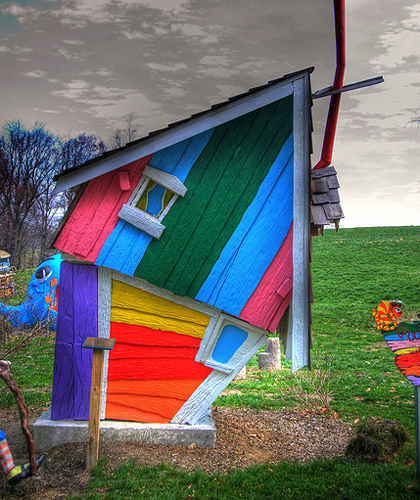 Photo Credit: Easement via Flickr
I knew that people had moved pieces from the amusement park to Elioak Farm, but I never went to Elioak, even though it wouldn’t be a big deal to look up directions on a map and find it. I don’t know what kept me from going to see it any more than I know what kept me from walking away from the goldfish pond.
A few weeks ago, the twins and I drove out to Columbia to see a school. It took us 45 minutes to drive out there on the highway, and I decided to try the backroads to get home to see if it was any faster. We got behind a slow-moving truck in Columbia and followed it on the one-lane road for over an hour while I kept an on-going monologue in my head torn between the greatness of the school and the distance from our house.
And as we drove through Ellicott City, behind the slowest truck in the world, going a very cautious 30 miles an hour, I saw the sign for Elioak Farm and the castle just a few meters back from the entrance.
 Photo Credit: Easement via Flickr
There it was, just this quick snapshot. This click of a moment, like opening your front door to find yourself back in your childhood house for a few seconds. I wanted to be back at the Enchanted Forest so badly that it felt exactly as if it were the 1980s, and I was walking to our car with all the grief of botching my final visit. I wanted to be a child again, going up to the top of the castle and waving down at my parents below. Seeing the pieces was like snuggling down in a too-large sweatshirt. I almost turned the car around at the next street to go back to the farm, but instead I called into the backseat, “will you take me there for my birthday?”
So that’s how I’m spending my birthday this weekend.
Just in case you were wondering what I might do to celebrate turning 38.
And I don’t mean to sound morose, but I always get down near my birthday.
June 1, 2012 59 Comments