

Ungaming and Comment Chaining, Part 6
For those who didn’t read my blog years ago when we used to do this fairly regularly (by which I mean a bunch of times and then not at all), this is a big online round of the Ungame. What is the Ungame, you ask? It is only the most fabulous board game ever made. You just roll the dice and move around the board, talking about your feelings. To bring it online, I’ve added an additional component of chaining comments so you find a new blog to read too.
Directions: answer the question in the comment section. Then leave a comment on the blog of the commenter directly before you (so it’s a chain. #2 comments on #1, #3 comments on #2, etc). The first person who comments gets a free ride and does not need to leave any comments. The last person who comments gets… screwed. My answer is below the picture.
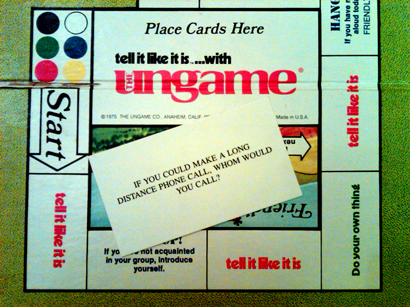
In case you can’t read it, the card states: IF YOU COULD MAKE A LONG DISTANCE PHONE CALL, WHOM WOULD YOU CALL?
Um… the cards can be a little dated on our 1970s version of the game.
As a side note, my grandmother was so freaked out about me paying long distance charges that even after I got a flat-rate calling plan, she wouldn’t believe me and she’d hang up on me because she said the call was too expensive.
So I’m going to take this card to mean who would you want to call that you can’t just pick up the phone and call. Which out-rules most people I am in contact with since… you know… flat-rate calling plans and free cell phone minutes means that I’m fairly comfortable calling them whenever I damn well please.
I would love to talk to my first boyfriend and see if he really became a rabbi, but I realized that after I found out that piece of information, I wouldn’t want to keep talking. The same goes for a bunch of people from my past. Except one.
I had a doppelganger at camp; a girl who looked so much like me that even my friends would mistake us. Her name was Michelle and we had very similar last names. There were a few sets of twins at camp and someone had the idea to round up all the twins for a special picture. Michelle and I protested, explaining that we weren’t related, but the counselors thought we were just being obnoxious tweens and made us get in the picture. So we’re in the camp’s twin picture in the camp yearbook.
Beyond our similar physical characteristics, we were alike in temperament and interests and expressions. I lost touch with her after high school, and I would love to call her (long distance!) and see how her life turned out. Did she end up getting married (maybe to a Josh)? Was she infertile? Did she have twins? Was she a writer? Wouldn’t it be bizarre if I found her and discovered that our lives literally were parallel paths all these years later?
Spooky.
Who would you call?
September 10, 2011 13 Comments
356th Friday Blog Roundup
Currently, I’m a little apprehensive with the report of the specific, unconfirmed threat on New York and D.C. I actually had to read the alert twice when it came into my email from CNN because at first skim, I thought it was saying that officials knew 10 years ago that there was a specific, unconfirmed threat. I was about to go onto the next email when I read it again and then said, “oh!” Or maybe it was more like, “oh.” It was sort of between an oh. and an oh!
We’re supposed to go about our lives but be alert, so it doesn’t really sound different from any other day. But on other days, there aren’t headlines in the newspaper telling us about a specific, unconfirmed threat. So it doesn’t really feel like any other day either.
It’s sort of in between everything and sort of nowhere at the same time.
*******
To ease that tension, on a side note, Cozy has taken to doing a daily urination handstand. Now it feels a little bit like showing off, like he’s silently saying, “you have to sit down to pee, but check out what I can do.”
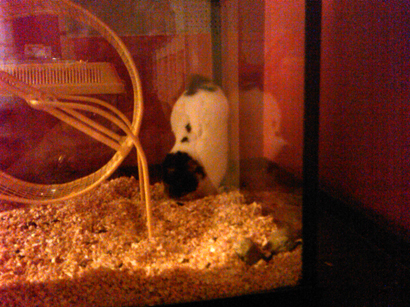
Apologies for the graininess of the image. I took it with my blackberry because it was the closest camera. And it’s not like he gives me a heads up when he’s about to saunter over to his very public bathroom.
*******
There is a second REI card giveaway over here. BlogHer is taking care of choosing the winner from the first one so that person should be contacted soon if they’re not already in possession of a “you won!” email.
*******
And now the blogs…
But first, second helpings of the posts that appeared in the open comment thread last week as well as the week before. In order to read the description before clicking over, please return to the open thread:
- “WTF Wednesdays: Beyonce Edition” (Theportofindecision)
- “F-You Uveitis” (Scrambled Eggs)
- “The Viewing” (Three Little Birds)
- “My Best Answer” (Rolling Around in My Head)
- “Spoilsport” (In Pursuit of Parenthood)
- “Those Dang Facebook Status Games” (Not Sugar Coated)
- “Regarding the Facebook Breast Cancer Awareness Games” (C. G. Ward Photography)
- “One of Each, or Not” (Life from Here)
- “Your Brother Henry” (Heart Heal Hope)
- “No More Suffering in Silence” (Making Babies on the NHS)
- “1460” (This is Not What I Had Planned)
Still Kicking Your Collective Ass: Okay, 11 is much better. Let’s make sure we do it again this week. There is a whole world of blog posts out there worthy of a little extra attention.
Okay, now my choices this week.
I loved Three Little Birds post about grieving enough. She is trying to make sense of the different ways she is grieving the loss of her husband and the loss of her mother, and the post literally walks the reader through a path in her brain, explaining how she is coming to accept that not all grieving will look exactly alike. It’s an emotional, beautiful post.
My Lady of the Lantern has a post about people who pretend they weren’t infertile after they are parenting. She is frustrated with a friend’s rewriting of her own personal history and the story she is presenting to the world. She asks a thought-provoking question: “Do you wish you could deny your infertility? Seriously, I want the truth. If given a chance would you do it? If you could wipe the memory of your friends and family clean, would you reinstall the infertile status in their memory?” Well, would you? Go tell her.
I featured it on BlogHer this week, but I literally love this post that much that I need to also post it here. Tales of a Batty Nurse has a post called “Loving Who I Am?” and it is about the struggle to truly love yourself. My favourite part was this: “It also annoys the hell out of me to be feeling melancholy over this. I don’t want to feel like my life is only complete or happy if I have a significant other, or a baby, or whatever. I spent too many years like that. I’ve enjoyed the last year or so being happy with what I have and I want that back. ” Go read the post in full.
Lastly, there were so many good posts this week on the fake pregnancy Facebook meme. I just wanted to highlight two of them. Too Many Fish to Fry has a brave post stepping out of the infertility closet (with an explanation of why she is doing it). Family Building with a Twist has a powerful post about the various ways cancer has touched her life, and she implores those who participated in the meme or those who want to understand more to read The Emperor of All Maladies to understand the facts about cancer.
The roundup to the Roundup: Feeling a little nervous and a little not about the specific, unconfirmed threat for Washington, D.C. and New York. Distracting myself by grabbing the camera every time Cozy does one of his handstand pees. BlogHer is giving away a second gift card to REI. And lots of great posts to read. So what did you find this week? Please use a permalink to the blog post (written between September 2nd and September 9th) and not the blog’s main url. Not understanding why I’m asking you what you found this week? Read the original open thread post here.
September 9, 2011 14 Comments
“Win a Baby” and “Baby for Sale” is What’s Offensive
As you’ve probably heard by now, Hot 89.9, an Ottawa radio station is holding a “win a baby” contest where they are giving away three rounds of fertility treatments (most likely IVF since the value of the prize is priced at $35,000). Why? Who knows — most likely for the publicity this brings vs. the goodness of their hearts and a strong desire to help infertile men and women.
Or maybe not, maybe someone on staff is infertile and suggested this contest. After all, the quote in the newspaper sounds fairly sensitive:
“When one in six couples have trouble conceiving — that’s a huge percentage,” said Hot 89.9 co-host Jeff Mauler. “If we help out those families or individuals who are looking to do this then I think those people who are against it should see the bigger picture and realize that we’re actually trying to help somebody who couldn’t do this otherwise.”
Well, that went beyond my expectations.
So it’s not the sentiment behind it that bothers me, even though the mere existence of the contest is what has commenters and radio listeners up in arms (most are, as you’ve probably guessed, wondering why more infertile people won’t “just adopt”).
My problem with the contest is what they are indirectly promising and the image they are putting forth in people’s minds about assisted conception.
It starts with the poster which has a baby holding a sign that says, “win me” as if the naked, diapered baby is the goldfish you’ll go home with if you can throw the ping pong ball in the cup of water at the fair.

Just in case you’re still thinking that this ad could be seen in another light, you move onto the second picture, another baby naked, diapered baby with the statement that “she could be yours!” with, again, the ultra-cute caveat: “baby may not be exactly as shown” which appears on all three ads.

Yes, three ads, because there is actually a THIRD version that asks “are you my mommy?” Of course it doesn’t ask “are you my daddy?” because men aren’t baby-hungry like crazy women with their floating uteruses clouding up their brain.

So I’m really on the fence about a radio station holding a contest like this. On one hand, I want to congratulate in advance the person who wins it who may not have had the opportunity otherwise to attempt treatments.
And on the other hand…
It perpetuates this myth that fertility treatments work each and every time. That it’s closer to corrective surgery vs. a game of roulette. The reality is that treatments give people who would otherwise have a low-to-no chance at conceiving without assistance a statistical leg-up in the chance department. But it’s just that — a chance.
It is what makes fertility treatments — I think — particularly nerve-wracking and devastating for those without mandated coverage who are paying out-of-pocket. You are investing a large sum of money in a chance, and that financial burden has to become part of the decision-making process. If you knew for certain that you could save for three years, invest the money in the procedure, and walk away with a baby, I don’t think anyone would gasp at the ticket price. But what you are always paying for with fertility treatments is a chance.
And beyond that, this contest presents the baby as a tangible item to be won, and if it can be won, it could also be bought or sold like any financial prize. This does nothing to help the general public understand the reality of assisted family building, which is no different from unassisted family building. People pay for the skill of experts. They pay for the tasks various personnel do for them. They pay for procedures and medications and surgeries.
But they do not buy a baby.
At least, when fertility treatments, donor gametes, surrogacy, or adoption are done ethically, the money is not for buying a baby but rather paying for expertise or medical bills. Which is no different from any other baby. All children come with a price tag whether that money is going to the doctor who delivers it, a midwife practice, or a hospital stay. Those engaging in assisted conception or families built with assistance have a few extra bills, but all of those are for services — not the child.
So that’s where I am with this contest. What are your thoughts?
September 8, 2011 38 Comments
September 11th
It’s the large elephant in the week — September 11th — and it begs you to discuss it, remember it, dissect it.
I didn’t know how I wanted to write about it. I could only acknowledge that my mind and heart felt like I needed to write about it, that neither wouldn’t be able to continue on to other thoughts or ideas until I had put this one to rest. So I started working backwards, figuring out how I didn’t want to write about it.
I didn’t want to relive it. I didn’t want to tell once again where I was when I found out what had happened.
I didn’t want to pull out my student’s recollections on September 11th and post a part of it here. That felt like I was trespassing on their hearts. Though I am still sitting with the idea of Googling a handful of them, reaching out to mark the moment with an email reminding them what they said ten years ago.
I didn’t want to discuss the news coverage. I didn’t want to go down to the memorials. I didn’t want to photograph anything or roundup posts.
Which leaves us with this.
*******
I am a huge lover of analogies and metaphors. It would probably make for an amusing piece of cloud art if someone culled all the various analogies from my last 5+ years of blog posts. I blame my mother — she is the master of the analogy.
I think it is human nature to want to explain something we don’t know by using something we do. It is not even always something we don’t know; sometimes it is just something too large, too messy, too emotional to be able to look at it directly. Sometimes we use an analogy in order to reduce something in size, make sense of it, contain it.
And I think we often do that with the concept of healing.
We know what it means to physically heal. Either we’re physically hurting, or we’re not. Either the bone is broken or it is mending or it is now imperceptibly different from before but still on this side of well. We know what it means to have physical scars that show a physical trauma. Healing doesn’t necessarily mean going back to exactly the way it was before, but with physical issues, we can usually define where we are on the spectrum from hurt to mending to healed.
Slightly more fuzzy becomes the idea of mentally healing since our mind is not as well-defined as our other body parts. Still, we know when our brains are on the mend, when it seems like a medication is working or not working. Control over the situation may wax and wane, but it still feels like something we can discuss in the realm of healing, of returning or bringing the brain to a place where we want it to be.
But where I think the analogy breaks down is applying what we know about physically healing to emotionally healing. We seem to believe that people emotionally heal in the same sense that we physically heal. We have sayings, for example: “time heals all wounds.” We know this isn’t true physically — do nothing to stop the bleeding and time won’t be able to jump in there and heal you. But it also isn’t really true for emotional pain, is it?
Sometimes I think a better analogy would be comparing emotional pain to a pair of binoculars. When you are in the moment, everything looks even closer and larger than it does if we had a bit of perspective. We focus on these tiny bits of information, replaying them over and over again in our minds. Maybe because the whole is too enormous to contain. And then time passes, and we turn the binoculars around. Years later, it pretty much all looks the same, except farther away and we’re more acutely aware of how the image we’re seeing fits into the bigger picture.
Maybe this is how empathy exists — because if we truly healed (applying the physical concept of healing), we would forget. But instead, we can all still visualize the object of our emotion pain, only it is faraway, remote, held in place by other points on the landscape. We don’t access it in the same way; we can’t turn the binoculars around again and view it close-up any more than someone who is in the throes of the moment can choose to turn their binoculars around and hold their pain at a distance. But we still see it; quite clearly albeit far away.
*******
The other problem is that when we apply what we know about physical healing to emotional pain, what we get is impatience. There is this idea that time has passed, therefore, you have to heal. We give people an incredibly small amount of sympathy all things considered, and then expect them to buck up and rejoin the human race. People become incredulous — “you need to move on and stop moping!” — or simply stop asking about the loss.
We don’t coddle our mourners on a day-to-day basis, which is why I’m a bit uncomfortable with this idea of a ten year check-in for September 11th. Will we be okay if we discover that widows are still finding it difficult to get through their day? If we find out that children are still devastated without their parents?
We are expecting all of them to say that life went on, that they’re living wonderful lives despite their pain. Humans need that — we need to hear that people can go on to lead full lives because it is what we grasp when we are in the trenches. We need to know there is a stopping point because how else can we survive if we face the fact that emotional pain is often open-ended? It changes in sharpness or frequency, but for some people, it doesn’t quite disappear fully?
On one hand, is there any other way things can go except forward? We all suffer from emotional pain and the world can’t grind to a halt. As much as WH Auden implores us to “Stop all the clocks, cut off the telephone / Prevent the dog from barking with a juicy bone / Silence the pianos and with muffled drum / Bring out the coffin, let the mourners come,” how can we let life remain at a standstill?
If we didn’t move from emotional pain, life would become a cacophony of an echoing past, much the same way sound hangs in the air in Tomba Emmanuelle. You need to move gingerly in there, and life cannot really float on ginger movements. Every single person on this earth is in a state of mourning someone.
But on the other hand, isn’t it equally as damaging to expect people to “get over” something? To move on? To forget? We know what to do to make a bone heal. We have protocols to treat a whole host of illnesses (sometimes they work, and sometimes they don’t). But we don’t have a cut-and-dried manual to emotional healing. We tell people to write about the loss, to talk about it, to join a support group. But we also tell them to get back to living (since when is someone not living just because they are mourning? Isn’t mourning a part of living?). To stop obsessing over it (since when is thinking about something that has affected you enormously obsessing? Wouldn’t obsession be a huge focus on a fairly small situation; disproportional? Isn’t it understood that enormous, life-changing events will occupy a large stake of our emotional energy, possibly even blotting out everything else?)
I wish we had a different word for it. I wish we didn’t treat emotional healing in the same way that we treat physical healing, if we didn’t paint both with the same broad brushstrokes. I know that I feel differently today than I did ten years ago, but I wish the word that we used wasn’t “healed” because I think it also doesn’t pay tribute to the way an event changes you. We don’t slide back into place easily, continue from the same point we were before a loss.
We instead build a new life, over and over and over again, more like a phoenix. It looks like the same bird, but it is wholly and completely different.
I assume that what we’ll see from September 11th, ten years on, is a snapshot of a life. It may show a scene where a person is holding down a job and making coffee every morning and raising their children. But I would guess that below the surface, there is a wide-range of emotional states: a wider-range than can be described with the term “healing.” There will be those who hold it together all day on the outside, and fall apart once they’re alone. There are those who will admit that there are triggers, but they mostly power through their day-to-day without thinking too long or hard about what they have lost. There will be those who will kick themselves because they don’t think they are sad enough ten years on and there will be those who will kick themselves because they feel like they shouldn’t be quite this sad ten years on.
And I am guessing it is this way with all loss — not just the ones we mourn on a national level. We all could do well to release ourselves from the word “healing,” from believing that what we know about physical mending can be applied to emotional mending, and to create a new vocabulary for dealing with loss. Something that brings in elements of healing, but is its own idea altogether.
*******
My heart goes out to everyone who is mourning, who is navigating the world without a person they love in it. I want to tell them to take the time they need, whether it is five minutes or a life time. Please don’t allow the mental timetables of others dictate how long you need to feel whatever you need to feel. Forgive me if you needed me to ask about your loss and I haven’t. May your rebirth from each loss be a peaceful one with time. The reality is that we need to let the clocks run again as well as let the telephone ring, but only you can decide when the right time is to see the secondhand turning or pick up the line.
I guess that is what I needed to say about September 11th. What do you need to say?
September 7, 2011 23 Comments
Slacktavism
One day, hopefully a long, long time from now, I will die, and when I do, I would like my death to be Twibbon-free. I would like your Twitter profile to remain whatever colour it is now. I have fewer feelings about requests on your Facebook status updates. Though I’d be thrilled if someone started something akin to what Msfitzita does every year asking people to do acts of kindness in memory of her son, Thomas.
Despite my last two posts and what I just said above, I don’t really have a problem with social media memes. I had a problem with the fake pregnancy one because it had the potential to affect my friendship when I believed that my friend had kept her pregnancy news from me. Plus, it was cryptic, doing nothing to actually educate people on the cause it purported supporting. (Quick, tell me three things you learned about breast cancer due to that meme.)
The reality is that my eye passes right over the Twibbons and Twitter profile colours and Facebook status updates because they’re usually not asking anything of me beyond two seconds of my attention. So it’s not that I’m ignoring them; it’s just that no one asked me to do anything therefore, I do nothing.
People skirted around the term in the comment section, but the urban dictionary word for this sort of thing is “slacktavism.” I’ve pretty much only heard it applied to online activities, and Wikipedia describes it as:
The word is usually considered a pejorative term that describes “feel-good” measures, in support of an issue or social cause, that have little or no practical effect other than to make the person doing it feel satisfaction. The acts tend to require minimal personal effort from the slacktivist.
Ouch.
I feel like writing is the most powerful tool I personally have at my disposal and my medium of choice is the Internet. Is writing about social causes such as… let’s say… infertility without a clear call to action essentially “slacktavism?” Am I a slacktavist? Is it only activism if you’re moving towards a goal (for instance, insurance coverage for fertility treatments) vs. doing something more touchy-feeling and amorphous such as discussing how infertility makes me feel (and perhaps, in doing so, providing another person an outlet for processing their feelings)? If you don’t feel good from it, is it not slacktavism?
And I guess that’s what I want to talk about: is there anything wrong with slacktavism? Is something better than nothing? Without the ability to chart the far-reaching affects of someone’s slacktavism (Wikipedia’s “practical effect”) and because it could possibly lead to activism, is it good to do something on the off-chance that it could indirectly lead to change? Why do we put more emphasis on tangible support such as money vs. the emotional support that can come from community building such as seeing people you care about express their feelings on an issue? If some people are emotionally hurt while other people are helped, is it worth it? Do badges and Twibbons do anything beyond state where we stand on a subject? Do we expect them (or need them) to do more than that?
Crap that’s a lot of questions.
I don’t have clear answers to those questions; I guess I wanted your thoughts. And I think we need to separate out statement-based online projects from action-based online projects. A statement-based online project would be something like the fake pregnancy meme. An action-based online project would be something more akin to the status updates that came out of this such as Elphaba’s or Keiko’s. They took a stand and then took it further, telling the reader what they can do in order to lend support.
I think the Internet is an amazing tool that has a bad rap. Because people misuse it — just as people misuse any tool — other people see it only through that lens. I take issue with the idea that online activities are “lazy” (as opposed to physical protests such as sit-ins or picketing) because we have actually seen social media change the world. Online does not equal unproductive: there is plenty that is being organized, disseminated, and discussed online in a very active way that is provoking change. It’s not the medium that is the problem; it’s the project itself.
So no Twibbons for me, though I can understand (and respect) why others do it. Though, really, in the event of my death, no Twibbons. Organize a massive comment-spree, hold a yearly Day of Comfort, create an email forward of people writing each other kind words done in my name. You don’t even need to wait for my death to do so.
But no Twibbons.
What are your thoughts on my questions?
September 6, 2011 19 Comments