

Susan G Komen, You Can’t Delete the Tweet
A lot has been written today about how Susan G Komen botched their reputation by not responding — or even attempting to control — the backlash against the organization in light of the defunding of Planned Parenthood. It’s sort of a study in what-not-to-do in terms of leading the public perception of a brand or organization. In fact, I am writing about this idea right now for BlogHer.
But in doing research for that post, I came across a retweet that was posted and then deleted earlier today by Karen Handel, the vice president of Susan G Komen who is behind the defunding of Planned Parenthood. Plenty of people took screenshots of the original tweet so it lives on, in all its glory.

I don’t know. It sort of speaks volumes about the person, which — of course — reflects on the organization she represents. I would love to have everyone print out the Planned Parenthood at a Glance page — the one that speaks to the numerous services Planned Parenthood provides — and mail it to Karen Handel’s office, since she seems to believe that 3% of services constitutes 100% of services, hence why she refers to this women’s health organization as a “pro-abortion group.” Unless I’m going to think that Handel is heartless and cruel, I need to believe that she is just poorly informed and ignorant. And therefore, the classy thing would be to educate her.
I’m going to send her my print out in the morning. If you want to send a letter to her office, you can too:
Karen Handel
Susan G Komen
5005 LBJ Freeway, Suite 250
Dallas, TX 75244
February 2, 2012 13 Comments
Thank You, Susan G Komen, For Showing Me That I Should Give My Money Straight to Planned Parenthood Instead
Every Friday, I have to drive down the same road to get to a class, passing the same buildings and houses that I never pass any other day of the week. A few weeks ago, Josh was off of work, and he ended up taking me to the class, so we were driving in the car together.
“I always wonder about that place,” Josh commented.
“Me too!” I exclaimed, sort of amazed that Josh had the exact same thoughts about the building we were passing, a building I’ve thought about on and off for about 9 years every time I’ve had reason to pass it.
“I would go in there, but it sort of looks sketchy.”
“It would be worth it though.”
“Really, I’m sort of surprised. This doesn’t seem like you.”
“You think I couldn’t hold my own and use them for what I want in the same way that they are going to attempt to use me to get what they want?”
“Melissa, what are you talking about?”
“I’m talking about the place that advertises that they give free pregnancy tests, which is obviously from the rest of the signage, an anti-abortion clinic. So I’ll listen to their spiel, blah blah blah and get the free beta. When you’re not in treatments, it’s hard to get a beta.”
Josh takes his eyes off the road to glance at me for a moment. “Melissa, I was talking about the tofu restaurant next door.”
Oh.
Here’s the thing: my ability to use that anti-abortion clinic to get my damn beta numbers (I am the queen of the beta of 9) is something I developed quite recently, that grownup trait of making up your own mind and sticking to your convictions, even in the light of external pressure. To be able to see someone else’s agenda and know whether or not they have my best interests at heart, or if they have put the message they want to push before the needs of the person sitting in front of them. In other words, until recently, I was the type of woman who needed Planned Parenthood, a place I could go where decisions would be left in my hands without an overriding political message.
Planned Parenthood was made for a woman like me.
A woman who was prone to being swayed by judgment, so they took out the judgment. A woman who was concerned about doing what was “right,” so they removed the idea that there was only one correct answer. A woman who sometimes didn’t know the right questions to ask, so they provided a wide-range of information. A woman who didn’t have a lot of money, so they ensured that all women could have access to basic women’s health care services including pap smears and breast exams.
You know, those two health exams that I’m assuming we all want every woman to have access to.
Susan G. Komen, the fundraising giant in the name of breast cancer, pulled funding from Planned Parenthood which was used to provide cancer screenings to those who cannot afford women’s health care otherwise. They are doing so because Planned Parenthood is under investigation for complaints raised by anti-abortion groups (in other words, there are no valid complaints made by a non-partisan organization). And I’m sorry, but there is no room for politics when it comes to women’s health — when it comes to anyone’s health. What we are talking about is literally life and death.
Politicans are fond of using live subjects — namely, people — to test out their political theories. Which makes them like cruel scientists. We would be horrified to learn that cats or monkeys were being killed in order to push someone’s personal beliefs, but we’re not equally horrified when people are losing access to health care and dying needlessly based on someone’s personal beliefs. The reality is that our STEM fields have stricter protocols on how and when they can use live subjects to test theories whereas human women are being used daily without any controls in place to test political theories.
The purpose of Planned Parenthood is — simply put — to ensure that women are in the best position to have children when they want to have them. Which means that
- They provide preventative services so they are not having children before they’re ready (according to their site, “76 percent of our clients receive services to prevent unintended pregnancy. Planned Parenthood services help prevent more than 584,000 unintended pregnancies each year.”)
- They provide screenings for diseases that could impede reproductive health (“770,000 Pap tests and nearly 750,000 breast exams each year.”)
- They provide blood work for infectious diseases that could impair reproductive health (“more than four million tests and treatments for sexually transmitted infections, including HIV.”)
- They provide abortions for a plethora of reasons (“Three percent of all Planned Parenthood health services are abortion services.”)
- And they provide education to “1.1 million young people and adults each year.”
Or, as their mission state succinctly begins: “Planned Parenthood believes in the fundamental right of each individual, throughout the world, to manage his or her fertility, regardless of the individual’s income, marital status, race, ethnicity, sexual orientation, age, national origin, or residence.”
In other words, they are fighting the good fight on behalf of women. They are trying to ensure that when a woman is ready, she is able to have a child.
Women’s health is not a pu-pu platter where we can each pick at the one item we want to take. Where you eat the spareribs and I’ll take the fried wontons. I can’t sit down to a meal with women who are going to tell me that I can take the IVF-access and they’ll take the mammogram-access fight but we’re not going to actually support each other to complete our goals.
Women’s health is women’s health is women’s health.
If you care about having access to fertility treatments, to the ability of your medical team to make decisions taking into account your unique situation and tailor a treatment plan that works best for your body, you need to care about making sure that all women have access to sexual and reproductive health services — even the ones you might never choose to use yourself. This is about the strength of standing collectively on an issue, about saying every inch of a woman’s body is important and deserves to be treated with respect, with the woman’s best interests at heart.
And Susan G. Komen isn’t doing that right now.
The problem is that all charities look like good charities meant to support the people they claim to support until they make a move like this, causing you to question how the funds you raise or give to other organizations are being used. And maybe that is why I am always a bit squeamish about giving to organizations that dole out grants vs. organizations that directly provide services. There are fantastic organizations out there that are working to channel money towards science and services in a completely ethical way. But there are equally fantastic non-profits who are on the ground, doing the hard work, providing the services, and those are the ones I think I’m going to turn my attention to supporting for the time being. Not just financially, but by volunteering for them, writing about them, and educating myself (and others) on the services they provide.
So, thank you, Susan G. Komen, for making me realize that there are more options than supporting a philanthropic organization. I can give my money and time to an organization like Planned Parenthood who provides the services. Sometimes we just need a reminder. So thank you for giving me one.
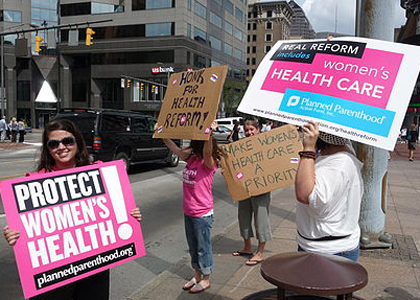
By ProgressOhio (Flickr: June 2009: Protect Women’s Health!) [CC-BY-2.0], via Wikimedia Commons
February 2, 2012 38 Comments
You’re Beautiful
 The ChickieNob needed new clothes, so I took her to the mall one night and told her that she could choose whatever she liked provided that it fit into the budget I had in mind and that I deemed it appropriate for her age. For instance, she wants a pair of steel-toed combat boots, but I told her that I wasn’t shelling out $100 for shoes she would wear all of one year. And while she has never asked for one, I would nix the black and white string bikini we saw last year in a size 5T.
So she picked out a bunch of outfits and took them to the dressing room. And then she slipped into each one and stood in front of the mirror, marveling at herself. “I look so beautiful! I look amazing.”
I ended up buying her everything because (1) it did look great — the girl has an amazing sense of style and (2) how can you not feed that self-esteem right now knowing how much it’s going to be damaged by life down the line. I mean, how many of us stand in front of the mirror and say with pure excitement, “I look so beautiful!” I am more likely to say, “wow, this isn’t half-bad” or “okay, this pair of pants doesn’t make me look too much like crap.”
I literally can’t remember the last time I tried on an outfit, looked in a mirror, and was amazed to see myself. To want to look at myself all day long because I thought I looked hot. Outfits that I was pleased with: certainly. But gazing at myself with the admiration I saw on the ChickieNob’s face: not in a long time.
Is it inevitable? That we get so accustomed to looking at ourselves that we get bored with ourselves? That youthful shopping trips are the equivalent of a new relationship? Of course everything is exciting — picking out your own outfits is new. It’s thrilling! It’s empowering! It makes you feel good! And then, like any relationship, we get used to it and we start picking it apart instead of just grinning at ourselves in the mirror. We start looking at clothing shopping as a chore — finding something that looks good that fits in a budget that is appropriate for the situation — vs. looking at it like an adventure, a sea of possibilities.
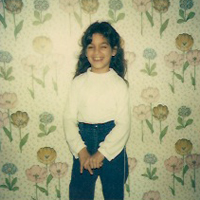
All I know is that I had this idea to take out the Flip camera and film her dancing in front of the mirror. The idea would be to show it to her later on, when she is starting to get down on her body. I’d remind her how much she loved herself back then. But then I thought about if it would change me to see myself gleefully loving my body, and I realized it wouldn’t. I did love my body like that; ask my parents to take pictures of me in outfits I loved with their Polaroid camera so I could instantly see the photograph and put it in my picture album (and now I mortify myself by adding those pictures to my blog post). I have those pictures and I looked at them to write this post, and it didn’t change the way I feel about my body one bit. Yes, I can guilt myself into feeling something different, but thoughts that stem from guilt are rarely lasting or even truthful.
I tried to think of the last time I looked at myself in the mirror and thought I was gorgeous, exquisite enough to be captured in a photograph. There was my wedding and the honeymoon afterward, when I felt good about my body. I was running daily and was at a good weight for my frame. I knew I was loved, and I had seen Josh’s face when I walked down the aisle, and that probably confirmed the good feelings I was already experiencing about myself.
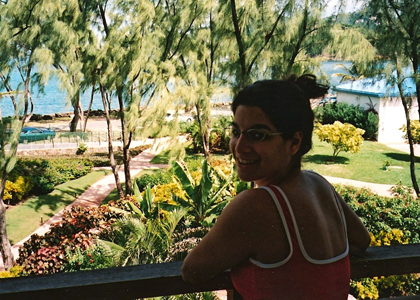
That was probably the last time I asked Josh to take a picture of me because I wanted to remember how I looked in a moment; because I felt good about how I looked. There are pictures of me with the twins in my belly, and I felt gorgeous then, but it wasn’t about me, per se. It was about them. So I would have to say that my wedding, 10 years ago, was the last time I gasped when I looked in the mirror and wanted to gaze at myself for a while.
When was the last time you felt that way about your body or how you looked? Is there any way to hold onto that excitement from childhood when you thought you looked fantastic?
Part of me thinks that I need to send myself to the mall with the understanding that I’m not going to leave it until I have found something that makes me look at myself in the mirror like that. I don’t have to buy it, but I have to find an outfit that makes me want someone to take a picture of me in it to capture the moment. Though it would only count, only be meaningful, if I really meant it. Until I’m in that moment, I can’t tell (as I write this in the kitchen) if I’ll really mean it.
February 1, 2012 30 Comments
The Saddest Chapstick Story You Will Ever Read
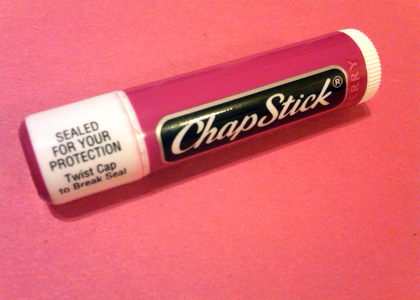
On Thursday evening, Josh bought the ChickieNob her first cherry chapstick. She had been coveting one for a while and he was at the grocery store, so he picked one up to surprise her. Needless to say, she instantly fell in love with her lip balm. So much so that when I took her brother to his guitar lesson, she brought it along just to hold it in her hand because she didn’t want to leave it back in the house.
And then she visited the school of chapstick hardknocks.
She did what ever single person has done at some point in her life, that quintessential moment of childhood when you absentmindedly (or in some cases purposefully) twist the bottom gear until the chapstick is up as high as it will go. For a few moments, she marveled at the red brick of waxy lip balm. And then she was taught the lesson every child learns the hard way: that twisting the gear to its limit brings about instant chapstick death.
At dinner, Josh had been telling me about a David Grossman book, To the End of the Land, where a mother drops off her child at base camp for army service. Terrified that in allowing her son to be in the army she is literally offering him up for sacrifice, and fearing that she will one day receive the dreaded knock on the door by the army telling her that he is dead, she leaves her house so she can never receive that knock. She spends the book walking through Israel, engaged in a game of magical thinking. If she never receives the message, the death can’t occur.
That’s what I was thinking about as I watched the ChickieNob fall apart only a few hours after that dinner conversation, feeling for the first time that deep weight of regret; that wish that you could have made a different choice, that you could rewind time and change one small decision so the future won’t happen. Right now, it’s a chapstick, and one day it will be something slightly bigger and then slightly bigger and finally bigger still, and with each moment that we’re emotionally forced to drink from that well of regret, we choke on the knowledge that there was something small we could have done. The ChickieNob could have left the chapstick on her side table and it would still be whole. The mother in the book could have kept driving past base camp, moved from the country, kept her son safe.
Of course, we never know these things in the moment. We only know them in retrospect. Which is why retrospect is such a bitch. Sometimes it seems cruel that our brains retain the memory of how we got to the place where we’re at. That it’s our tendency as humans to walk ourselves backwards through each moment to consider all the tiny twists and turns. By which I mean the twist of a road. The turn of a chapstick.
After tuck in, the ChickieNob went into the bathroom to cry by herself, and Josh made me get her out and tell her the story I’m about to tell you. So we sat in her rocking chair and I explained that my father once bought me a cherry chapstick, and I loved it because I thought it made my lips look red. I wanted to be like Snow White or Alice in Wonderland and have pale skin and red lips so badly. And while I couldn’t quite get the pale skin, the chapstick at least gave me the red lips. I used it for a while, making the sharp edges become rounded until the top was a perfect dome. And then I twisted the knob at the bottom just to see what would happen. And of course it broke. And I cried, hard, because when you’re a child, you never know when you’ll get another tube of chapstick, which is something adults forget. We become so accustomed to knowing that we can pick up a new chapstick the next time we’re at the store that we forget how much children are dependent on us, how difficult it is not to know when you’ll get a new pack of gum or a fresh chapstick.
The ChickieNob took another few minutes to cry, and there was a part of me that hoped as I held her that this moment somehow acted as a vaccine against all the stupid decisions she’ll make in the future which will lead to regrets. That somehow drinking from a deep well of regret over a broken chapstick will keep her from stepping on other small rocks in her path that will lead to future remorse. That she’ll always use a condom. She’ll never get in a car with someone drunk. She’ll be late one day and miss a terrible accident; she’ll be early one day and meet the person she’s supposed to meet.
Afterwards, I explained how a chapstick and a deodorant container and a twistpop work, how the twisting mechanism — which is very similar to the gears she uses in Lego robots — is connected to a rod, which raises a platform, and how this method of propel-repel is actually one of the greatest inventions of all time. In fact, it would make the perfect science fair project, since it would not only be fascinating to take apart the chapstick container and the deodorant stick and the twistpop and see the parts inside, but it might actually save her fellow students from the heartache she is feeling now. She stopped crying and considered this. She agreed that she would take the chapstick apart. So I agreed to go to the store and buy her a new one. Since she had obviously learned the lesson.
She went to bed with her heart a little less broken. Almost as if I allowed time to rewind by agreeing to get her a new cherry chapstick. Which maybe erases the most important lesson there was in all of this: that we usually can’t go back and change the present so it looks the way we want it to look. That most moments in life are not as fixable and inexpensive as purchasing a new container of chapstick. The man in the car crash can’t go back and switch lanes. The woman who is raped can’t decide not to enter the house. People who die can’t be revived. And most of the time, we can’t know which one of our decisions is leading to that possible outcome until after the event occurs, after we mentally retrace all our steps. And even if she’s cognizant of that lesson and retains it, there is very little we can do to temper the feelings that come with retrospect.
So I let that lesson go, in exchange for a science fair project and a new chapstick so she could go to sleep with a lighter heart.
January 30, 2012 25 Comments
Today’s Menu: School Lunch
Last year was our first experience with school lunches in the twenty years since Josh and I left high school. I have to admit, I pretty much never bought a school lunch as a child because I was (1) a vegetarian, (2) picky, and (3) had enormous food phobias. Plus, once I was allowed to not each lunch in the lunch room, I never ate lunch in the lunch room again. I mean, I literally didn’t step foot in the cafeteria for social reasons throughout most of middle school and high school. My friends and I ate lunch in the hallway or outside. Or more accurately — I ate my lunch throughout the morning in small bites sneaked during class so there was pretty much nothing left when it was actually lunch time.
So it was pretty much with a lot of preconceived notions and a touch of horror with which I allowed the twins to purchase lunch for the first time. Since that time, they both have purchased lunch a handful of times. It happens about once or twice a month, and it is only when there is pizza or grilled cheese. Actually, as of late, only the Wolvog buys and only when it is grilled cheese because pizza made by anyone other than me and one restaurant have been bumped off his list of six foods he eats. As far as I can tell, the ChickieNob spends lunch time mostly daydreaming or mentally recording everything around her which leaves very little time to eat. That child will write fantastic tomes one day, thick books with characters invented from various parts of all her classmates from these days when she seems to exist solely on air, noticing and remembering every small detail around her.
Once upon a time, I had this vision of myself joining them for lunch in the cafeteria, perhaps on pizza day, after I finished my volunteer work at the school. That vision fizzled from my mind once I stepped foot again in a lunch room after being absent for more than twenty years. When I have to swing through for whatever reason, I stand by their long table internally retching, trying to avert my eyes from the macaroni and cheese (cheese still being one of my food phobias) and mouth breathe. School lunches look awfully one-colour, and that one colour is sort of a reddish brown. It’s sort of a tannish brown. It’s brown.
The USDA announced this week their new standards, and I got to sit in on a phone call with Agriculture Secretary Tom Vilsack and television chef Rachael Ray to talk about them. As a side note, I absolutely loved that Rachael Ray mentioned the fact that she doesn’t have children, but she is still involved in this fight for healthier school lunches because as she says, “I don’t have kids but I feel socially responsible.” As an infertile woman, that spoke volumes to me on the ways we parent — the ways we mother — society as a whole even before or after the loss of our children.
But school lunches.
The USDA have set new standards that will be tweaked at the local level. In other words, there will be a base standard that will ensure better nutrition to all kids, and then local school boards can make decisions that reflect the financial realities of their school district: do they want to use organic produce, buy locally, or grow their own food. Schools will increase the fruits and vegetables on the lunch tray every day, including a lot more leafy greens. Only low-fat or fat-free milk will be offered. School chefs will utilize more whole grains. They’re all good steps in the right direction, and all of these changes are being put in place so children can be well-fed and more able to learn. It actually sounds like the tray may contain more than just beige.
Though the question remains: you can get it on the tray, but it’s up to the child on whether it goes in their body. Some will eat it because it’s in front of them, and some will decide that it tastes good, and others will end up dumping those leafy greens in the rubbish bin right after they polish off their pizza. Vilsack spoke about even the snacks in the vending machines sending a consistent message about nutrition to the kids, but if those messages aren’t reinforced at home, I don’t think there is any way for the school to make them loud enough that they drown out the inadvertent messages from parents, friends, commercials, billboards, happy meals, etc. By which I mean, we all need to shout louder at home with our actions in order to support the work the USDA is doing to try to get good food into children’s bodies.
What were school lunches like for you as a child? Did you buy them and like them? Or did you avoid them like the plague (or wish you could)?
January 29, 2012 32 Comments