

Traveling to London with Kids
Yes, this post keeps kids in mind when touring London, but you can easily do all of these things sans kids. This trip is for anyone who wants to explore the history of London via literature (as well as pop culture such as the Beatles). It’s obviously written by someone not from London, which I assume — if you’re a Londoner — is as painful to read as it is for me when people write “I Went to D.C.!” posts. So… er… skip. Or add in more tips in the comment section below.
Some general tips for traveling to London before we jump into an overview of the trip.
- Write up an itinerary before you go that contains all the facts you want to convey to the kids. Believe me, when the days begin blurring you’ll forget all the cool trivia you meant to tell them while you were in Westminster Abbey or at Trafalgar Square. Even without kids, my itinerary has always made keeping track of what I did on the trip so much easier when I put together a photo album upon returning home.
- Have your kids look up information on every site you’ll be visiting before you go. It will help them to gather enough background information to appreciate what they’re seeing. For instance, while we told them that they’d see the Rosetta Stone at the British Museum, we didn’t tell them why the Rosetta Stone was important. Which meant that when we got to the museum, they didn’t realize why we were dragging them to see a stone. I think we just expected them to get excited because we told them that it was exciting. We then had to discuss the importance of the stone for ten minutes until that information clicked, and then see the stone again. We could have avoided a lot of this if we had taken time before we left to have the kids learn about important sites or items at home.
- Most kids rise to the occasion when they sense their behaviour will be determining what they are allowed to do. You know your kid better than anyone else. Don’t put them in situations where they’re doomed to fail. If they are the sort who need to run around outside, there is plenty here outside. If they are the sort who can tour an art museum, by all means, take them to an art museum. But always ask yourself before you decide on a site whether you’re asking too much of your travel partners. For instance, we really wanted to see Churchill’s War Rooms, but knew that was too much for the twins. They would have probably loved Legoland, but I wasn’t giving up a London day for that. So we all compromised and tailored the trip so everyone could be reasonably happy with our personal limits kept in mind.
- There are many Tube closures on the weekends (for instance, while we were there, we couldn’t take the District or Circle lines). Make sure you look up travel directions before you go but also have a back-up plan in mind.
- There are plenty of great neighbours to stay in, but we found Kensington to be fantastic for kids. We could walk to the park, it wasn’t that crowded and therefore noise was at a minimum at night, and there were plenty of kid-friendly restaurants.
- Be realistic about money. London is a very expensive city. The entrance fees to sites will blow your mind if you’re accustomed to US museums. You can save money by packing a bag lunch and eating breakfast in your hotel room, purchasing tickets ahead of time, and opting to visit free sites with a few paid sites sprinkled in.
- Bring more than one kind of camera. We brought along a point-and-shoot which fit in my pocket and an iPhone and ended up having the perfect picture depending on the lighting without having the camera take up a lot of space.
- Rent a wifi device. Instead of using free wifi (always risky) or paying daily for the hotel wifi, we rented a portable wifi device. This saved our ass many times when we had to look up information on the fly, but it also enabled us to skype with people back home and send photos right as we took them.
- Rather than have the kids keep a detailed journal (they were pretty exhausted by the time we got back to the hotel each night), we made an audio journal as a family. It’s about two hours long. Each night, we’d sit on a bed with the recorder in the middle and talk about our day, telling what we did and the random funny things we noticed along the way. We got a lot more detail than we would have gotten if we had written for ten minutes and the audio journal became one more souvenir from the trip.
I wrote out where we sprinkled in daily Harry Potter stuff below, though I’ve sectioned out the pictures and details into two separate posts. So know that information is coming. And to make it easier to plan a Harry Potter trip, I’ve designated what was Harry Potter book sites (meaning, trying to find the real Diagon Alley or Ministry of Magic) which I’m calling HPBS and what was a Harry Potter movie location (such as where they filmed the Leaky Cauldron scene in the first Harry Potter film) or HPML.
Day One
We took a night flight from the US and skipped the airline dinner so we could go to sleep immediately on the plane. We got a few hours of sleep — enough to allow us to function the next day — and then hit the ground running once we reached London and checked into our hotel.
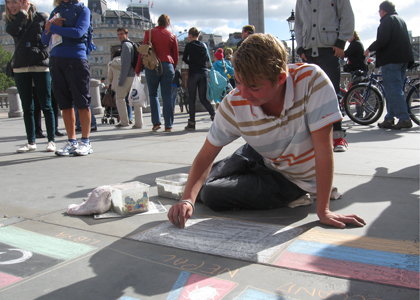
We started off with a little Harry Pottering because we knew the kids were excited for that. We focused on HPBS, trying to find the real Diagon Alley (see the next post on Harry Potter sites in London for the details). And we ended up walking to Trafalgar Square where the kids played on the base of the statue of Admiral Nelson, enjoyed the sunshine, and watched a chalk artist (was it Bert from Mary Poppins?).
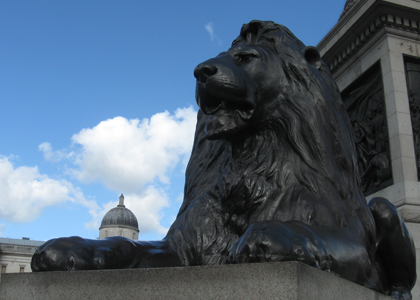
Heads up — it’s a £500 fine if you’re caught feeding the birds. There’s also legend that if Big Ben in the clock tower chimes 13 times, the bronze lions will stand up.
The Sherlock Holmes Pub is in this area if you’re into those books (you also can visit the Baker Street tube stop to see the wall mural and the statue of Holmes). Afterwards, we went to St. Martin in the Field instead and did brass rubbings in the crypt.
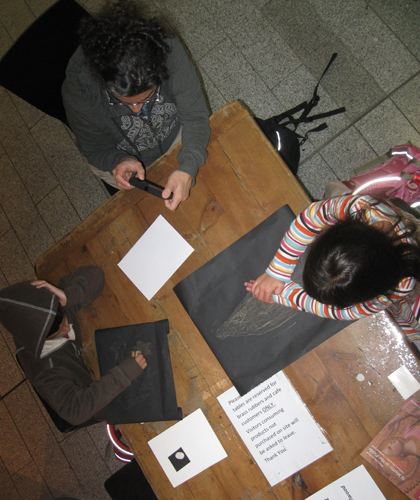
And swung through the Portrait Gallery to see some kings and queens before dinner.
Day Two
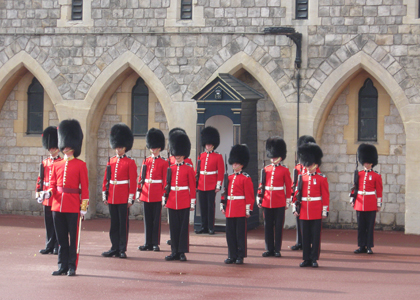
We went to Buckingham Palace to see the Changing of the Guards.

And then to a few Harry Potter sites (again, outlined in the next post), finally ending up at the Tower of London. We got a great Yeoman Warder for our tour and then saw the White Tower and Bloody Tower on our own. The kids were fascinated by the story of the murdered princes.

There are a lot of places to eat in the area. We ended up getting coffee and then walked over Tower Bridge at night, which was beautiful.
Day Three
This was probably our least successful day (hence the lack of pictures). We went to the British Museum, a lot of which was over their heads. Again, next time, we’ll pick ten items, have them research them ahead of time, and then go to the museum so they know exactly what they’re looking at. We also went to the Victoria and Albert Museum of Childhood. We thought it would be a big hit, but looking at cool toys behind glass doesn’t really excite kids we found out. Lastly, we swung by Harrods, which was crowded beyond comfort.
Day Four
Seven hours at the Making of Harry Potter! Er… this needed its own post.
Day Five
Started with standing at the location of the Ministry of Magic (again, next post), we walked by Parliament and the clock tower that holds the bell, Big Ben.
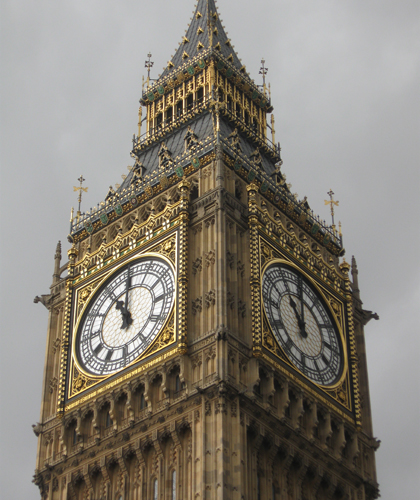
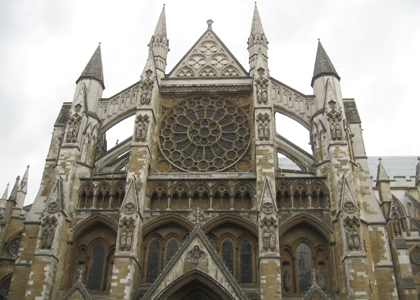
Then we went to Westminster Abbey. The kids had worksheets to fill out and we had an audio guide to help them answer the questions.
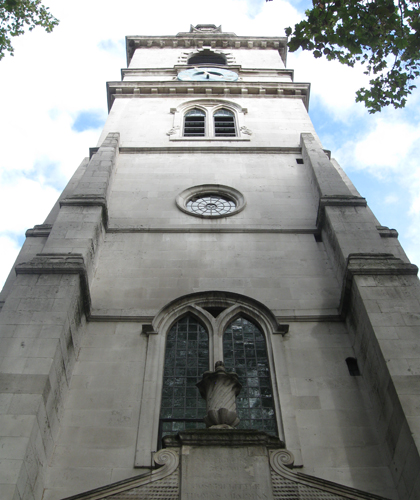
Afterwards, we traveled to the Temple area to see more Harry Potter stuff and St. Clement Danes (“oranges and lemons say the bells of St. Clements”).
There was more Harry Potter stuff at Kings Cross station (important information on that in the next post), and finally Abbey Road where we crossed the street just like the Beatles and saw Abbey Road Studios as well as signed our name to the wall.

Day Six
Alice in Wonderland and a trip to Oxford — this also needed its own post.
Day Seven
Took a day trip out to Windsor Castle.

We caught another Changing of the Guard ceremony. We got to tour the state rooms and see Queen Mary’s dollhouse and go to the church where the Queen Mum is buried.
After lunch, we crossed the river (a short walk) to see Eton College, an all-boys boarding school for ages 13 – 18. It was where Prince William and Harry went to school. We took the kids there because we felt it was as close as we could get to a school like Hogwarts — old stone buildings, formal dress.
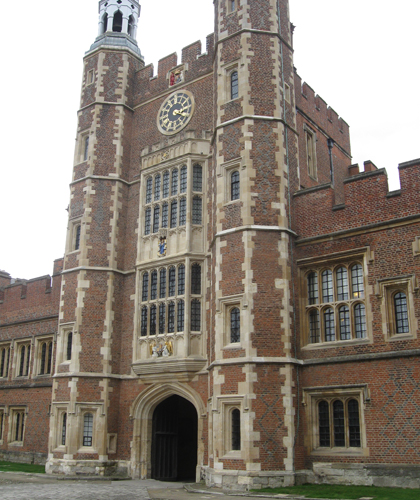
The Wolvog didn’t think it was funny how often we asked him if we should put him down for Eton, but it did lead to an interesting conversation over dinner about boarding schools in general.
Day Eight
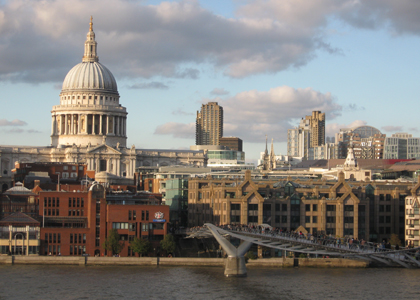
We spent the day wandering around London, spending it mostly outside such as chasing pigeons in front of St. Paul’s and watching an artist there.
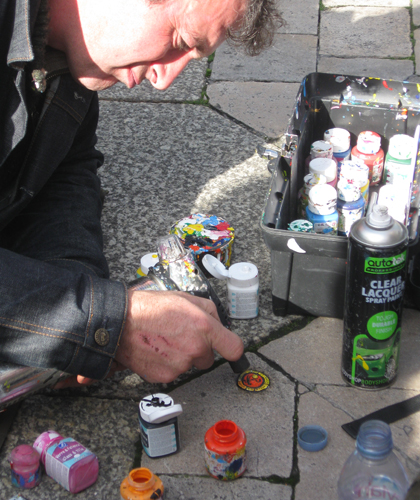
Or seeing a lot of street performers such as a fire juggler…
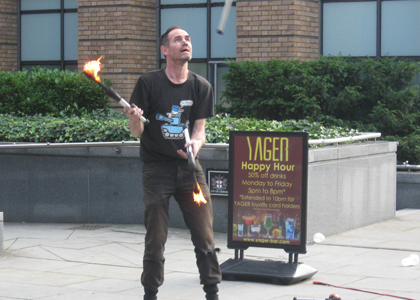
…and a weird headless man and ate street food.

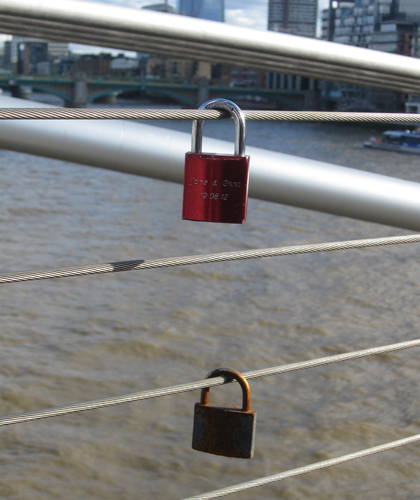
We walked over Millennium bridge in the afternoon (which is in the sixth Harry Potter movie) and loved the tradition of lovers placing locks on the bridge. (I know this is done in many places, but it looked particularly pretty here.)
We ended up at the Tate Modern. While we saw the permanent collection, the twins wanted to spend most of the time inside a performance art piece that was taking place on the ground floor. Like three hours in a performance art piece — that’s how much they loved it (and that performance art piece probably needs its own post as well).
Day Nine
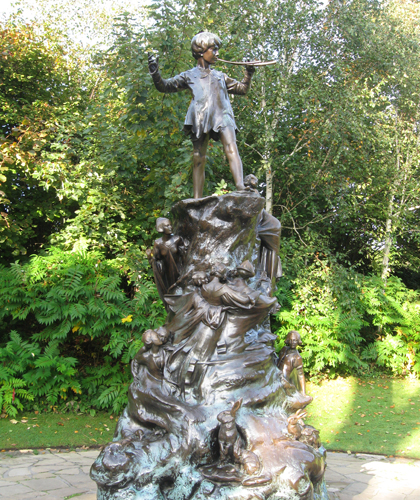
We walked to Kensington Gardens to see the Peter Pan statue.
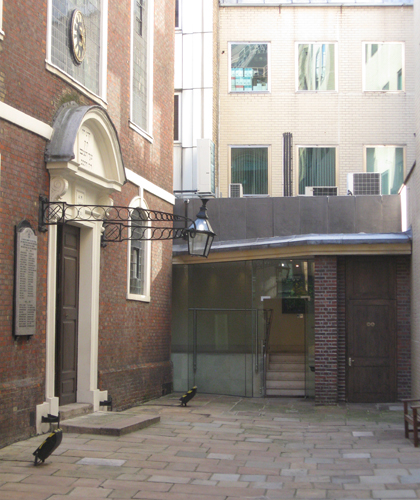
and then continued on to Bevis Marks, the oldest shul in the UK.
Afterward, we hopped a ferry for Greenwich where we stood on the Prime Meridian.
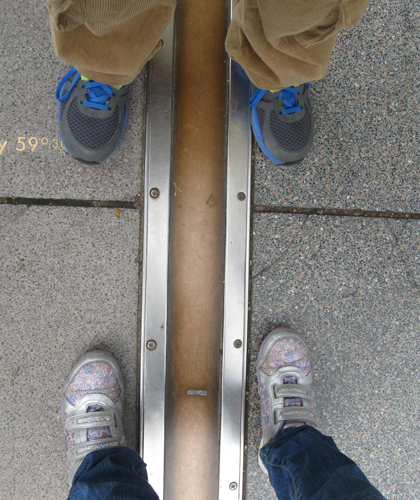
And learned a lot about time before heading over to the Queen’s House to see if we could catch the ghost on the Tulip Staircase.

And finally, we headed back to London, to eat at our favourite Italian restaurant in Kensington, pack up, and head back to the US to tackle the enormous quantity of laundry spilling out of our suitcases.
Fini.
Coming up: Harry Potter sites around London, spending a day at the Harry Potter movie sets, and an Alice in Wonderland tour of Oxford.
October 24, 2012 15 Comments
Merry Old England
A month or two ago, we were at shul and the woman in the row in front of us turned around at the end of the service and said, “your children are amazing.” They were pretty damn amazing. It was a night service, and it was past their bedtime. They had nothing with them, so they had to sit in the adult service, which was entirely in Hebrew and try to seek out letters they know in the prayer book (hint: not many). But they sat there silently, swinging their little legs off the end of their chair in a picture of patience.
“Oh,” I said, looking down at them. “They’re just acting this way because we told them that if they were mature enough, we’d take them with us to England.”
The twins can now return to armpit poking and pulling hair; there is nothing to hold over their heads any longer, behaviour-wise. We’re back from London.*
*******
We picked England as our first foray into international travel with the twins because it was one of a few soft landings. We wanted to go somewhere that was just different enough but still had some ties to life at home, and we wanted somewhere that Josh and I had some familiarity with to make planning and navigation a tad easier. We didn’t want a language barrier on their first trip. England, Ireland, and Israel all fit the bill, and England won because it came higher up when we placed them in alphabetical order. Actually, we wanted to do a literary vacation, one where you read a bunch of books and then go explore the setting (either the one in the book or where the author wrote the book), reenacting scenes from the book or trying to discern what about the space influenced the story.
So we read three of the Harry Potter books, Mary Poppins by PL Travers, and Alice’s Adventures in Wonderland by Lewis Carroll.
Before we left, I typed up a 9-page itinerary with Josh detailing everything they would see while we were over there as well as important facts to know while they’re in each space. We did this because we wanted them to feel empowered while they were over there; equal travel partners who were in the know. This was a great idea in theory (and we’d certainly do it again) but we found on this first trip a bunch of chasms we hadn’t considered until we fell down them in the moment. So… yeah… I think I need to document the chasms for myself (to re-read before the next trip) and if they help you to not make the same mistakes we made, all the better.
We also ran into a bunch of random luck on the trip, hitting the right person at the right time and receiving information that made our trip magical. In other words, we would have never found Platform 9 3/4 or found the door that Alice ran through if not for the random directions from strangers, and even returning home, I haven’t been able to Google and find this information online. So I want to write that stuff up too in case anyone reading this (or Googling for the information) wants to find out too.
I’ve broken down our trip into
- The next post which is an overview of the trip, a bunch of non-book-oriented stuff we did, and overall thoughts on travel.
- Harry Potter: how to visit all the film sites in the area as well as places such as Charing Cross Road to look for the real Diagon Alley.
- Making of Harry Potter: we spent 7 hours on the actual film sets for the movie and the pictures are just cool. Plus a few heads up if you’re planning on making the pilgrimage.
- Alice in Wonderland: how to plan an Alice in Wonderland trip to Oxford.
You may notice that there is no Mary Poppins day. There was very little Mary Poppins-related to do in London with the exception of seeing where Mr. Banks worked or running into a chalk artist.
One thing you should know is that with the exception of the Making of Harry Potter day, we sprinkled in Harry Potter sites daily on our way to another London location such as the Tate Modern or Trafalgar Square rather than chunking it together and having full Harry Potter days. But you’ll figure that out when you see the next post which is an overview of the trip.
One last thing, we planned this trip with kids in mind, though I probably would have taken pretty much the exact same trip if the twins weren’t with us. I love books that much. And we’ll take another literary London trip in the future, this time swapping in Tolkien for Carroll while in Oxford. Or the Narnia books. And of course Austen and Dickens and…
* I know some people who are reading this are actually from London, and were there while I was there. We may have even passed each other on the street or sat next to one another at Wagamama. While I thought about trying to get a bunch of bloggers together, the reality is that we went from early morning to late at night without much of a break. I’m not sure how we would have worked in anything else since there was ultimately so much we ended up missing this trip. Which is more reason to go back.
October 24, 2012 12 Comments
Being at the Daily Show is Like Watching Television Sausage Being Made
I went recently to the Daily Show to talk with a producer and see the offices and a taping because one of the characters in the new books is a writer for a comedy news show. (Is it Rachel’s new career? Is it a different character entirely? Does Gael suddenly become a funny? I guess you’ll know come April 2013 when Taking Seconds hits the bookshelf.) It was this eye-opening experience where I realized that while I have spent hours upon hours on farms, studiously learning how food makes it onto my plate, I have never really taken the time to think about — much less observe — how those moving pictures on the television screen are created.
There are a lot of people who work on a television show. About 100 people every night (and that doesn’t taken into account people who work on the web or in marketing and such) are needed to put together a half hour of the Daily Show. There are the producers and directors and writers and actors, and there are the hair and make-up people, wardrobe, cameramen, sound people, lighting staff, and best boy grips (I don’t actually know if they had a best boy grips or what a best boy grips does, but I always see that listed at the end of a movie, so I privately called the guy who brought out the guest chair before the interview segment the best boy grips. Apologies to the man in that position if that isn’t the name of what you do. Now that I think about it, it probably isn’t. Unless the “grips” part refers to the fact that you grip the chair as you lift it off the ground to set it on the stage.)

Walking through the backend of the studio — all those rooms that contain a lot of computers and televisions — made me realize just how little I know about television production. The writers’ nook felt like steady ground. The head writer’s office looked like every other writer’s office (or a little place I like to call my kitchen table): many stacks of papers and books. Every other writer had their own office as well, and there was a common room at the end of the hall with sofas that looked straight out of a high school friend’s basement. (I am thinking specifically of one of my high school friends, but feel free to substitute in your high school friend’s basement.) The job of staff writer felt very clear-cut and easy for me to understand.
And then we left the writers corridor and everything got a little murky in my head. Producers. What do producers do? They seem like they have a lot of plates to spin, and I’m assuming from the title that they produce or create the show. But what does that mean? I know that these are thoughts probably best kept to myself lest you wonder how stunted my imagination truly is, but I never took a communications class or a production class in college. I truly have no idea where the director’s job ends and the cameraman’s job begins. Or how much leeway Jon Stewart has over how he says things and how much he has to listen to the director. Or… it truly was like watching sausage made. Television sausage. Though I’m glad I saw the studio. It just led to a lot of extra questions.
The writing process feels like it has fewer positions you need to keep track of. There’s the writer. He or she writes. There’s the editor. Sometimes the acquiring editor isn’t the editor who edits the book, but sometimes they’re one and the same. There’s the publisher who is overseeing the whole imprint or house; looking at the big picture of where the book fits in with all the other books. There’s the book designer who does the cover art… Actually… now that I’m writing this out, I realize there probably are a lot of people that I never consider in book publishing who have a hand in getting the book to your bookshelf. Like publicity. And sales. And marketing. And production. And who is responsible for picking the typeface or writing up the colophon or registering the copyright? And the agent! There’s the agent and the sub-rights agents and the agent’s assistant. And all the other assistants to all the other positions. Oh my G-d. Writing this post just made everything much much much more complicated.
I can’t tell how much publishing makes sense to me and I can distinguish all the jobs because it’s what I’ve studied or lived for 20 years; if I would have the same understanding of television production if I worked on a show for a bit. I don’t know. Television just felt a lot more complicated looking at the process.
Complicated and cool.
The six pages of notes will all make it into the plotline of The Other Man* so I’m not going to outline everything I noticed, but suffice to say, it’s totally worth going to a taping of a show if you ever get the opportunity. (You can get tickets through their website… I think. There were 216 people there that night. Actually, I’m not sure how one goes about seeing a taping, but obviously a lot of people get tickets somehow.) Jon Stewart was so smart and so funny; I don’t think I realized how much of the show was off-the-cuff. He answered questions and spoke before and after the taping, and he was quick, responding with fantastic jokes that he pulled… I was going to say out of his ass, but he probably took them from his mind. There was no teleprompter during the interview portion, and even when there was a script, he’d stray from it here and there.
And that’s why Jon Stewart is in front of a the camera and a person like me is not — because I would (1) not be able to function in his job because you need to wear actual clothes that are suitable to be seen by other people for HOURS at a time and (2) you need to be able to speak and be charming, even when you’re in a cranky mood (I’m not very good at hiding my mood) and (3) you need to interact with people all the time, and I’m not that great at interacting with people. Hence why I’m a writer. In sweatpants. Working all by myself and just chit chatting with Siri from time to time.
It was bizarre to be seeing the offices and having Lewis Black or John Oliver or Jon Stewart just standing there, milling around. I guess it’s normal for them considering that this is their job. But it was bizarre for me because they were normal size and at night, when I see them on my television, they’re only maybe 6 inches tall… tops. But, you know, John Oliver is a totally normal-sized man in real life. In fact, he’s actually quite tall with broad shoulders. And I think that threw me off.
I also have to admit that I was suddenly overtaken by ONCE AGAIN the desire to fall into the lunge. While they were filming, I was sitting about 10 feet behind the guest. So my chair was right behind the man’s back (and he had a lovely back) and I was facing Jon Stewart. Which was admittedly a little awkward because I didn’t know where to look. Do I look at Jon’s face when he’s not talking but the other guy is? Do I look at the back of this man’s head? And as I fretted over where to leave my eyes, I started thinking about the lunge. About how this would be a perfect time to jump up and go into full lunge position. Forget the camera — who needs to the photographic evidence? I just needed to luuuuuuuuuuuuuunge.
It took all my willpower to sit calmly in my seat, like a human being.
But I did it. So perhaps I do have acting chops since I was able to play the role of a person with social skills for three whole hours. And then scurry home and slip into sweatpants, surrounding myself with books and paper.
P.S. I’m very grateful to the Daily Show for letting me come and observe so I could add a layer of verisimilitude to the new books. I think it says a lot about the people who work there that they would take the time out of their busy schedules to help a writer out. So you guys have gotten a fan for life. Not that I didn’t watch you daily anyway.
My agent has pointed out that I should add more interesting plot points to my next books, forcing me to request all sorts of cool research trips such as what it’s like to lie on a beach in Hawaii or hang out with the Queen.
October 22, 2012 21 Comments
A Little Perspective and Believing in Yourself
JK Rowling was on the Daily Show last Monday, and in addressing Jon Stewart saying he’s impressed that she is letting the magical world rest and writing another book after the success of Harry Potter, she said,
But you know, it’s funny because a lot of people say this is very brave. I’m not sure it felt very brave. The brave thing, honestly, was working on something for seven years with no hope of getting it published. So I look back on those days and think I was brave then because I showed a lot of self-belief.
Seven years. She didn’t write the first book during NaNoWriMo, send it out to a few agents, and the rest is history. She experienced what most fiction writers experience. She had an idea and she fell in love with it. She worked on that novel for years. She went through ups and downs with how she felt about it. And then she had to work to get an agent. Then she got an agent and she had to work to get a publisher. Then she got a book deal and she still had the uphill battle of having her book noticed in the market. You may gloss over that part of the story in your head when you think about her success, believing because you loved her books so much that it must have been a straight shot for her, a slam dunk. But it was seven years of her life believing in herself before the rest of us believed in her.
| The Daily Show with Jon Stewart | Mon – Thurs 11p / 10c | |||
| J.K. Rowling | ||||
|
||||
And this is true for most fiction writers. Dick Wimmer’s obit pointed out that his book — the one that received a favourable review in the New York Times — was rejected 162 times by agents and publishers. 162 times. 25 years. He believed in himself for 25 years, even though other people were telling him via their rejection letters that his book wasn’t worth dedicating his time and energy to see into publication. (Okay, so that’s not really what most rejection letters mean; but that is how we often internalize them.) Oh, and lest you think that getting a second novel published is a given after the success of the first, he had 83 rejections for his second book.
Judy Blume — two years of plugging away to get her first book published — and that doesn’t count the writing time before starting the process of querying. She writes,
I would go to sleep at night feeling that I’d never be published. But I’d wake up in the morning convinced I would be. Each time I sent a story or book off to a publisher, I would sit down and begin something new. I was learning more with each effort. I was determined. Determination and hard work are as important as talent.
Yes, this is the same Judy Blume whose books shaped your childhood. If she hadn’t kept plugging away, you would not have the chant, “I must I must I must increase my bust” running through your head right now.
Beyond the flukes such as EL James, most fiction writers take years writing their first book, and it may not even be their first book that lands the agent. They may have several manuscripts completed before they finally sign with an agency. Having an agent doesn’t even mean you’re going to be published. Plenty of authors find that it takes months or years (or not at all) to get a publishing contract. And even then, like Rowling, you still need to figure out how to get eyes on your work, and some of that is that readers are drawn to writing talent and good stories and some of it is random luck.
And through it all, as Rowling says, you have to be brave. You have to believe in yourself. You have to understand that publishing is partly about talent and partly about perseverance. If you want to be published, you need to be willing to spend 7 years of your life on the chance. You need to be willing to be rejected 162 times. And then you still need to show up for the 8th year or the 163rd rejection because as Judy Blume says in her essay, the only way to publish is to submit, submit, submit.
If reading that last paragraph fills you with dread, I don’t blame you for thinking that publishing doesn’t sound like a good use of your emotional energy. It took me ten years to get my first book published. I stopped writing for a bit when we were doing treatments the first time, and there were times when I wasn’t querying or working on anything. But it’s not as if I left my MFA program and was holding a book a few months later. Ten years. That’s about how long it took to see my first book in print. Ten years of believing in myself.
If you aren’t freaked out entirely by the last two paragraphs or you can gird yourself for the long haul in knowing what potentially lies ahead, I think the traditional publishing experience has highs that balance out the lows. If you are the sort of person who can submit, submit, submit; who can have a good cry and then send out the next query; who can believe in your story even without the external motivation of accolades or awards, then you have what it takes to be an author.
I write this as both the other side to the jealousy post that I wrote last week, as a reminder to myself to think about the back story whenever I’m jealous of a success (and seriously, you would think going through infertility and knowing what a lot of us go through to build our family that I’d naturally consider the whole book and not just the final chapter of every writer’s story), and as an injection of self-belief in case you’re going into NaNoWriMo or simply picking back up the writing project you set aside for a bit.
Put these words above wherever you work: I believe in myself even when the rest of the world doesn’t know how good my story is yet.
And if you need the reminder said in a different way, publishing is not a race. With the exception of time sensitive books such as a book about the current election, you are the only person putting the pressure on yourself to finish something in a certain amount of time unless you are under contract. NaNoWriMo is great if it lights a fire under your ass, but I really do worry about people judging themselves on their ability to write intensely for a month. Don’t race others, don’t race yourself, just write at the speed in which you need to write, at the speed everything else in your life dictates, and you’ll reach the end when it is time to reach the end.
October 21, 2012 14 Comments
414th Friday Blog Roundup
By Thursday morning, there were already 74 posts submitted to the 2012 Creme de la Creme. I’ve started reading them and… I know I say this every year, but this is really really really going to be an amazing list. For everyone who has already submitted early, thank you. It makes the task a little easier to get started now. For everyone who has already blogged about it or tweeted about it or Facebooked about it or Pinterested it or Google+ed it or emailed about it… THANK YOU. Getting word out before the December 15th deadline is important. I don’t want anyone to feel left out nor do I want them scrambling come December 14th, trying to pick something and running out of time. So please, spread word and do it often because people forget between reading the tweet and actually completing the task.
For everyone who hasn’t submitted a post from 2012 yet, what are you waiting for? Take some time this weekend to skim your archives and then carefully read this post and learn how to get on the list. I want every single person in the community on it.
*******
There is a really odd situation happening in the town next to mine in which a yoga studio has split in two and both places have taken pretty much the same name. There is the original Namaste Yoga Studio and now there is the rival Namaste Yoga Space. So you can no longer just say, “meet me at Namaste tonight for the 7:30 class.” I am sure that if both studios don’t end up folding under their animosity toward each other that people in the area will develop their own shorthand on how to refer to them overtime. But until then: damn confusing.
It made me think about how we lay claim on baby names. Is that a new thing? In my parent’s generation, there are many people with the same name. A few married into the family, but two of them are first cousins. So two sisters named their two sons the exact same name. Somehow we all know exactly which person we are referring to when we tell a story about one of the four people who all have the exact same name.
Josh and I are lucky in that no one in either family would ever use the types of names we’re drawn to so I could even tell everyone right now the potential boy and girl names we’ve chosen if we ever get to have a third child and no one would scoop them. (Of course, if the child comes to us with a name already that becomes a moot point.) There is zero percent chance they’d come to these names on their own if we didn’t say anything. But here’s the thing: we were really set on the Wolvog and ChickieNob’s names before they were born. We knew those would be their names for years prior to their conception. Would we have been able to bestow those names on them if their first cousin happened to have the same one? Or would we have felt strange doing so — and would we worry that it would be strange for our kid or their cousin? Would we have been able to wrap our minds around changing our name choice? Would our kids always feel as if they received the wrong name?
Maybe those two yoga studios couldn’t imagine any other name for their business, all residents in the area be damned.
Would you use a name for your child that already exists in your family if you loved it a lot? Or does a name come off the list once it is used by someone close to you?
*******
And now the blogs…
But first, second helpings of the posts that appeared in the open comment thread last week. In order to read the description before clicking over, please return to the open thread:
- “Working Mama” (A Half Baked Life)
- “Plaidbryo Cycle” (Creating Motherhood)
- “Friends and Infertility” (Whitney & Erick)
- “Time Warp Tuesday: Hope” (Stumbling Gracefully)
- “My Internet Diet” (Stirrup Queens) — thank you, Keiko!
- “Why It is Important to Break the Silence about Baby Loss” (Small Bird Studios)
Okay, now my choices this week.
Little Bird has a very moving post about a memorial walk she went on for her daughter, Charlotte. I was drawn to this post for the images, but I love the final line so much. And yes, you’ll need to click over and read the post to know what it is. Equally beautiful is the post that came after as she writes about how to teach a child that comes after about a sibling who died. She writes, “It’s nearly been 2.5 years and all the memories are breaking apart. I’m trying to find ways to tell B about his sister, but I don’t know what to say so I just point to her picture and tell him, “that’s your sister.” … How can I expect him to love someone he’s never met?” Again, the ending of that post is mind-blowing.
I snickered through MRKH Musings’s internal dialogue between Mrs. Brightside and Mrs. Darkside (both of her internal voices are married?) that comes before she opens a letter from her doctor. You can practically hear the chirping optimism of Mrs. Brightside and the raspy anger from Mrs. Darkside. I also love that both her internal voices have potty mouths, as well they should.
Lastly, Awful But Functioning has an extremely powerful post about death. It is specifically about the death of her grandfather, but wow… it’s about all death and the afterwards and… I just loved this thought: “I’ve had so much ugly shitty and gut-wrenching death in my life the last five years, I had forgotten that death can be welcome, and peaceful, and beautiful.” My heart goes out to her as she mourns, but I’m grateful she shared these words with us.
The roundup to the Roundup: The 2012 Creme de la Creme is open and chugging along. Would you use a name that someone else in your family already used? And lots of great posts to read. So what did you find this week? Please use a permalink to the blog post (written between October 12th and 19th) and not the blog’s main url. Not understanding why I’m asking you what you found this week? Read the original open thread post here.
October 19, 2012 24 Comments