

What Steve Jobs’ Death Taught the Wolvog about Mourning
I am completely overwhelmed — and grateful — by everyone reaching out to the Wolvog after Steve Jobs’ death*. We tucked them in, and Josh went downstairs to heat up dinner while I sat down for 20 minutes to take those memories out of my head. The emails and Facebook wall posts and Tweets had started to come in while we were telling the Wolvog the news, but we had walked away from electronics for a few hours to eat and clear the pictures off a camera. When I opened email again right before bed, we both stared at the number of emails, the number of people who said that they thought of the Wolvog when they heard the news, and said “holy shit.”
I cannot thank you enough, and I feel horrible that I can’t respond to everyone’s writing personally. You took the time to tell him that you were thinking of him, and that makes my stomach twist to not be able to write everyone directly and let them know how much that meant to him (and us!). I have put all the emails and Facebook wall posts and Tweets in a folder for him to start reading this weekend.
The Wolvog is mourning in this very strange way; it’s the loss of a hero, but not the loss of a family member or friend. He is not someone he saw every day, but he’s someone who affected my son’s mind every day. Harry Potter is magic, but Mac is magic too — perhaps more so because while the Wolvog watched or read about how others utilized wands, he was able to place his own hands on the computer and control what he wanted to do; where he wanted to let his imagination go.
That is all a wand is — a computer that is rolled into a tight, little stick. And a computer is just a wand that has been rolled out into a rectangle, both objects capable of changing the world in the right owner’s hands.
This is what the Wolvog learned when he saw all the notes (and thanks to BlogHer sending it out, they came from strangers all over the world, all touched by his story):
That people shouldn’t mourn alone. That being sad together somehow spreads out the burden of grief. That we should always reach out to someone who is mourning and take part of their load simply because it is the right thing to do as humans. That coming together is better than dividing apart. I hope what he retains from this is that he should never dismiss someone else’s grief; that he should always give the hug, say the kind words, ask what he can do.
You taught him that, so thank you. Which feels like two too small words to convey how you drove home the humanity we’ve been trying to instill in them in birth. That it’s always better to connect, to reach out a hand, to not ignore, to give empathy.
Some people mourn by talking about the person. Some people mourn by cleaning or trying to control their environment. The Wolvog backed away from scary thoughts about the unknown and death — ideas he couldn’t wrap his mind around — and returned by morning to the orderly computer world, where everything is black-and-white; where a command always creates the same action. If I brought up Steve Jobs, he’d look at me and then say, “I need to talk to Tim Cook about why they keep changing the thinness of the iPhone. I need to understand that.” And then I’d tell him that his kindergarten teacher wrote to say she was going to find him at school and give him a hug, and he’d say, “do you know that they released the iOS5? Do you understand how this is going to change the iPad?”
Coincidentally, I went to a discussion on Tuesday night about children and anxiety, and one of the things the speaker covered was how children have no perspective or context. In other words, an adult hears that someone died of pancreatic cancer, and our thought it how rare that is. And a child hears that someone died of pancreatic cancer and all they know is that there is “happen” or “can’t happen.” There is no context, no in-between. So part of last night’s discussion was trying to give them that context, the idea of rarity, the knowledge that just because something can happen doesn’t mean that it will happen.
On Wednesday night, the twins learned that heroes die. And they made the jump to the idea that one day Josh and I would die. And finally they traveled to that space where they learned that they would one day die. We spent an hour and a half before tuck-in standing on that very scary patch of mental ground. And I didn’t know what to do the next morning, so I put cartons of chocolate milk in their lunch box. I hoped that chocolate milk said to them everything I wished I could find the words to say.
* Again, to understand the backstory about the Wolvog and Steve Jobs, it is here and here and now here.
October 6, 2011 22 Comments
Goodnight Steve Jobs: A Hero’s Goodbye
Josh called with the news, 15 minutes from home, while we were watching Harry Potter. “Keep him up,” he told me. “Wait for me to get there.”
We sat down in the Wolvog’s room; me in the rocking chair with the Wolvog on my lap, and Josh on the Wolvog’s bed holding Chickie. It was the wrong formation, the wrong order of things; they are usually in the other parent’s lap when we start tuck-in. There was this moment, a second before I told him that Steve Jobs had died, when he still didn’t know and he was in his Star Wars pyjamas, Harry Potter on his mind, reading homework tucked into his school binder, that I wanted to freeze indefinitely.
I have never had to kill someone’s hero.*
Because that was what it felt like to destroy whatever ideas my son had constructed in his mind about immortality. That yes, old people died, and people who stopped eating died, and people who ran into the street because they weren’t hold their mother’s hand died, and bad guys died. But being named someone’s hero; that protected you, infused you with the ability to live forever because you need to by necessity of the fact that you are someone’s hero. People need their heroes; we can’t have them die.
The Wolvog’s face crumpled and first he cried in this shattered sort of way, and finally he entered this place where he was very very quiet. His sister asked 1000 questions, trying to understand cancer, trying to understand what would happen next at Apple, suggesting different things her brother should do — or we should do — in order to process this. I finally motioned with my head for Josh to take her to her bedroom, and the Wolvog curled up against my chest, his hand over his eyes as if he was saying the Shema.
We rocked for a long time, so I had a good ten minutes to formulate what I wanted to say. And this is the gist of what I told him:
Bad guys die, and heroes such as Steve Jobs die, because both bad guys and heroes are simply humans who have touched our lives in an enormous way. It’s important to always remember that heroes are people; that they don’t have powers that the rest of us don’t have the chance to possess: they simply make choices that lead them in one direction or another. We all have the ability to become someone’s hero, and I fully suspect that one day, the Wolvog will be someone’s hero. And that while heroes themselves die because they are human, what continues to live on are their ideas, the actions they took while on earth, the people who remain alive who think about them and love them. That he will never be fully gone from this earth because there are tangible reminders of him in our very house with our iPad or our iPods. And the way we really honour our heroes is to emulate them; to grow up and similarly repeat (while putting our own flair on it) the good things they did. Following his computer bliss would be the best way to honour Steve Jobs’ life. Finally, I told him that the chicken he had eaten at Rosh Hashanah had been my grandmother’s recipe, and I had made it to feel close to her since I was having my parents over for dinner too. So while she is gone, we still are connected to her through her recipes — these cooking ideas that were so important to her while she was living — and we will still be connected to his hero via enjoying his ideas, his inventions.
And then I put the saddest boy in the world to bed.
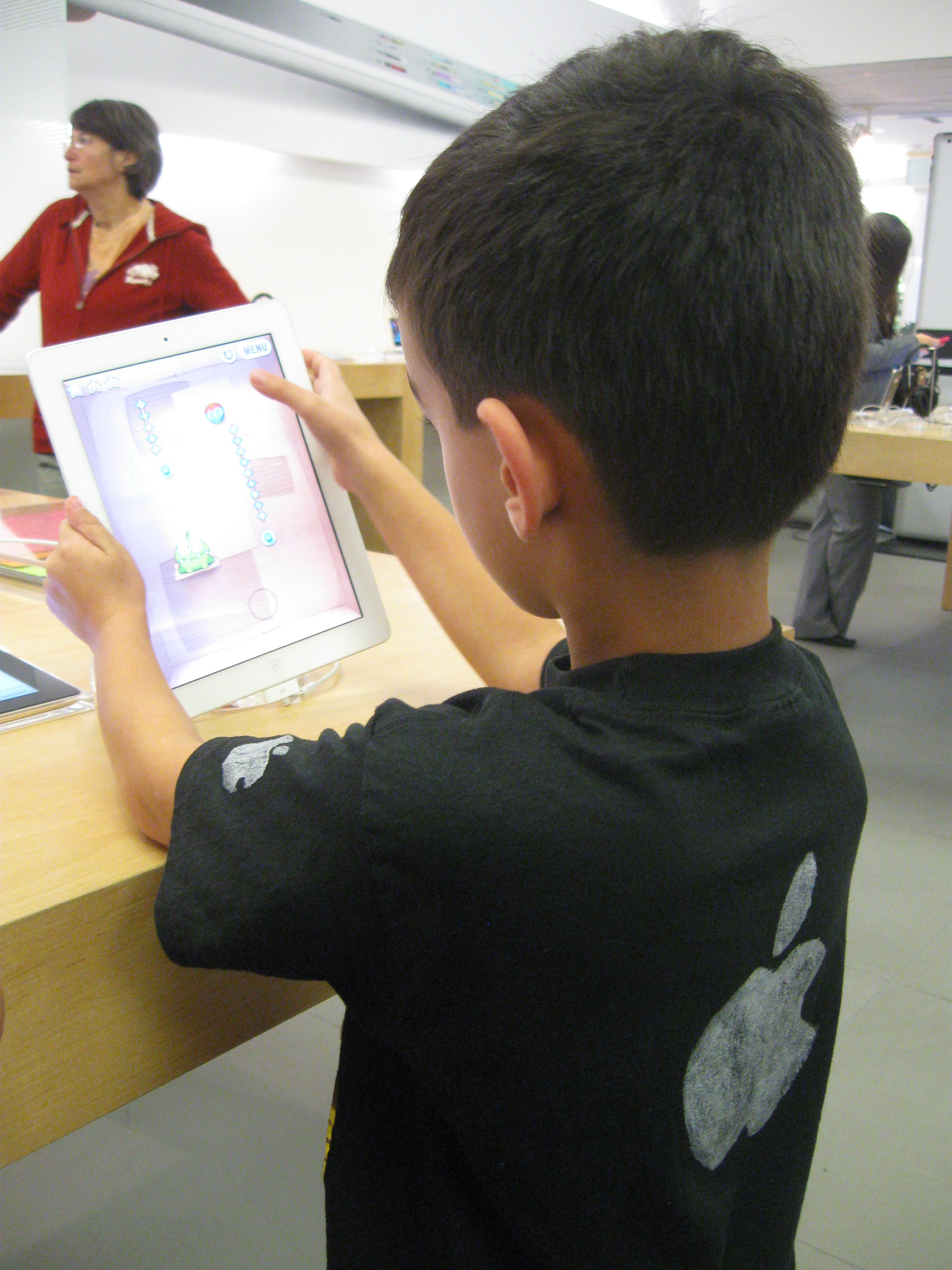
I love everyone who took the time while we were talking to him to call our house or send an email or write a note on Twitter or Facebook. I’m going to gauge his mood in the morning and then read them to him when it feels like the right time. I asked him what I could do to help him with this, and he asked me to take him to the Apple store tomorrow — his holy space. And I told him that I thought it not only was a great idea, possibly more healing than a funeral, but it probably would have made Steve Jobs happy to know that we are going there and enjoying his inventions, keeping his ideas alive.
So that’s where you’ll find us until he’s ready to come home.
* To read the backstory about the Wolvog and Steve Jobs, it is here and here.
October 5, 2011 64 Comments
Shiny Happy Bloggers
I read this great post last week due to BlogHer that ties together a plethora of topics: Trey Pennington’s suicide, everyone has emotional pain at some point in their life, what we post and what we don’t post, and most importantly, this impulse we have to be a shiny, happy blogger.
I think we all implicitly understand that what we see on a blog isn’t the whole story. We are seeing a sliver of someone’s life. Sometimes, it is the most important sliver, the emotional cloud that is threatening to rain out all else or the amusing moment that defines the whole day. Other times, we eschew the most important parts of our emotional landscape in order to present the picture we wish to present: look at me, I’m a shiny, happy blogger.
I have the perfect house, and we eat three balanced nutritional meals each day. I have a dog who’s just a little rascal. I have the perfect husband who stands still for all of my photographs. Have you seen my fourteen children, all cherubic and unnaturally clean? Have you seen how I change all the decorations in my house to match the time of year? Have you seen how all my furniture matches and there is no clutter at all and my friends stop by my house each night for creative cocktails and tapas? Do you see us laughing in all these pictures? Well, do you? DO YOU?
It’s obviously not just blogs. Some people have a Facebook feed that reads like a storybook. They’re just so grateful for their great friends and their great family and their great big Christmas tree and their great vacation and their great great greatness. Nothing ever mars their feed. The kids never act up, no fights with the husband, dog never dies.
There are times when we edit the story because it’s not our story to tell. Airing your marriage gripes doesn’t just affect you — it affects your partner too. Talking about your child’s foibles can hurt them down the road whereas talking about that cute thing they said probably won’t. But other times, we edit either because it’s the image we want to present to the world or we edit because it’s the message we’ve gotten from society.
I recently posted something that bothered me and why it bothered me. Scattered amongst the people saying, “that bothered me too” or “funny, that didn’t bother me at all when I saw the same thing” were the people who wrote, “I find it absolutely pointless of every single one of you to sit here and wallow in self pity. How juvenile.”
I’m not the only person who has gotten a crappy comment telling them that they need to stop whining. The Lotus Pad’s post starts out with a similar situation — she wrote about a physical ailment, one that frankly sounds scary and upsetting, and someone told her that, “I sounded like a hypochondriac and why was I ‘complaining’ so much in public, going so far as saying ‘all I had were headaches anyway’.” She writes about how being told to shut-up after writing about her situation upon leaving the hospital affected how she wrote about future issues as well.
No one wants to be the complainer. We don’t want to be the complainer so much that we swallow expressing our feelings in order to save ourselves from being labeled the complainer. I’ve seen people mourning the death of their child apologize to readers that they’re still writing about their loss. Since when does moving through the mourning process warrant giving an apology? I want to tell those people rip your clothes, tear out your hair, cry your eyes out, and do what you need to do to get through this even if it’s just writing an “I miss her” blog post every single day for a year. For five years. For twenty years.
Writing your way through your emotions is more important than pleasing a reader. Because at the end of the day, you shouldn’t care what I think. You shouldn’t be catering to me — you should be catering to you and what you need to say because YOUR blog is YOUR space.
I’m not entirely sure what the purpose is of the Internet Shut-up*. I mean, it is so much easier to click away than to stay and leave a comment. You have to wonder about the people who would rather use up five minutes of their time telling you that you’re a whiner than using five seconds of their time to stop reading and click away.
The Lotus Pad asks a question that has been asked around the blogosphere a lot in these last few weeks after Pennington’s death: “How could someone with 111,301 followers not find the words to ask for help?” I think part of that contains an assumption that we’d want our help to come from the online world. I think different people use their various social media accounts for various reasons, and perhaps for Pennington, that social media world was never going to be the world he turned to for help. It also contains an assumption that he could ask for help, that it was within his control. My understanding of depression is that there is a lack of control. The same tasks a well person might do to get help is out of the capabilities of someone mentally ill.
And while we know intuitively that having no one to talk to and no one to listen is lonely, it is also possible to feel alienated surrounded by 111,301 followers. Having your blog read or your Twitter feed followed doesn’t make you immune to the very same emotions felt by those who do not have their blog read or their Twitter feed followed.
That said, I think there is a third point buried in there, one that needs to be examined thoroughly: if humans are going around, giving people an Internet Shut-up, can they understand the role they play when people stop talking? Can they understand how enormous that is to take away the comfort one feels in expressing themselves? That they’re asking people to rethink the worthiness of their feelings — telling them that some people’s feelings are more okay than other people’s feelings.
Have you received an Internet Shut-up? How did it affect you sharing your thoughts in the future on another topic? Did it spill over into how you comport yourself in the face-to-face world?
* I’m defining the Internet Shut-up as that comment that is solely written to point out that you have no right to feel whatever you are feeling. The one that tells you to stop writing about whatever you are writing about; not because what you are saying is particularly offensive, but because the reader wants you to know that they are bored/think you should move on/you have nothing to complain about.
October 5, 2011 25 Comments
50/50 and the Smother Mother
This past weekend, Josh and I went to see Moneyball AND 50/50 on the same day. Just to clarify my nerdiness, we bought the tickets to both shows at the same time, and I made a big deal of exiting the theater by one step, pivoting, and walking back in again so the ticket taker could tear our next tickets. The only other time we saw two shows in one day was when we left Shrek 2 so incredibly pissed that we had wasted our time with the movie that we went in to see Mean Girls, which was fantastic… in comparison. Perhaps if we had seen Mean Girls first, we would have left and seen Shrek 2 in anger.
I loved the writing in 50/50,* loved it to the point where I will probably buy the movie when it comes out on DVD**. It was the sort of film where you wished you were watching it with the script in hand so you could highlight all of your favourite lines. I guess that is what I look for the most in a movie or in a song — not the visuals or the sound, but the way the words form together. What is said.
It’s a comedy… about cancer… based on the experience that writer Will Reiser had when he was diagnosed with spinal cancer. Joseph Gordon-Levitt plays a version of Will (now called Adam Lerner) and Seth Rogen — who is Will Reiser’s real life friend — plays a semi-fictional version of himself. Somehow the movie works, pointing out the absurd in the same way that… let’s say… A Little Pregnant points out the absurdity in infertility. Infertility and cancer are not funny, but in the hands of a gifted writer, we can have the release that comes from laughing while you’re crying.
The relationship that resonated the most with me is the one between Anjelica Huston (his mother) and the main character, Adam. At one point, she turns to his therapist and says something along the lines of “I smothered him because I love him.” It was one of those uncomfortable, gulp-worthy moments because… I am a smother mother.
It’s not something I particularly want to be nor is it something I don’t want to be, but I also don’t know how to control it AND remain true to myself. I am an effusive person without infertility and pregnancy loss nudging me in the direction of extreme gratitude. I am the type of person who tells Josh and the twins daily that I love them, and I don’t say it as a thoughtless toss-off ending to a conversation. I mean that I tell them each in a mindful way every single day that I love them. I think it’s one of my best traits — though it’s obviously an offshoot of my extreme anxiety, the one that brings to mind 1,000 terrible what ifs daily. My “I love yous” in that sense are practically a vitamin. I tell the person as well as the universe how much I love them in the hopes that it somehow protects them — protects both of us. But it’s also that I never want people around me to wonder: if I love you, I’ll tell you. I’ll hopefully also show it through my actions, but I like things spelled out for me, so I spell them out for others by telling them in no uncertain terms that I love them.
I don’t think I’m a helicopter parent because I’m quite willing to let my kids make mistakes and learn from them. I’m not the type of person who is going to swoop in and fix things, though I’m happy to coach from the sidelines. Sometimes that coaching is to put on their big girl or big boy underroos and speak up for themselves. But still, I smother — and I know I smother — because that is who I am by my very nature. I am a please-don’t-let-me-go sort of person. I have already spent nights crying thinking about them leaving one day for college and they are only in first grade. If Josh didn’t ground me, I could see myself moving to wherever they go to college, and yes, I already have made myself sick thinking of the idea that they could go to two vastly different areas.
The thing is, I live my life without regrets. That is, I try to live my life without regrets because it is the only way I feel comfortable. We have run up against a lot of other people’s desires for our children, and my life is a series of weighing them against my what ifs and making informed decisions. We chose their school, their camp, their synagogue, their extracurricular activities all under this umbrella of where we can predict the least amount of possible negative outcomes. Because it’s life and accidents happen, but if we’re already worried about car crashes, let’s say, with a particular person, I would have more regrets if I squelched my what ifs and put the twins in that car than if that very same crash occurred with another driver. It’s about living with myself, about respecting my own intuition. And yes, my intuition is sometimes wrong. But it’s also sometimes right. And the only way I can live without regrets is to follow that intuition. Accept the consequences of following that intuition, knowing full well that it pisses off people along the way, but also knowing that anyone who really has my back also accepts my irrational what ifs; my strongly honed intuition.
Which all comes down to this fact: I am the opposite of a free-range parent (or, rather, I’m a free-range parent only within the confines of my intuition, which is based on past experience, gut reactions, reading between the lines, and interpreting behaviour). I smother. And I do so out of love. Out of this intense love — the sort that builds when you think the person is never going to arrive. But seeing Adam’s reaction to his mother’s behaviour on the screen made me gulp, made me squirm in my seat. And it also made me ask myself where do I go from here: how do I deny this side of me which is such a deep part of my personality? Which has a good side even though it has an annoying side as well? How do I stay on the correct side of the smothering line? Where it’s just enough and not too much?
At the end of the day, I don’t think there is a right way to parent. I think there is only a right way to parent your particular children. I am wary of parenting experts who tell you what you should or shouldn’t do because they are making those statements in a bubble, without knowing your circumstances or how your children react to your parenting techniques.
Therefore, I don’t think being a smother parent is solely a negative thing just as I don’t think that being a free-range parent is a positive thing. I think there are a lot of crappy free-range parents and a lot of fantastic smothering parents. I think there are people who use and who abuse attachment parenting, the family bed, baby-wearing and every other thing we have felt the need to slap a name on in the past decade. The only thing I am against is people being a proponent of a particular parenting technique whether it’s bottle feeding or breastfeeding; Ferberizing or no-cry sleep training and saying it’s the right way, the best way. Because it may be for one child, but it certainly can’t be for all children.
I gulped not because I think it’s a terrible thing to smother your child; but because I never want the twins to feel like it’s a chore to be with me. I want them to grow up, and by default, that also means that they must grow away. But I hope that I get to enjoy with them a relationship much as I have with my mother, which is one part friendship and one part mentor and one part I-will-always-be-your-mommy. And yes, she always has told me that she loves me, made sure she looked into my eyes and kissed my head. I know how that has made me feel over the years. And I only want that for my children too, staying on just this side of the smother line. Of not stepping over into Anjelica Huston’s character’s land.
Maybe that’s why I get uncomfortable when people tell me that I’m a good parent: because there is that smother line and I could always step over it. Because I don’t necessarily see myself as a good parent but more as a work-in-progress. By which I mean that I think I do a pretty good job as a working parent in the same way that I do a pretty good job as a working writer, and I’m basing that on the feedback I get from others as well as how I feel about myself at the end of the day. But I don’t think of myself as the best parent in the world any more than I think of myself as one of the literary greats. I just try to raise the kids to be mindful, kindhearted individuals, and I try to write books that transport you for a while away from your day (or maybe give you insight into something you’re trying to process in your life). And that’s pretty much all I need to feel like I’m coming out ahead.
* I also loved Moneyball and recommend it, but I found the ending so profoundly sad. There were the feel good moments — for instance, I bawled when Hatteberg hit his homerun — but the ending left me feeling so empty for Billy Beane. This was perhaps not the feeling you were meant to leave the theater with since no one else seemed to be vacantly processing the way Billy Beane saw his life. So maybe that was just me.
** Will Reiser, on the off-change that you’re reading this because you happened upon it in this day-and-age of Google alerts; I truly thought that it was some of the best writing I’ve heard/read in a long time, and I don’t use that compliment lightly.
October 3, 2011 17 Comments
Internet Atonement
There are ten days between Rosh Hashanah (the Jewish New Year) and Yom Kippur (a holiday of atonement) that Jews are supposed to use to reflect on the past year. They are supposed to think about promises they made that they didn’t keep, as well as ways they’d like to do things better in the upcoming year. One of the names for these ten days is Ya’meem Noraim, which literally translates into Days of Awe.
Nora (pronounced NO-rah) means awful or terrible, which is a word you have to step back from a bit in order to see. It is a term that evokes disbelief — awful; full of awe — at the enormity of the situation, as if you can’t quite take it in. Things that are awful fill you with an overwhelming mixture of fear and reverence. Terrible is another word that you have to step back to see. The “ible” suffix means “capable of.” Something terrible is capable of evoking terror. Perhaps because it is so important to you.
The term fits in this case — nora is the perfect word: ten days full of awe — because it’s an introspective period of time when you are supposed to reflect on what you’ve done as well as what you plan to do if given another year to live. Many people use it as a time to apologize to people they may have hurt in the past year, either knowingly or unknowingly.
I’ve written about this before, but every year, before Al Cheit prayer during the Kol Nidre service, my rabbi recites his own personalized apology to the congregation. As I’ve said in the past:
It is a way to reach out to those that you inadvertently hurt during the year but didn’t tell you. If a person tells me that something I wrote or said hurt her, I can address that apology directly. But I am sure I have scratched someone emotionally and have had no clue that my words or actions have done damage.
So, once again, I offer this apology to you, repentance in the Internet age, where our actions or non-actions online may affect someone just as much as the things we do in our face-to-face world.
- For the times it took me an enormous amount of time to return an email, and for the times when I didn’t return the email at all because so much time had passed that I was embarrassed to admit I was just getting to it now.
- For the times I missed a blog post that you took a lot of time to write.
- For the times when I didn’t comment, even knowing how much writers like feedback on their words.
- For the times when I missed your Facebook status and had no idea something enormous was happening in your life.
- Equally, for the times I missed your Tweet and had no idea what you were going through.
- For the times when you learned something through my blog or a social media site, but you’re close enough to me that you should have been told directly.
- For the times that you commented on my blog, and I didn’t comment on yours.
- For the times that I wrote posts that offended you or were just plain boring or too fucking long.
- For the times that I cursed if cursing offends you.
Part of an apology is this unspoken promise that in pointing out your foibles that it won’t happen again. And yet, as I make these apologies, I know that all these things will happen again. I will curse because I sometimes curse, and I will write things that will offend you this year because I have no idea that my words are offending someone until they are doing their damage. I will not be able to return every comment, I will miss the vast majority of tweets and status updates because I don’t spend enough time on those social media sites to catch all the words. I will continue to read blogs on a mobile device that makes it difficult to comment, and I will sometimes miss blog posts entirely when I have to skim to keep up. There will be times that it still takes me a week to write you back.
Which I hope doesn’t make this apology empty. I’ve realized by this point in life that apologizing for my foibles doesn’t make the foibles go away. I am pointing out these things more as an acknowledgment to your possible experience with me. I own that it happened, and I own my part in how I made you feel. Hopefully, the good interactions help balance out the times when you want to slap me through the screen.
We need to own what we do online just as much as we need to own what we do in our face-to-face world; all actions have the potential to help or hurt whether they take place in virtual or actual space.
For these times and for the times I didn’t know enough to include, pardon me and forgive me.
October 2, 2011 10 Comments