

The Chapter on the Pain Olympics from the ALI Community History Book
Too Many Fish to Fry had a post about the Pain Olympics this week, asking more the why-we-do-it question. So go over there for that discussion (and don’t forget to read the comment section). What I want to talk about here is the history of the Pain Olympics and the waves the ALI community goes through. But a tangent for a moment. Does anyone remember when I coined the term ALI community? It was 2008, and it was embarrassingly with this post. Did we know that post would lead to a sticking term? I don’t know… sometimes looking at the history of things is amusing.
The first time I heard the term Pain Olympics in regards to infertility was in 2004 on Tertia’s blog. She was responding to Laughter and Forgetting’s post about Pain Points. She summed up the feeling that was fairly common in the community in that moment: “And yet. I do feel as if there should be some acknowledgement of the pain of a ‘lifer’ on Infertility Row.” I think back then, in 2004, it was more common for people to respond to this sort of post by offering comfort or verbally diminishing their own pain in the face of someone else’s, even if they also hinted that the Pain Olympics weren’t helpful.
Adding up your Pain Points (which as bloggers and commenters stated were obviously ascribed in the eyes of the beholder; not everyone would agree with the numeric value assigned to certain procedures or paths to parenthood) gave you a sense of place. It wasn’t that you weren’t accepted in the community; it really never occurred to me that it was an acceptance thing or a non-acceptance thing. It wasn’t a you-can-give-advice-or-comfort thing or not (until it came out that way later… more on that in a moment). It just… was.
But you can see from the comment section that we weren’t always anti-Pain Olympics even if there were always people who didn’t embrace the idea. When the idea was proposed in 2004, it was hailed as a great explanation by some and rejected by others. But it was more of a discussion, politely held, with support given and inclusivity kept for the most part.
In fact, Laughter and Forgetting’s original Pain Points post was about how we couldn’t quantify emotional pain. She made the Pain Points to point out how bizarre it was to think that we could really have worse and better exist in a vacuum. She pointed out this fact as did others in the comment sections of various posts that appeared around that time jumping off of L & F’s post: there were too many non-definable factors that go into how you process your IF including your emotional reserves, your support system, the state of your partnership (if you had one), your financial situation, your culture or religion… the list is endless.
The discussion about the Pain Olympics bubbled up from time to time, and then in 2007, there was the Redbook Infertility Diaries brouhaha. Readers were up in arms that the two IF bloggers were both parenting. To say that people reacted explosively is an understatement. It was a little disturbing to see the ire vented at the bloggers, and This Sorta Fairytale said it best when she wrote, “instead of directing anger at the editors who did not bother to consider the feelings of their readers or their bloggers, we have once again directed it at one of our own who is doubtless still dealing with the emotional toll infertility takes.”
On one hand, diversity is just common sense and gives a panoramic view of a situation (of course, with only two slots, it was never going to be all-encompassing). And on the other, I think it’s a branch off the Pain Olympic tree — this idea that some were worthy to discuss infertility and some were not. Julia’s history was known, her Pain Points high, her pregnancy currently happening. Lili’s history was not known, and she was pounced on. It was a really divisive and upsetting moment in the ALI blogosphere since it was directed at individuals, and the fallout went on for a while. Later on, Redbook had a string of bloggers write about their infertility, always reaching a stopping point and then starting with a new person. But that came after people had trotted out what amounted to the Pain Olympics, wondering who was worthy to talk about infertility, who was not.
One of the interesting things about blogging for so long is that you process all new posts against old posts. You see ideas go in and out of vogue. At some point, the wave turned and now those who supported the Pain Olympics were in the minority and those who were against the idea were in the majority. I don’t think you’ll find many posts outright supporting the concept of the Pain Olympics now. We are more likely to sit on one of the branches than hug the main trunk.
I’ve always been against the idea of the Pain Olympics — back in 2004 and still now — but I come at it as someone who has spent many years teaching Voltaire’s Candide, which covers this topic thoroughly. I’ve always proposed the idea of the Pain Campfire, where we all sit around it sharing our stories and listening to one another rather than racing each other as if it’s a competition. But I’m also a kumbaya-singing wimp like that.
The community changes constantly, and that is mostly due to the fact that the people in the community change over time, bringing in new ideas or renewing old ones. The culture of the community changes; at times anger is directed inward at other infertile men and women, and at other times, we bond together and fight against something outside the community. I guess I always wonder about these waves — why the community explodes from time to time, and how we bring the same ideas back (what determines the interval?).
Sometimes I think about writing up a history of the ALI community as I know it, recording all the explosions and times of peace, the blogs that were here, the writers who have morphed or disappeared entirely. Just so we have that context. Even though it’s usually fairly uncomfortable to reflect on those bad times — even the ones you just observed from the sidelines — as much as it’s sad to sometimes scroll back through a comment section and notice all the names of people you know have moved on from the blogosphere.
February 5, 2013 26 Comments
Imagining the Future (A Verbal Time Capsule)
I’m reading a book right now, The Age of Miracles by Karen Thompson Walker. It’s apocalypse fiction, chilling in how real it feels. The description from the back of the book:
On an ordinary Saturday, Julia awakes to discover that something has happened to the rotation of the earth. The days and nights are growing longer and longer; gravity is affected; the birds, the tides, human behaviour, and cosmic rhythms are thrown into disarray.
The world in the book feels exactly like our own. When the news breaks, people remain indoors all day watching the news on a continual loop (which, of course, consists of chewing over the same tiny bit of regurgitated information followed by pontification by experts). The story started to feel so real that as we watched the Super Bowl on Sunday night, I wondered what the stretching of time was doing to the game clock. And then remembered that the Slowing has occurred; that it’s only fiction.
There are a few times in the book when she mentions how all the predictions we made in the past about our current life are now off because we never accounted for this catastrophe and its far-reaching effects. As I made dinner, I tried to imagine what life would be like 20 years from now. I picked 20 years because I can clearly see the differences between today and what life was like at the start of college. While we had a low-tech form of email — hardly a medium you wanted to use for quick conversation since most people only checked it from time to time — there was no social media. Cell phones weren’t commonplace; if you wanted to find someone, you walked to all the likely places they might be. We were worried about HIV. A high-tech portable music player could carry 90 minutes of music. We flew with little security. Books were only read on paper. We got out news from newspapers or television. Back in that time period, standing there with my paper books and Walkman, I couldn’t imagine a world where I would walk around with this tiny computer in my pocket capable of not only making phone calls but holding dozens of books and movies and music and surfing the Web and receiving emails. I’m sure other people could fathom this in 1993; but I couldn’t.
Therefore, I found it difficult to stretch my imagination and predict what life would be like on earth 20 years from now without falling into science fiction cliches. I pictured the landscape dotted with biosphere-like buildings containing crops. I thought about the creation of organs from cells that could be used for transplant (could this ever be possible?). Hovercraft-like mobiles used not for actual travel but for playing around on over grass; the next stage of the toy car. And then my imagination fizzled out.
It is so much easier at times to picture my personal future; what I wish will be my personal future. The people I hope will still be in my life 20 years from now. But the world itself, our surroundings, how we’re living and where we’re living — all of that is fuzzy, like a snapshot taken at a high speed where you can clearly see there is a subject even if the details are blurred by movement.
What do you think life will be like 20 years from now? Name one thing that will be commonplace in 20 years, and I will repost this again in 20 years so we can see how closely we guessed.
*******
Beyond that, let’s create a verbal time capsule. Describe what is important right now in our current age; what you’d want people 20 years from now to remember about this time. It could be personal in nature or reflect greater society. It could be something tangible (an iPhone) or intangible (we still haven’t had a female president).
A verbal time capsule, created solely out of words, to explain to people 20 years down the road how different their life is from what we’re living today. Simultaneously imagining what we’ll be living with 20 years from now.
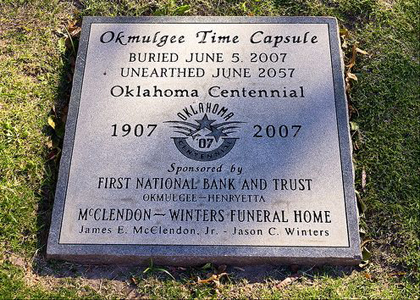
Photo Credit: Doug_Wertman.
February 5, 2013 8 Comments
Does Social Media Make Being Social Too Easy?

Before Christmas, an old friend died. A bunch of people from childhood as well as his new friends from adulthood all gathered on Facebook to share memories, and I ended up connecting with people I haven’t spoken to since we were teenagers. I was so excited to be back in touch, and they said they were so excited to be back in touch. And then… crickets.
[I don’t mean actual crickets, since those would make me shriek in horror. I just mean social media silence. Which is similar to radio silence but comes from your computer instead of a radio. A radio? What’s that again?]
At first I was bitter about it. My long heartfelt emails went without a reply even though these people were clearly online and still posting on Facebook. Why the hell had they said they were happy to be back in touch if being back in touch was meaningless? I didn’t need us to all sit down to a cup of coffee and have a big love fest, but I expected something beyond the initial “I’m so happy to connect with you again!” email.
And then, in discussing this with a friend, it occurred to me that while I wanted to reconnect for keeps, that maybe I was the anomaly in expecting the connection to continue beyond that initial moment where we come together, comfort each other, and part. After all, we’ve all been through an emotional upheaval. Maybe just seeing each other’s names and stating our collective “I remember you!” was enough to get them through whatever mortality anxiety comes when someone dies. And maybe I was just still in the moment of needing more connection, and it would fade for me too after another day or so.
But our discussion raised the point: what if those moments were real? What if it wasn’t a rote recitation of what we’re supposed to say, but that people just aren’t hard wired for anything more than brief connection and flitting away?
Are humans just doomed by our short attention spans?
Which raises an interesting question: is social media an enabler, playing to our human instincts that we used to have to fight in order to have a social life. We used to need to put in a lot of work to have a circle of friends. We needed to call them. (Remember that? Telephones that called people instead of ones that send texts and emails?) We needed to make plans to see them. If we didn’t do these things, we felt disconnected from society.
But now one doesn’t have to do anything more than send out and read a few 140 character messages to connect with other human beings. And we have connected; that connection is real. But it is also sometimes a replacement for the much harder work of talking on the phone and making arrangements to meet for lunch. I get nervous going to parties; I never feel nervous going on Twitter. Why would I ever opt for the more emotionally difficult act of talking to strangers face-to-face when I can chat with them online while in my sweatpants?
It’s a question I asked myself recently when I went on a friend date. A mutual friend connected me with a woman who moved to my town, and I was grumbling a bit internally as I walked up to her house, thinking about how shy I am and how stressful this is for me to hang out with people. And then I met this amazing woman who is fun and smart and our kids meshed well and I could tell our husbands would mesh well. And suddenly I remembered why social media alone isn’t enough. That it can’t really replace that much-harder-to-get-but-equally-necessary connection of plopping down with someone face-to-face and talking about the minutiae of the day.
I am the type of person who thrives with social media, and I’d never wish it away or set it aside in a digital sabbatical to make a point. If I’m not online it’s because I can’t get online. It has connected me with people I would have never met otherwise, people that make my day easier, who give me advice, who support me, who make me feel less alone in this enormous world. I cannot thank social media enough. But I also can’t allow it to be an enabler, stopping me from pushing myself to do the hard work of being social. Of getting out there and meeting people face-to-face and losing myself in a phone conversation for hours while the dishes go unwashed. Just because I could technically do all of my socializing via social media doesn’t mean that I should.
And I need to stop thinking that the online world should mimic the face-to-face world. They are both governed by their own rules and regulations. Quick, intense connections that get us through a difficult moment are maybe perfectly at home online and I shouldn’t judge them by offline standards. In the same way that a long phone conversation is perfectly normal offline, but an email that takes you an hour to read is overkill.
Social media and the offline world truly are apples and oranges in the sense that they are both fruits on the communication tree. But one — social media — comes with a skin that is easy to bite into and can grow in many more climates. And the other — face-to-face communication — comes with a peel that needs to be removed to get to the fruit. Not an insurmountable obstacle, but one that makes me reach for the apple 9 times out of 10 when given the two fruit options.
What I need to remember is that fruit salad is always more satisfying, even if it amounts to more work. And that while an apple a day may keep the doctor away, a diet of only apple slices will give you scurvy. Or some analogy like that.
What do you think? Do you also use social media more than offline communication because it’s emotionally easier? Do you think we’re hardwired to crave the quick connection vs. want to put in the long, continuous effort in maintaining a relationship?
Photo Credit: The Busy Brain via Flickr.
February 4, 2013 16 Comments
A Zipper of a Life
The Road Less Travelled has a post about the unlived life, bouncing off a new book from Adam Phillips called Missing Out: In Praise of the Unlived Life. I’m not sure whether my unlived lives are worthy of praise, and while I’m cognizant of those other lives, I’m not sure I crave them even if I crave aspects of them. So I’m not sure how much embracing the fact that they aren’t lived out possibilities will reduce frustration at life as is. Or maybe I just don’t emotionally fall into the group of people that Phillips is discussing since my mind is more on the future than the past?
Because don’t we focus on both? There are the roads diverging in the future — that idea that we’re constantly standing at a crossroads and making a choice that leads this way or that — as well as all the diverging roads behind us. So life looks more like one of those two-way zippers, with the threads pulling apart at the top and the bottom, connected in the middle, where you are right now.

Infertility is about living in the future. Any time you’re working toward something, you’re not really frustrated with roads not taken insomuch as you’re frustrated by the idea of roads you can’t get on yet. And loss is about living in the past, thinking about all the what ifs, the tiny things you didn’t do that maybe would have made a difference even if you know that it probably would not. And when you mix infertility with loss together… how does your zipper heart know which direction to go?
And then there are the roads not taken that I don’t even remember not taking (or even deeper than that, the ones I wasn’t even aware existed). Sometimes I’ll read an old journal entry and suddenly remember a decision I made that I’ve forgotten about. Do all of those choices subconsciously stay with us? Is our heart just a clutter of all the rejected choices like deleted emails in the trash folder before it gets emptied? Except it never gets emptied? Do all those unlived lives have the same weight when it comes to current decision making, or do the lived choices carry more power than the unlived ones (or vice versa)?
It’s a lot to chew on, thinking about past unlived lives or future ones we hope to live.
Where is your mind — traveling more to the past unlived lives or the future not-yet-lived lives? Which has a stronger pull on how you feel about your current life — the past or the future?
Photo Credit: Lululemon
February 3, 2013 14 Comments
429th Friday Blog Roundup
We almost never watch a new television show from the beginning. There are few series (maybe one?) that we’ve given a chance until it has been on the air for a few seasons. Part of it is quality: we want to make sure a show has sticking power before we invest our energy in it. The other thing is that we seem to rarely hear about a show until it hits its eighth season. But we heard about The Americans before it aired and decided to watch the first episode. We were interested enough in the FX show to endure the last 20 minutes of a Tom Cruise/Cameron Diaz film beforehand.
The Americans didn’t disappoint. I’m not a fan of seeing violence, but I immediately liked the characters and the plot device. It’s set in DC in 1981. It unfortunately looks NOTHING like the DC area in 1981. But even with that distraction, we really enjoyed it. Enough so that I put an alert on my calendar to remind me to watch FX on Wednesday nights.
But.
I really need to discuss this one part of the premise, and since this isn’t a spoiler, I’ll throw it out there. The idea is that the man and woman are KGB agents that have been taught to sound and move like Americans. They came to America in 1965, pretending to be husband and wife, and built a life here, always working for the KGB. It’s now 1981. They live in suburbia. They have two kids. They’re spies.
The man would like to defect from Russia; leave behind his life as a KGB agent, make a deal with the CIA, and go into hiding. The woman would never desert Russia and points out the flaw in the man’s plan: what would they tell the kids? The kids have no idea their parents are Russian much less part of the KGB. They have a whole fictional backstory they’ve been fed about their parent’s American upbringing. To defect and go on the run would mean telling them that their parents aren’t really in love, aren’t really Americans, and that the kids are just props in their parents’ charade.
Except won’t that be the case when the kids are older? At some point, isn’t the woman going to retire from the KGB and go back to mother Russia? While she could orchestrate a disappearance in her old age, is having your mother mysteriously disappear that much easier on the psyche than finding out she’s a KGB agent? Really, how does one handle dealing with the props when the props grow up?
Isn’t this an interesting idea?
*******
 A massive thank you again to everyone who has supported me with the release of “Nidah,” my first short story this week. The people who have read it, first and foremost, plus everyone who has emailed or cheered me on. The people who have Tweeted and Facebooked and Pinned and Stumbled and blogged and talked to friends about it.
As I said yesterday, I take that support also as a sign of trust, and I don’t take that trust lightly. I never want to dishonour it, and I want you to know how much I’m touched by it.
*******
And now the blogs…
But first, second helpings of the posts that appeared in the open comment thread last week. In order to read the description before clicking over, please return to the open thread:
- “A Sense of Urgency” (Genuine Greavu)
- “Refuges in Rural Sweden” (Antropóloga)
- “In Child Loss, There is No ‘Fake It Until You Make It’” (Still Standing Magazine)
- “Trials and Trails” (The Misadventures of MissOhkay)
- “Henry’s Birth Story” (For We Are Bound By Symmetry)
- “Is the Unlived Life Worth Examining” (La Belette Rouge)
- “So Much Less that I Will” (I Can’t Whistle)
- “A Sales Pitch to Our Day 3 Embryos” (It Only Takes One)
- “The Weight of Today” (Family Building with a Twist)
- “Obligation to Give Back?” (A Glimpse Inside)
- “These Two Lands” (A Thousand Oceans)
- “Honing Empathy” (Searching for Our Silver Lining)
- “Living Childless” (The Quest for the Golden Egg)
- “In Which I Contemplate Pregnancy After Loss” (Dear Finley)
- “The Bracelet – the One She Never Got to Meet” (We Say IVF They Say FIV)
- “Probabilities” (An Expat’s Journal)
- “Thoughtful Thursday: Really Really” (Baby Smiling in Back Seat)
- “The Room” (Hapa Hopes)
Okay, now my choices this week.
The Maybe Baby (Babies) has a post about how much telling other people about your child’s origins matter. She’s not talking about close friends and family; she’s talking about the strangers you encounter for brief intervals of time on life’s path. She’s talking about the person you get into a chat with at a conference or the salesperson at the store. What do you owe them insofar as the whole story? There is also an interesting discussion going on in the comment section so be sure to read both.
Inconceivable! has a post about the people who you think will step up and support, and the people who actually do. It’s not always the people you expect. It’s about our expectation of reactions, using The Queen as a jumping board to discussing the ideas people bring to how they think others should reaction. Great post.
Waiting For Little Feet has a post about the reality of parenting a newborn vs. what she imagined before she found herself in that situation. Going to give you a hint: it isn’t all cooing and sleepy snuggles. I love her unpacking of the concept of “supposed to” and the additional pressure it places on an already overwhelming situation. It’s an important read, especially because it’s difficult to sometimes find the truth so you can enter a situation with your eyes wide open.
Lastly, The Great Big IF has a very funny (and true) post about discussing babymaking with kids conceived via IVF. You’ll need to pop over to read more.
The roundup to the Roundup: Did anyone else watch The Americans? What do you think of the idea of breaking the news to the kids? Thank you to everyone who gave me support this week with the short story, “Nidah.” And lots of great posts to read. So what did you find this week? Please use a permalink to the blog post (written between January 25th and February 1st) and not the blog’s main url. Not understanding why I’m asking you what you found this week? Read the original open thread post here.
February 1, 2013 14 Comments