

Kittens are What Has Been Missing from Your Infertility Explanation
I know that if you are like me, you encounter people from time to time who don’t really understand infertility. They’ve gotten their information from the mainstream media, or they only know about it through an unrealistic storyline on their favourite soap opera. So they make unhelpful suggestions or say hurtful things, and then you are in a position where you need to educate them on the basics of your reproductive situation. You forward them a link to a helpful website, or you point them towards an article.
What has been missing from your explanation of infertility — up until this point — is kittens.
33 of them.
Mostly — judging by size — a few weeks old. Baby cats. To explain why you can’t have a baby. A compendium of borrowed feline babies to tell the story of your malfunctioning uterus.
I can haz IVF?
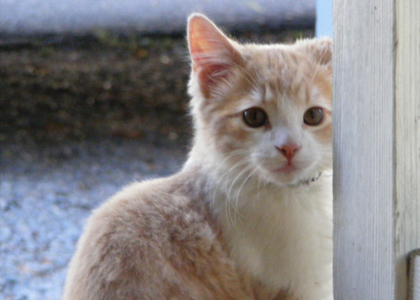
Image: Nick Perla via Flickr
Sarcasm aside, I don’t really know how to process Buzzfeed’s “Infertility Explained By 33 Impossibly Adorable Cats.” Someone just sent it to me, and I started reading it with my head cocked to the side, as if looking at the screen askew would somehow bring the message into focus. But… and I can’t believe I’m writing this… my breath caught when I got to #17. And #18. And there were moments where I stopped thinking about how someone was describing something devastating with cats (what’s next? Cancer explained with pony pictures? Malaysia Airlines Flight 370 understood through puppies?) and started reading it as simply an explanation of something devastating.
And then I just felt very quiet.
Your thoughts?
March 25, 2014 31 Comments
Clickable Friendships
I’ve been bothered by one part of the heartwarming story of the child who didn’t want a birthday party because he said he had no friends and discovered — according to People magazine — that he actually had 2 million. (“No Friends for Lonely Fifth-Grader? Turns Out He Has 2 Million.“) I know — a very opportune story in light of all my recent party posts.
His mother brought Colin’s plight online, and people left encouraging words and sentiments of friendship on an online Facebook page. Over 2 million people have “liked” the page, and the boy is overwhelmed by all the good cheers.
And that is lovely. That is a good thing. That is the sort of story that makes you smile.
But those aren’t friends.
Friendship is more than hitting a “like” button — and that is true when it comes to high school students playing online with their face-to-face friends and it’s true when it comes to a little boy like Colin. People can say friendly things on a Facebook wall, but that does not make those people friends. Nor does Colin ever get a chance to practice being a good friend to other people. Friendship flows in two directions.
I fear that every day we are moving deeper into believing that hitting “like” really connotes friendship. That Facebook calling a connection “friends” makes two people connecting actually friends. But when you step back from the moment and let the likes die down, Colin is still where he started except perhaps with the knowledge of support in his back pocket. For a shy, unsure child, maybe having that reassurance would be enough to push that child out of their comfort zone and reaching out to others. But Colin’s problems go beyond low self-esteem. His mother states: “He eats lunch alone in the office every day because no one will let him sit with them, and rather than force someone to be unhappy with his presence, he sits alone.”
There is a lot missing from this story. Why does the school condone this? From the wording in that statement, it sounds as if the school permits the other children to be terrible to this child. I hope the school has put out an effort to help this child learn socialization skills. What does the school’s counselor think of this situation? The mother also doesn’t state what she has done to help her child build and maintain friendships. Does she set up playdates? Are all of her attempts to help her child rejected? Was this the first time the topic of a party has been broached? Yes, we all want to keep returning to those 2 million clicks, but I can’t help but think about all the holes in this story. None of the articles I’ve read seem to want to focus on those holes, pretending that the act of Facebook likes is the Great and Powerful Oz, and pay no attention to that little boy behind the curtain.
Colin didn’t need 2 million people clicking a button. What he needs are a bunch of compassionate adults who happen to have compassionate kids who can give this child a chance. This family needs their son to meet other kids who will accept him as he is, and play with him. They do not need to become best friends, close confidantes that share all their secrets as they skip off into the sunset. But yes, every kid needs people they can turn to on the playground and join in their game. Kids need constant practice at socialization in order to master socialization skills such as team work and listening and compassion and discussion.
This really feels like the social media equivalent of that Jesus parable of “teach a man to fish” except it’s even less helpful. Hitting “like” doesn’t give this kid the fish to have a satisfying meal, and it certainly doesn’t teach him how to reel in the kids on the playground and make a friend.
I sort of wish that there had been fewer likes and more kids, in his town, who stepped forward and said, “let’s have a playdate.” His mother states, “I have seen him in this last month blossom because he knows he has 2.1 million friends and that is something that nobody else has. His self-confidence has grown.” Now that he has that self-confidence, I wish someone would step forward to make a real friendship. Because he hasn’t 2.1 million friends. He doesn’t even have one friend from this if no one connects with him in starting a conversation. What he has is a lot of finger clicks by a lot of people who know this is a problem and have no clue how to solve it. Or they know what actually needs to get done to solve it, but they choose not to step forward and do something beyond clicking “like.”
That inaction is a very real problem for a lot of kids: Colin isn’t the only child who has no friends.
My hope is that the story continues, and we hear about what his school has done to help foster relationships with other kids. That we hear about a local group for kids with special needs that invites Colin to join a structured social group that takes in mind his special needs. For instance, we have a movie-going group in town that is a social group for autistic kids. I’d love to hear that something like that exists in his neck of the woods, and that group invites the family to join them for their next outing. Moreover, I want to hear about local parents who threw a party for Colin, and their kids who stepped forward to say, “what you thought wasn’t actually true.” Because that’s the missing piece of this story. “Likes” from adults (and they must be over Colin’s age since he is about 10, and you can’t be on Facebook until you are 13 or older) are well and good, as are visits from hockey teams. It’s sweet. It’s clicky. It makes us feel good.
But it doesn’t actually change anything in the long run for Colin.
This is not to dismiss online friendships. Some of my closest friendships started online. A few of them continue to this day via a multitude of mediums such as email and phone calls, never getting to move into the face-to-face realm due to distance. If Colin gained a few online friendships from this page, I’d consider it a win too.
But I’m not getting that sense. And perhaps that’s just the cynic in me who spends a lot of time volunteering with kids and seeing how much they need friends. How many kids perceive themselves to be on the outskirts. And how that affects their behaviour when they go through their school day feeling as if no one has their back. I want Colin to get a very real, living and breathing friend. Not 2.1 million of them because no, friendship is not about collecting likes. I want Colin to get two of three kids who would want to come to a birthday party next year, or maybe hang out and play some video games, or at the very least, play some pick-up basketball at the park.
That I would consider a very sweet ending to this story.
March 25, 2014 14 Comments
At What Age Should You Read Each Harry Potter Book?
The topic of which age you should let your child read each Harry Potter book keeps circling around in my life, and I decided to throw up my thoughts here in case they are helpful to anyone else. I came up with these guidelines as a former teacher (looking at similarly thematic literature presented to kids within the classroom), as a writer who knows that readers tend to “read up” (books for teenagers tend to be read by preteens), and as a mother to sensitive kids.
All of this is to say that you may find your child is ready much earlier, or you may find your child is ready much later. But this is information (without containing any spoiler details) to help you make a decision that works for your kids or students. Wait, actually, scratch that. While there are no exact details, I broadly discuss plot. So if you are super-sensitive to spoilers, stop reading this post.
One more note: I chunk the books with age chasms in between. If you can read Book One, you could also read Book Two. But there’s a maturity chasm between 2 and 3. To indicate which books can be read back to back without a time gap to account for maturity, I’ve made asterisks between where I see the breakdown and explained why.
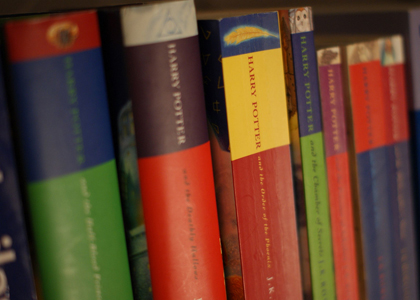
Image: Sonia Belviso via Flickr
Book One: We started reading the series together when they were six years old. I based the decision on a few things: what they had already been exposed to within books and movies, how these particular books were constructed (the most terrifying parts, until you get to the last few books, are always at the very end), and how fearful/not fearful they seemed as we started reading.
I started the series by telling the twins that before we began, I wanted them to know that Voldemort was no longer in this world. I wouldn’t tell them if any other character was alive or dead, but I wanted them to know that no matter how scary Voldemort sounded, he was gone. As a result, our evenings were nightmare-free, though the books themselves weren’t ruined.
The first book is constructed with two “scary” scenes that are sort of the fear-equivalent to the kiddie roller coaster: small dips and twists. In the middle of the book, there is a troll fight that cements the friendship of Harry, Ron, and Hermione, and at the end of the book, there is the requisite fight scene. Again, the end scene is creepy, but nothing more upsetting than what you would get from a bad guy in a Disney film. Your child has already been exposed to the concept of parental death via any Disney film as well. Er… unless you haven’t encountered a Disney film yet.
Book Two: Can be read immediately following Book One, which means that it’s okay for a six-year-old child. The scary scene is at the end, and it mirrors the intensity of the first book’s fight scene. The only change is the introduction of the idea of a child dying. A girl was murdered in the school years earlier by a magical animal, and her story is told in this book. Personally, my kids glossed over that fact because it’s a tangential character. But Rowling puts that concept out there in this book: kids can die too.
******
Book Three: There should be a small age jump between Book Two and Three, unless it has taken you a long time to read these books and your child is now seven or beyond. My kids had just turned eight when we started reading this book.
This book introduces the concept of a serial killer, as well as someone who kills impersonally. Up until this point, in all the stories about death contained in the series, the murder has always had a purpose and the murder and the murdered always knew each other (or “of” each other) somewhat. In the case of the murder discussed in this book, the killer didn’t know most of his victims because he took out a street full of people. Again, the twins sort of glossed over the enormity of this idea, but Rowling is setting the stage at this point to introduce the ideas in Book Six. The scariness of the series is still in the kiddie roller coaster zone, though the pace is picking up somewhat.
*******
Book Four: There is a steep drop-off in scariness between Book Three and Book Four. We waited until just before they were turning nine.
This book introduces the first two character deaths. The first one occurs at the beginning of the book. The characters is a stranger, but the child is reading about the murder in real time vs. hearing about it in retrospect. The second death happens about three-quarters of the way through the book. It’s a lesser character, one your child probably won’t be very attached to, but it’s a student’s death.
Additionally, this book has a twist at the end, which my kids found much scarier than the death of the student. The idea of an adult violating the trust of a child — or really, anyone violating anyone’s trust — hit much closer to home than murder by magic. Additionally, this is the book where I think it really hits home that our world can be be permanently changed by the actions of others. That even if we do everything right, there are others who can negatively impact us. I know my kids struggled with seeing this idea in such stark terms.
Book Five: If your child can handle Book Four, they can probably handle Book Five, hence why I didn’t put a gap between these books. Again, the scary part takes place at the very end. The death, this time, is of a “major” character. It’s a character far enough away from the action that the reader won’t feel the loss as acutely as they would one of the main people in the book, but still, if Harry loves this person then we love this person. So it’s the first close death.
*******
Book Six: We will not start this book for a while. The twins are turning 10 this summer, but they still feel far away from ready for this book.
Rowling introduces the concept of what murder does to a person’s soul, and how there could be people out there who want to have their soul wrenched apart. We have enormous, unwanted responsibilities being placed on the shoulders of a child, and even his parents can’t protect him from what he’s being told he must do. Both concepts are really scary ideas for kids to consider: that someone may enjoy taking someone’s life and the idea that your parents can’t protect you.
Because that is the theme of this book: there is no one on this planet who can protect you forever.
That there’s no space — not even a place as protected as Hogwarts — that is completely safe, and the people in charge of protecting us — such as parents — can be taken away at any moment. That is a scary, scary thought for a kid. That ending alone is why I would wait to introduce this book. The death that occurs at the end is very intense and upsetting.
Book Seven: If your child can handle Book Six, they can handle Book Seven. Yes, there are many many more deaths, but quantity shouldn’t be confused with quality. Yes, there are beloved characters who die, and each one is disturbing in its own right. But the reader doesn’t learn anything new in this book. Let me rephrase that: they may learn a host of lessons about internal strength or what we can endure or the importance of the choices we make. But all of the worst facts about death and murder have already been covered by this point in the series. And maybe it’s looking at the good side of human nature that tempers some of the worst facts about life.
*******
A lot of people read this series with their kids for the enjoyment of being there as the story unfolds. They enjoyed the books, and now they want their kids to enjoy the books. But if your kids are reading these books on their own, you may want to jump in and catch up so you can discuss. I think there are certain books — the Harry Potter series, Harriet the Spy, anything by Judy Blume — that scream out for a bit of adult guidance. This is not to say that your child can’t read those books on their own — most of us certainly did. But your child will get a lot more out of it with some discussion.
We use the same guidelines above for the movies, perhaps being more conservative age-wise with the movies since the twins seem to react more emotionally to the visual than the written word. The movie comes at the child in a condensed, two-hour window. The book unfolds slowly over many days, giving them time to process.
On a side note: the two Harry Potter tours we created for the kids in London (Harry Potter sites around London and visiting the Harry Potter movie set) were both done when the kids were on Book Three. It’s possible to do both with a much younger kid who is in the middle of the series without giving away anything from the later books.
Anything you’d add about knowing when your child is ready for Harry Potter?
March 24, 2014 39 Comments
What Should You Write?
There’s a tiny point that I don’t want to have get lost inside why I read your blog, and that is a piece of advice that someone gave me while dating that applies to writing too.
There were plenty of ways to meet people while I was single. Some of them involved attending events where all the people there would be people who were also looking for someone to date; singles events in bars, for instance. On the surface, attending events like that were ideal because I knew for certain that the people I would meet were looking to date too. There was actually only one problem with those singles events.
I dislike bars.
Sometimes I would suck it up and go, and sometimes I even met a nice guy and got a date out of it. But most of the time, I went home frustrated because I had spent two hours doing something I disliked and had nothing to show for it.
On the other hand, I really enjoy sitting in coffeehouses, reading. It’s what I did most evenings when I was single.
Most of the other people in the coffeehouse I frequented weren’t looking to hook up. They were meeting friends or going out on dates already or getting work done. But every so often, I’d fall into a conversation with a guy at the neighbouring table. And every so often, I would end up with a date from it. And really, those dates usually led to more dates since the guy and I had something in common: we both liked to read in coffeehouses.
What is the point of all of this? And how does it apply to writing?
If you do the activities you like to do, you may meet someone great or you may not, but at least it will be time well-spent. You’ll walk away from the activity feeling fulfilled, and if you meet someone great along the way, that’s the icing on the cake. You can’t really force meeting someone anyway. All you can do is put yourself out there so your paths can intersect.
If you write the posts you want to write, you may get readers or you may not, but at least it will be time well-spent. You’ll walk away from your blog feeling fulfilled. If nothing else, you’ll have a record of thoughts and some weight off your chest. And if your words resonate with someone else, that is the icing on the cake. You can’t force readership. There is no magical formula where if you write X then you will get Y. There are no shortcuts. All you can do is put content out there that resonates with you, and hopefully you will find that it resonates with other people.
Like this post. I wrote it for me. To remember this advice lest it gets forgotten someday. Because I’ve always found it an interesting frame in which to make choices. Because it’s what I want to say. Hopefully, it’s also something other people want to read. But I can’t control for that.
On the other hand, there are plenty of topics I could write about that I think would bring readers. They don’t really interest me; writing about them would be like attending those bar events. If the readers didn’t come, I’d be cranky that I had spent my time on those topics.
So I don’t. I stick to what I want to say, and I stick to reading in coffeehouses.
Both have served me well thus far.
March 23, 2014 14 Comments
486th Friday Blog Roundup
The “Other” category on my iTunes account is back up to over 6 GB. An Applecare technician was able to reduce it to a reasonable amount right before Christmas. Unfortunately, she did this by giving me terrible advice that erased my phone completely, causing me to lose my contacts, calendar, and photos. But… you know… the “Other” category was smaller afterward, so it was an overall win?
And then I synced my phone and it jumped to 2 GB. I synced again and it was over 4 GB. And today, I had to sync my phone, and now it’s over 6 GB.
I’ve tried all the suggestions I could find online: turning off the phone while it’s plugged into iTunes (this is supposed to reboot it?), deleting old messages, deleting the cache in Safari, deleting apps that I added recently.
Before I call Applecare again and risk losing what I’ve been able to reconstruct, does anyone know how to reduce the amount of space taken up by “Other” in the phone? I’m assuming, by this point, that it’s corrupted files because the number jumps with each sync. But how do I get those corrupted files off the phone? Or maybe it isn’t corrupted files. Has anyone else had a problem with the “Other” category on iTunes, and how did you reduce the size of that category?
*******
And now the blogs…
But first, second helpings of the posts that appeared in the open comment thread last week. In order to read the description before clicking over, please return to the open thread:
- “A Bleak Choice” (Abigail Rieley)
Okay, now my choices this week.
I’m going to touch the third rail here and link to two posts that I think are important posts to read. We will never move forward by sweeping our foibles under the rug.
A+ Effort has a post about positive adoption language, and the incident that happened on Facebook this week. She explains, “Bottom line: language matters. We, the infertility community, KNOW THAT. We bristle at ‘just relax’ or ‘it’s God’s will.’ We spend a lot of energy educating those around us that we have a medical problem and that it’s unthinkably rude to suggest maybe we aren’t meant to be parents … The community of adoptive parents* has as strong of an interest in teaching people to use appropriate language about adoption…” It’s a wonderful, respectful, thought-provoking post that points out that talking about difficult subjects doesn’t require perfection, but it does require the listener and the speaker to both be able to communicate openly with one another.
Additionally, From IF to When has decided to move to a new blog space, and also touches on the Facebook incident. Her post shines light on the responsibility of a host. If two guests started shouting at each other in your living room, you would jump into the fight and try to quell the hurt feelings. You would maybe moderate the conversation between the two sides so they could come to a place of peace. You wouldn’t stay in the kitchen, humming to yourself while you refilled the veggie dip bowl. And the same goes for online gatherings. When arguments bubble up, it is the host’s responsibility to address the tension: in another blog post, within the comment section, in individual emails, in a new thread. There are plenty of options, but silence or saying that you don’t have time to monitor comments isn’t one of them when it comes to responsible hosting. Or, silence/lack of monitoring is an option, but then the host needs to deal with the consequences of that silence. In this case, the silence hurt the community, and as I stated above, the only way forward through hurt feelings is forward. Yes, it may be upsetting to dredge up comfortable thoughts, but really, it weakens our community when we can’t speak openly with one another. Ultimately, if people are willing to listen and respond, a lot of good can come from those tough conversations.
And now onto other topics.
A Greater Yes is moving from family building to family living in this post about being almost done (in 2015) with trying to conceive. After being ensconced in this mindset for half of her life, she muses about how difficult it will be to stop thinking in terms of embryos and cycles after 16 years. She writes, “Honestly, I don’t know how to be anyone but this one. Almost my entire adult life has revolved around trying to become a mother. And now to complete our family. Yet I look forward to letting this chapter close and just focus on the children that I do have. No more looking for embryos. No more saving money for treatments. No more comparing medication prices. Just living.” It’s exciting and settling and scary, all at the same time.
Lastly, If You Don’t Stand for Something has a post about emerging from the long winter. It’s been a hard period of time, and all of her energy has been going into getting through it. (Well, and her remaining energy is going to Girl Guides — thank you!) I like this post because it’s a glimpse into someone else’s life, like looking through a window.
The roundup to the Roundup: Save me from the “Other” on my phone. And lots of great posts to read. So what did you find this week? Please use a permalink to the blog post (written between March 14th and March 21st) and not the blog’s main url. Not understanding why I’m asking you what you found this week? Read the original open thread post here.
March 21, 2014 15 Comments