

Category — Uncategorized
I Like Big Bookstacks and I Cannot Lie
There is a word in Japanese for the act of buying books that you don’t read: tsundoku. I love that this word exists because buying books I don’t read is the one wasteful thing I do without an ounce of guilt. I wring by hands over a leaf of uneaten lettuce, but I buy e-books willy nilly. I buy paper books without a care in the world. I like words, even the ones I don’t consume. I’m okay with the books that go unread.
And I like that the article points out that “while this might sound like tsundoku is being used as an insult, Prof Gerstle said the word does not carry any stigma in Japan.”
Because it shouldn’t.
I always have the intention of reading the book when I make the purchase. It’s usually a very immediate need with the thought that I will start the book after I complete the one I’m reading.
Patrick Melrose is a case in point. I purchased it in Edinburgh, marveling that the Edward St. Aubyn books cost a lot less in the UK than they do in America. I am ravenous to read these books. BUT. They are still sitting unread on my side table because two books I was waiting for at the library came available, so I had to read those first. And I still need to read the third book in the trilogy I was reading before I left for Scotland. So Patrick Melrose is still unread, though I have high hopes that I’ll get to him soon. Though sometimes the whim to read something never comes back even though it was strong when I made the purchase.
Still, I’ll never regret owning a very inexpensive copy of Patrick Melrose. Even if I never learn the ins and outs of his heroin addiction.
I’ve never counted the unread books, but I assume they number close to 100 at this point. Maybe more? We have a lot of bookcases.
Do you engage in tsundoku? What is one of your current unreads?
August 5, 2018 7 Comments
How to Set Up a Bullet Journal (and Supercharge It)
I am a huge fan of bullet journals. I keep two of them. People asked last week how I set up mine. Here is how I organize my two bullet journals.
Work
One is for work. It has a very simple set up. The first page is information I need to know quickly, such as the optimal image dimensions for a Facebook ad or the conference line number for a bi-weekly call.
The next page starts the actual journal. If I have something to say — and only if I have something to say — I write the date and the event:
7/29/18 Call with Jane
Then, underneath that, I take notes during my call with Jane. If Jane asks me to do anything, I put an empty box on the left side of a new line and write the task:

When I take care of that task, I check the box.
If I have another meeting, I write the date again (even if it’s the same day), any details about the meeting (“weekly meeting with IAC”), and then any notes during the meeting or any tasks. If it’s a task that I want to take care of at some point but isn’t something I’m tackling any time soon, I’ll use a circle instead of a square.
I take care of work tasks quickly, so the most I need to do is flip back a day or two and see if there are any open squares (tasks) to tackle. I always carry the notebook with me — even when I leave the house.
Personal
But the bullet journal that is more of a traditional bullet journal is my normal, personal bullet journal that I call Charlotte. I love Charlotte. The twins know that if I write down a task in Charlotte, it is as good as done. If I don’t write it down in Charlotte, well… you’re taking your chances.
Charlotte begins with a few special pages:
-
- Carried Over: this is similar to the first page in the work journal except the information is stuff that I always forget. For instance, I always forget the name of the poet Simon Armitage. So I have Simon Armitage written on that first page. When I invariably forget his name and it’s bothering me, I turn to that first page and say, “Oh! Simon Armitage! Right.” That section is currently five pages long. It has stuff that I always want to be able to access quickly and remember, either because I forget it constantly or it’s just good info to know. It’s called “Carried Over” because I carry it over to each new journal, recopying it and adding anything important from the last journal. I will not add to it again until the next time I start a journal, so however many pages it ends up being is how much room it needs to be.
- To Be Read: this is a two-page spread for books I hear about that I want to read. I sometimes download a sample from the book into iBooks so I can try it out before buying or borrowing it. But these pages are for times when the book isn’t out yet and I don’t want to miss it when it’s released. All I write down is the title and last name of author.
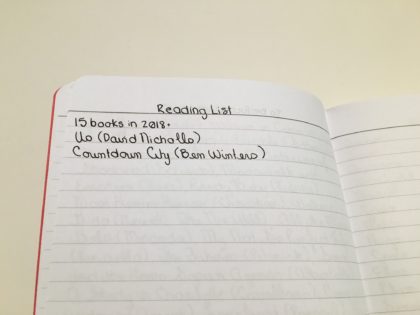
- Reading List: these are books I’ve read during the duration of the journal, and I leave three pages. I am usually starting a new journal during a random month of the year, so I just begin this list by saying how many books I’ve read that year to date and then the names of the last two or three so the lists fit together if I flip through old journals. So the new page looks like this: I’ve read 15 books so far in 2018 plus these two…
- Names I Like: a list of names I like. I only give myself one page, but I make it a double column.
- Key: a place to jot down what every symbol means. Do I really need this page? No. But I leave it there in case I need an extra space to jot down something important in the future. I use three symbols:
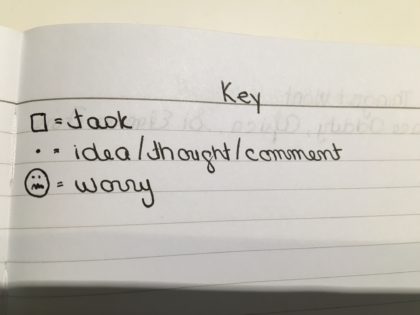
The box means that it’s a task. The dot means that it’s a thought or idea or comment about my day. The worried face means it’s something I’m worried about so I can take it out of my head. I’ll use these symbols later when we get to the daily entries. - Things I Want: I don’t really need this page. But I keep writing down things that I would like to purchase one day but don’t need urgently. Like a song that I hear and like. I almost never purchase anything off this list.
Okay, now this is where the real bullet journal begins…
Each month begins with a miscellaneous page:
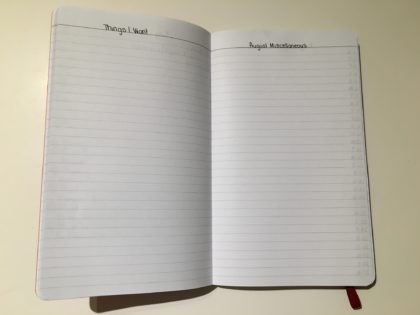
It’s a place to put stuff that I’ll need to find again quickly, but not things that I need to find forever. So… examples would be blood test results. I want to find them again quickly, but they’re only important until the next blood test. So I put things like that on there, and these are the only page I look at when I create the “Carried Over” pages in the next journal. I grab anything important and evergreen from these pages and move them to the Carried Over list.
Next, I line the page with the date and day of the week:
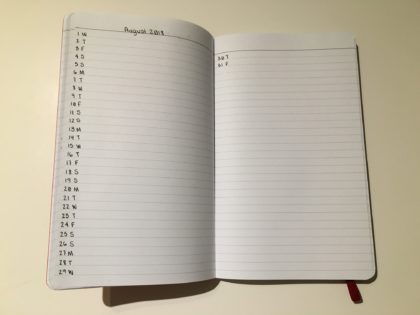
Each day, I write one sentence about my day. Whatever I can fit on that line. It may be profound. It may be boring. But it’s a memory from that day, so I usually write it before I go to bed.
At the bottom of that diary spread (because it usually runs a line or two onto the next page), I add any long-term projects. Tasks that don’t have a due date, but whenever I can get around to them, I’ll get around to them. There are usually eight or so things on that list. Some remain on there month after month.
So after those pages, I start my general journaling on a new page. (Remember, each month gets a miscellaneous page, a two page diary spread, and then however many pages are needed for general journaling.)
There is only an entry if I have something to jot down: a task (with a box to the left), a thought (with a dot to the left), or a worry (with a worried face to the left). So an entry may look like this:
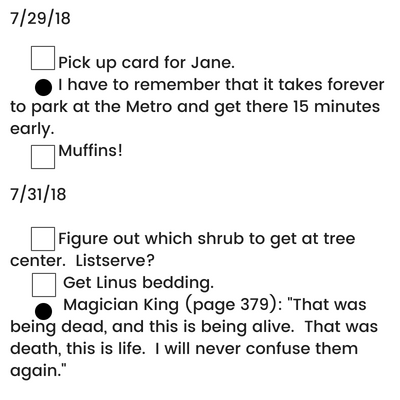
So tasks, reminders, notes, great quotes — anything I want to remember. Sometimes days will go by without an entry (though I always write something in the one-sentence, diary spread section).
At the end of the month, I make a new miscellaneous page for the next month, a new one-sentence calendar spread (two pages) for the next month, and then recopy all outstanding checkboxes from the last month so I can see a critical mass of tasks that still need to be done and assign them to the first day of the month in the general journaling section.
And that’s how I bullet journal.
August 1, 2018 6 Comments
Enjoying Shows Again and Again
We’re watching Sherlock with the twins, and we’ve moved into the fourth (and final?) season. Before we started the first episode, the Wolvog asked me a question about it, and I shrugged saying, “I don’t know.”
“You don’t know?” he asked, looking back at the screen. “But you’ve already seen this.”
I have but I don’t remember any of it, so it feels like I’m seeing it for the first time. Or… it’s actually more enjoyable, like seeing a puzzle come together again. As each piece moves into place, you see the picture emerge that you remember liking once upon a time. I only re-watch shows and re-read books that I enjoyed the first time around.
In the explore/exploit continuum, I am far on the exploit side. It doesn’t feel like a waste of time because I’ll always find things I missed the first time encountering the show or book, AND I know I’ll like it because I liked it before. I just don’t remember it.
There was an Atlantic piece last week on how the way we consume television or books or movies actually leads us to forget more of it. Knowing you can see it again (or read it again) makes our brain less likely to hold onto it:
Research has shown that the internet functions as a sort of externalized memory. “When people expect to have future access to information, they have lower rates of recall of the information itself,” as one study puts it … You don’t need to remember a quote from a book if you can just look it up. Once videotapes came along, you could review a movie or TV show fairly easily.
So my brain doesn’t retain the facts of Sherlock (or even basic stuff like who is still alive in the fourth season) because it knows it can rewatch Sherlock as many times as I wish. Even stuff that is a one-time-only viewing (such as a Fathom Event) isn’t retained because we’ve told our brains that they don’t have to remember the details, it just needs to remember where to find it again.
It’s a really cool article on memory and what you can do if you want to retain more facts about Sherlock. Which, clearly, I don’t because it makes for a more enjoyable second (or third or fourth) viewing experience.
July 31, 2018 8 Comments
Heads of State
The ChickieNob and I started playing NationStates. Many years ago, I had a region with a bunch of students. I’ve thought about playing since then with the kids, but never took the time to sign up and create a new country. But then the ChickieNob brought it up at dinner; her friend was playing NationStates and it sounded like fun. Would I want to play with them? Uh… YES.
So I started a country and the ChickieNob started a country, and I started a region so we could live in peace without being recruited dozens of times per day by other regions. I love my little country. Political freedom is at the world benchmark level. My civil rights are superb. We have quokkas despite being nowhere near Australia. Life is good.
Life isn’t as great in the ChickieNob’s country on the mainland. Crime may be unknown within her borders, but her citizens aren’t happy. She is learning the hard work of being a ruler.
If you haven’t played NationStates, you set up a country and choose a few basic traits, such as the type of government and the history of your inhabitants. Then you start playing. Playing means getting an issue several times per day and making a decision on it. Your decision always has an impact on your citizens or country. Someone is always unhappy with what you’ve chosen to do even as others are celebrating your action. For instance, I stopped someone from mining gold from a government-owned lake. The environmental groups were thrilled because mining would have harmed the wildlife. The mining industry was furious because they couldn’t make a living.
I like the game because it makes you think deeply about how every action you take — in your day-to-day life as well as the game — affects other people, positively and negatively. When I buy a container of yogurt, I’ve given money to a store which in turn supports a business which in turn employs people. When I decide to drive the longer but easier route, I burn more fuel and impact the environment. That yogurt negatively impacted the people who work for a rival brand. That drive benefited the gasoline manufacturers. It can be immobilizing if you think about it too hard.
The ChickieNob is learning that it’s not so easy to be the queen.
July 29, 2018 3 Comments
The Start of a New Bullet Journal
Updated at the bottom
I am days away from starting a new bullet journal. I’m at that point where I don’t have enough space left to squeeze another month in the current journal, but I’m leaving a few pages unused. Hate waste. Also hate having my months in two different spaces. Alas.
In addition to the regular bullet journal sections, I also keep a few running lists in my journals. One is a “Things that make me happy” list. I decided to drop my “Things I’m worrying about” notes into regular months and mark them with a worried face (instead of a box, which is what I use to note tasks, or a dot, which is what I use to note thoughts). I have a list called “Things I want,” so I can note things I’d like to one day obtain, though the fact that I never get these things is probably a sign that I don’t need this list. I have another list called “To be read” of things to be read, and one called “Reading list,” which notes what I’ve read since the journal began. (46 books this time.) There is a list of names I like. It’s always smart to travel with a list of good names.
And now I’m thinking about dividing a section into fours and trying these lists every month or so.
- Things I Want
- Things I Want More
- So I Choose
- And Will Stop
It’s from that linked post, which is about an Elizabeth Gilbert talk and an Amber Rae book. It’s easy to say no to things you don’t want to do. It may be cringe-y in the moment, but it’s not as if you have regrets about not doing that thing, even if you have regrets about how someone else took your “no.”
So this is an interesting exercise to list out all the things you want (or think you want) to do. Then pare it down to the most important things. Then choose one and look back on the rest, releasing them.
This is how I removed “learn Irish dancing” from my to do list. Goodbye, Irish dancing. I look forward to watching other people dance without taking the time to learn myself. I said goodbye to book projects that didn’t seem worth the time. Goodbye to games that looked really good but I didn’t want to play at the expense of other activities.
Hello new bullet journal.
Update:
I’m happy to show people how I bullet journal and the various sections. I’ve added quite a few over the years. Let me take pictures, and I’ll post them after I finish setting up the new journal.
And then show the second bullet journal that I use to balance work projects. So I actually use two very different bullet journals daily to keep everything straight and make sure everything gets done.
July 25, 2018 8 Comments