


How to Set Up a Bullet Journal (and Supercharge It)
I am a huge fan of bullet journals. I keep two of them. People asked last week how I set up mine. Here is how I organize my two bullet journals.
Work
One is for work. It has a very simple set up. The first page is information I need to know quickly, such as the optimal image dimensions for a Facebook ad or the conference line number for a bi-weekly call.
The next page starts the actual journal. If I have something to say — and only if I have something to say — I write the date and the event:
7/29/18 Call with Jane
Then, underneath that, I take notes during my call with Jane. If Jane asks me to do anything, I put an empty box on the left side of a new line and write the task:

When I take care of that task, I check the box.
If I have another meeting, I write the date again (even if it’s the same day), any details about the meeting (“weekly meeting with IAC”), and then any notes during the meeting or any tasks. If it’s a task that I want to take care of at some point but isn’t something I’m tackling any time soon, I’ll use a circle instead of a square.
I take care of work tasks quickly, so the most I need to do is flip back a day or two and see if there are any open squares (tasks) to tackle. I always carry the notebook with me — even when I leave the house.
Personal
But the bullet journal that is more of a traditional bullet journal is my normal, personal bullet journal that I call Charlotte. I love Charlotte. The twins know that if I write down a task in Charlotte, it is as good as done. If I don’t write it down in Charlotte, well… you’re taking your chances.
Charlotte begins with a few special pages:
-
- Carried Over: this is similar to the first page in the work journal except the information is stuff that I always forget. For instance, I always forget the name of the poet Simon Armitage. So I have Simon Armitage written on that first page. When I invariably forget his name and it’s bothering me, I turn to that first page and say, “Oh! Simon Armitage! Right.” That section is currently five pages long. It has stuff that I always want to be able to access quickly and remember, either because I forget it constantly or it’s just good info to know. It’s called “Carried Over” because I carry it over to each new journal, recopying it and adding anything important from the last journal. I will not add to it again until the next time I start a journal, so however many pages it ends up being is how much room it needs to be.
- To Be Read: this is a two-page spread for books I hear about that I want to read. I sometimes download a sample from the book into iBooks so I can try it out before buying or borrowing it. But these pages are for times when the book isn’t out yet and I don’t want to miss it when it’s released. All I write down is the title and last name of author.
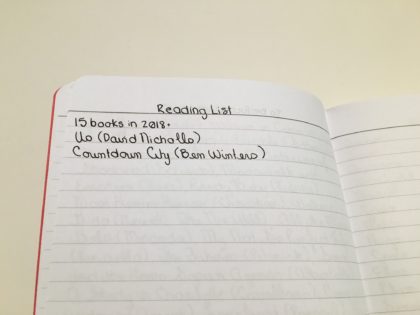
- Reading List: these are books I’ve read during the duration of the journal, and I leave three pages. I am usually starting a new journal during a random month of the year, so I just begin this list by saying how many books I’ve read that year to date and then the names of the last two or three so the lists fit together if I flip through old journals. So the new page looks like this: I’ve read 15 books so far in 2018 plus these two…
- Names I Like: a list of names I like. I only give myself one page, but I make it a double column.
- Key: a place to jot down what every symbol means. Do I really need this page? No. But I leave it there in case I need an extra space to jot down something important in the future. I use three symbols:
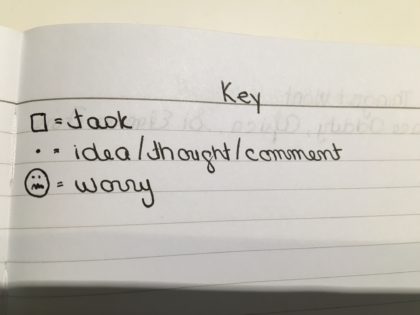
The box means that it’s a task. The dot means that it’s a thought or idea or comment about my day. The worried face means it’s something I’m worried about so I can take it out of my head. I’ll use these symbols later when we get to the daily entries. - Things I Want: I don’t really need this page. But I keep writing down things that I would like to purchase one day but don’t need urgently. Like a song that I hear and like. I almost never purchase anything off this list.
Okay, now this is where the real bullet journal begins…
Each month begins with a miscellaneous page:
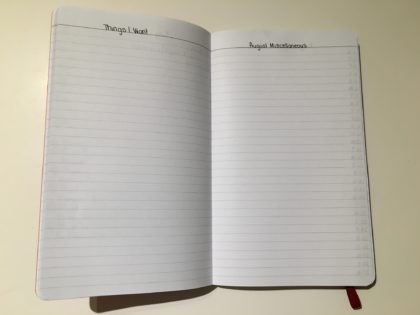
It’s a place to put stuff that I’ll need to find again quickly, but not things that I need to find forever. So… examples would be blood test results. I want to find them again quickly, but they’re only important until the next blood test. So I put things like that on there, and these are the only page I look at when I create the “Carried Over” pages in the next journal. I grab anything important and evergreen from these pages and move them to the Carried Over list.
Next, I line the page with the date and day of the week:
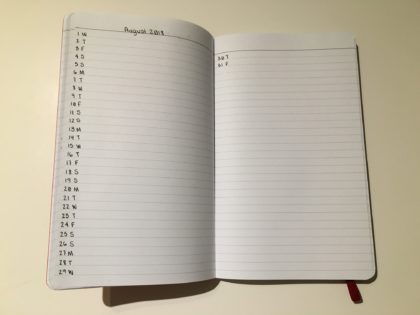
Each day, I write one sentence about my day. Whatever I can fit on that line. It may be profound. It may be boring. But it’s a memory from that day, so I usually write it before I go to bed.
At the bottom of that diary spread (because it usually runs a line or two onto the next page), I add any long-term projects. Tasks that don’t have a due date, but whenever I can get around to them, I’ll get around to them. There are usually eight or so things on that list. Some remain on there month after month.
So after those pages, I start my general journaling on a new page. (Remember, each month gets a miscellaneous page, a two page diary spread, and then however many pages are needed for general journaling.)
There is only an entry if I have something to jot down: a task (with a box to the left), a thought (with a dot to the left), or a worry (with a worried face to the left). So an entry may look like this:
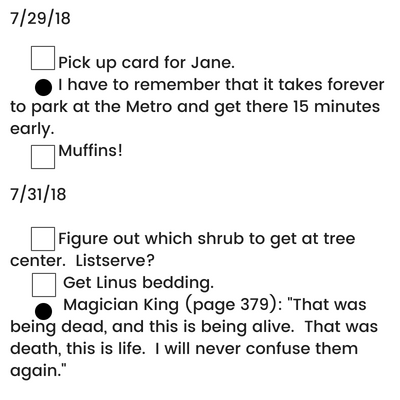
So tasks, reminders, notes, great quotes — anything I want to remember. Sometimes days will go by without an entry (though I always write something in the one-sentence, diary spread section).
At the end of the month, I make a new miscellaneous page for the next month, a new one-sentence calendar spread (two pages) for the next month, and then recopy all outstanding checkboxes from the last month so I can see a critical mass of tasks that still need to be done and assign them to the first day of the month in the general journaling section.
And that’s how I bullet journal.




6 comments
I bought, and have been intending to start, a bullet journal, I have bookmarked this post so that when things settle down at work (this week is even more than the usual hectic craziness), I can come back to it.
However, I will say that it sounds like a lot of work. Not sure if the benefit(s) will outweigh the effort. Hmmm.
Agree with Sharon. I’ve talked to a lot of people in my field about how they keep organized on projects, and the consensus seems to be that the actual system being used doesn’t matter, all that matters is the time you put into organizing. No system will save someone who is disorganized. Likely that’s a bit of hyperbole, but I think I would already be organized some other way if I had the resources to commit to this sort of system. Things move smoothly when I’m not super-busy and they get disorganized when I am, no matter what system I’m on.
Thanks for sharing this! I agree with the others that the setting up the system sounds like a ton of work…I mean, I guess by now for you it’s super easy, but for me just starting out it seems daunting!
And I do think there is truth to what was said above that “no system will save someone who is disorganized”. And that feels like me! If I actually got something this complex set up, I would need to be super disciplined to keep up with it, and I am not sure I would make that happen. Maybe for my day to day life it would help, but I am also the person who gets satisfaction at tossing the paper when tasks are complete.
But I am definitely going to think on this and come back to this post when my brain is not so occupied and give this a try.
Love the structure of your bullet journal! Writing down a short line about a day – whatever it may be – is a really nice idea. Do you go back to your old journals often?
Post bookmarked! Thank you for sharing this! I’m overdue for getting a bullet journal started and this is inspiring me.
My Filofax calendar & lists (and post-it notes, lol) serve me pretty well… but I’m always fascinated by how other people organize their stuff… and there is nothing I love more than a blank journal and some pretty coloured pens, lol. 😉 Thanks for giving us a glimpse into your system!