

Category — Uncategorized
Catching Your Dreams
I’ve been listening to a celebrity memoir on audio book and marveling at how easily everything falls into place in the story. I’m sure that living his life is very different; that his memoir is the literary equivalent of a curated Instagram feed. Maybe that’s why I’m not naming the memoir. I have zero clue if this actor is the type of person who has a Google alert on their name and will admonish me for this take-away. But all I have to go on are the words on the recording, and those words make things sound very easy, including success the very first time he and his partner tried to conceive.
Not that I wanted them to struggle, but this is success #582958 in the book, so the words “of course” moved across my brain in that moment like ticker tape.
I was recently reading The Rest of Us Just Live Here by Patrick Ness, and the mother and son are having a conversation about the mother’s political campaign. She’s been waiting for a certain position to open, and she’s currently running for that office. It seems likely that after years and years of waiting, this is going to happen for her. And she has decided that this is the time to dump her heart out to her son. She says on page 155:
“What do you do when your dreams are about to come true?” she asks. “No one ever tells you. They tell you to chase them, but what happens when you actually catch one?”
So little is written about what happens next. The self-help books seem to take you right up to the moment of success and then step back, as if the only option when you catch your dream is to live happily ever after.
The truth is that sometimes you catch your dreams and you realize that the reality is very different from what you imagined when you were working towards the goal. The heart is terrible at knowing what will make it happy. And other times you catch your dreams and it’s bliss upon bliss. It’s exactly what you hoped.
I was thinking about this quote as I listened to the celebrity memoir because there is no chase. There’s just a short queue in front of each dream, and he gets into the line, waits for relatively short amount of time, and collects the dream. And I was thinking about what is lost and what is gained without the chase.
March 3, 2019 2 Comments
The People Who Don’t Exist
You know that urban legend that says everyone who appears in your dream is someone you saw once before. Even if they’re not familiar, your brain registered their face in the background of a crowd, because humans cannot imagine faces we’ve never seen. Which may or may not be true, but it’s the first thing that popped into my mind when I saw the pictures of the AI-generated faces.
Those people don’t actually exist.
It kind of freaks me out.
It’s easy to see this technology used in the creation of realistic-looking images for marketing or advertising purposes, for example. But it’s just as easy to imagine someone using it to create fake “evidence” of events that never happened in order to promote some agenda. At the speed this tech is progressing, it soon might be impossible to tell whether you’re looking at a real photograph or a computer generated image.
Is anyone else really uncomfortable over the idea of generating fake faces? (Or, for that matter, fake cats?)
February 27, 2019 5 Comments
When Are You Old?
There is a great quote by the writer Lydia Davis:
I had reached a juncture in my reading life that is familiar to those who have been there: in the allotted time left to me on earth, should I read more and more new books, or should I cease with that vain consumption—vain because it is endless—and begin to reread those books that had given me the intensest pleasure in my past.
Explore or exploit. To find the new or to dive deeply into the things you already know you like. The answer is mathematical: explore when you have a lot of time ahead of you and exploit when you have limited time left. So explore in childhood, exploit in old age. Explore your first year of college, exploit in your last few months before graduation.
It’s easy to know which way you should go when you know exactly when something is going to be over. But what if you don’t know how long you’ll live? When does old age begin if you have no clue if you have three days or three months or three years or three decades left? When should you switch over and start becoming pickier, spending time only with what will make you happy rather than giving your time over to find things that could make you happy?
*******
The ChickieNob was telling a story about an “old man” who turned out to be in his 40s. “I’m in my 40s,” I told her. “That means you think I’m old.”
“But you are old,” she reminded me from her 14-year-old point-of-view.
*******
Josh and I were driving, trying to guess a person’s age that we just met. “He’s in his mid-to-late sixties,” I guessed.
“I couldn’t get a read at all. He may have been in his fifties.” We were trying to figure out if this person may be nearing retirement age. Josh shrugged, “Sixty sounds really young to me right now.”
Me too.
February 26, 2019 9 Comments
People Would Like to Tell You About This 3-Year-Old Study Because… Babies
Why is People magazine telling us about a three-year-old study, apropos of nothing? This week’s article:
There could be another (surprising!) anti-aging solution for women: having more children. According to a study conducted by researchers at Simon Fraser University in 2016, the number of children a woman gives birth to can have an effect on the rate at which her body ages — slowing the process down.
I’ll admit, the first time I read the opening my eye skipped over the date, and I felt like shit about myself. But the second time I read it, I felt like People thinks shit about me because they are delivering up a three-year-old study as if this is breaking news for seemingly no reason. Like reporting on the sinking of the Titanic as if it happened last night but including the fact that the news is 107 years old.
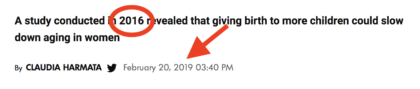
In other words, it’s not news, but they’re putting it out there because fertility sells. Articles about motherhood sells. Scaring you with ideas about your biological clock sells. Because they believe their audience wants to read about three-year-old studies as if it’s breaking news. There is no update, no reason for saying it now; this is not evergreen content.
I’m putting this out there in case you wanted an example to use to explain to people society’s hyperfocus on fertility and how it affects people who can’t conceive. You can show them a 2019 article about a 2016 study and ask them to find an article on any other topic that does the same, for instance, a 2019 article that solely covers the 2012 report about concussions and football as if the study came out this week. Strange how that never happens.
February 24, 2019 6 Comments
Get Rejected Then Fail at Something
I’ve been holding onto a New York Times opinion piece, reading it from time to time and taking comfort in the words. Emily Winter set out to get 100 rejections. She figured that if she wasn’t rejected, it was a win because she got a job. And if she was rejected, it was a win because it was part of her project. Pretty sneaky.
The point is that you can’t achieve things if you don’t put yourself out there. Every achievement comes with the possibility to failure baked in. And even if you don’t end up finding closed doors along the way, there is the possibility of closed doors along the way.
But mostly I loved this piece because of Angela Duckworth’s words about grit and what plugging away at something — even if you never succeed — is worth for the life lessons learned along the way. It, of course, made me think about infertility. Plugging away, month after month, only motivated by hope. How much grit does our community have collectively?
Does the piece have a happy ending? Not really. It has a realistic ending. And maybe that’s why I keep reading it over and over again. No prancing unicorns; just a believe in the worth of putting your heart out there again and again.
February 20, 2019 4 Comments