

Posts from — October 2011
Why I’m Not Joining Spotify, and Other Tales of Internet Privacy
About ten years ago, my car gotten broken into while it was parked near Josh’s apartment. I used to leave for work around 6 am to get there on time, which meant that it was usually dark and the streets empty. As I walked towards my car, I could tell that something was wrong. There were cassette tapes on the front passenger seat and the glove box was open. I couldn’t imagine how the glove compartment could pop open like that on its own nor how the tapes could be projected onto the seat simply by the glove box coming open. As I got closer, I saw that there was shattered glass across the backseat, so I started walking backwards away from the car and ran back up to his apartment.
He came downstairs to inspect the damage, which was fairly minimal. The back window had been smashed open. Someone had taken a handful of change that I used for meters. They had left the dollar bills in the glove box. They had left the radio. They had taken a few mix tapes.
The car smelled like the person, and it was clear that while he or she wasn’t there now, they had spent some time sitting in my car, going through the items in there.
I drove home bawling, unable to articulate why I was so upset from it. No one was hurt. The window itself cost under $100 to replace. The person took less than $2 in change though there was probably $20 at the top of the glove box. It’s the reality of city living; it happens all the damn time. And it sucks when it does, but you fix the window and move on. It’s not worth dwelling on beyond the initial tire kick of frustration.
And yet, here I am, over ten years later, writing about it.
I still can’t articulate what bothered me so much about having my space invaded except that it bothers me to have my space invaded. I think it bothers most people to have their space invaded — different cultures like to literally keep varying circles of physical space around each person. I perhaps had a stronger reaction to the event because I had been violated in a different manner years before that and perhaps transferred the powerlessness I felt in that situation to this one, but still, if you knew that someone had been in your house, touched your things, took nothing and left, wouldn’t you still have your stomach twist like a wrung towel?
And can you explain to me why? When no one is hurt, nothing of value is taken (neither sentimental nor monetary). Why do we cling to our privacy, when our privacy doesn’t really have that much value. I mean, consider your life — it makes sense to fight to protect your life. But what about protecting your privacy or your figurative space (which is comprised of your physical space and your intangible space)? Why do we fight so hard to keep information to ourselves, especially when nothing truly horrific could come from other people knowing that information? What could possibly happen if you knew how much money I made or what music I listen to or where I shop? How could that possibly affect my life except that it does in the same way that I can’t really explain how that person sitting in my car affected my life.
Maybe it is due to age, or maybe it is due to the far-reaching hand of the Internet, but I can feel myself cocooning over my figurative space more and more. Every new privacy change roll out on Facebook makes me consider deleting my account. I used to be quick to try out new software or social media sites. Now I start by looking at the terms of service, then read up on the site, and then, once I’ve spent more time considering it than any site is probably worth, I decide whether or not to make that account. I miss out on things I’d really like to try simply because I think they take too big a bite out of my figurative space.
For instance, Spotify. I’d like to try Spotify mostly because one of my friends told me about Spotify and then we could hear each other’s music (thank you, Magpie!) But I don’t want to download software or set up yet another account or link it to Facebook in order to try it. Sometimes more is simply more.
Opening Internet accounts reminds me of the warnings I got about how opening a lot of store credit card accounts could hurt me. They entice you with the discount, but unless you honestly shop at that store regularly enough to reap more than the initial 20% off your purchase, opening all of those accounts harms your credit. Which is a trade off that will affect you enormously when you go to do something important such as buy a house.
And I think having too many Internet accounts and not being a bit discerning does the same thing. You’re enticed with the promise of something fun, but unless you’re going to keep it up to make opening the account worth it, you’re going to find that having all of those accounts will affect your emotional well-being, especially in regards to feeling cluttered and overwhelmed. Many of them send out constant reminders to use their site (yes, Facebook, I’m talking about you). When there’s too much noise in your life it harms your life credit score; that one that tells you whether you have the emotional bank account to afford weathering stressors.
A friend told me recently that she needs to go to an ashram to calm her body from information overload.
I would totally join her.
Because the Internet is beginning to feel like a boulder somersaulting down a hill. Too many new sites pop up daily, dividing people’s attention. Sometimes I open Twitter only to shut it again because it feels like 140 people are all talking at me at the same time. And then there is the reality that we’re being told that our lives should be more like open books, we should visually show all of our connections.
We should mash all of our friends together into one big pot of friend soup on Facebook. We should like businesses and show where we shop. I open the Washington Post and I can see which of the people I’m connected to via social media sites have linked to an article. I can see what music my friends listen to, where they’ve physically been, who we know in common.
And does it really matter? Does it matter, as Josh asked me, if people know that I listen to a lot of Green Day? (Okay, that’s a lie. What Josh actually said when we discussed this was, “it’s interesting that you are fine telling the world that you have wonky ovaries, but you draw the line with letting the world know that you love Wham.”)
Maybe the difference is that I choose to tell the world about my wonky ovaries. This is my space and I have the ultimate control over it. I can decide what I write or what I don’t write. Maybe my discomfort is in turning over access to my figurative space and allowing another person to control it. They are deciding if people know that I listened to “Careless Whisper” on my iPod, not me. Except… er… that I just told you. But that’s not the point. The point is that when I go to someone else’s site, they have control over my privacy. And while I can’t articulate why it bothers me, I know that it does bother me. And shouldn’t I follow my gut on that one, even if my gut is irrational and can’t prove anything and swims against the Internet stream of sites that other people love?
I am hoping that this isn’t making me sound like a crotchety old woman pouring over TOS contracts with a yellow highlighter. Because there are the sites that I embrace, that I use regularly, that feel worth the trade-off. I give them some of my privacy, and they give me back an excellent distraction.
The world is moving towards more transparency, more lack of walls between inside the house and outside, even if the people in the world kick and scream a bit about it. We’re encouraged to post more, admit more, connect more — especially bringing together the various places we frequent, the people we know. The more that is expected of me to reveal, the more I become circumspect, desiring privacy. I’m not sure I’m completely ready to live with a glass wall on the front of my house, which is a strange thing for a person who writes about her wonky ovaries to say.
It’s nothing I need to hide, but it’s also not things I need everyone to know.
And maybe the Internet is different because it feels more permanent. Once privacy is breached on the Internet, it never truly goes away since nothing disappears completely from the Internet. That person in my car was a single person entering my space without my implicit permission. But the Internet — with all my various connections — is like finding hundreds of people entering my space without my implicit permission. I expect anything I put here is fair game; I’ve invited you to know it. The tangential information that comes from social media sites — such as who we know in common — is an uncontrollable side effect from using the site.
My privacy means very little to me when I hold it up against things that do mean a lot to me. And yet I am dragging my heels with social media sites, with shopping online, with partaking in new software.
And I can’t help but think about that person who sat in my car. Who took very little, but obviously imprinted something into my skin by their actions, something I can still sense over ten years later even if I don’t have the words to describe it.
Do you feel the same way about your figurative space in the world (both your physical space as well as the intangible, online, information-based world)? Can you explain why we value our privacy so much, and what is our privacy anyway?
October 11, 2011 23 Comments
Ahead and Behind
Josh pointed out that we’re going on holiday soon-ish, and when he said the words, I felt my heart drop a little, almost like my muscles fumbled for a moment. I don’t want the holiday to get here, not because I don’t want a vacation — I desperately do want a vacation — but because I love still having it in front of us. Once we go, it will mean that we’re one step closer to having it over. And then it will actually be over and we’ll have to deal with that down period that comes after a long-awaited trip or event.
I like to call this time period my pre-disappointment.
I felt this way about my wedding too. I sort of didn’t want the day to arrive because then it would all be over, and I’d have to jump back into regular life. And add to that my Bat Mitzvah, I didn’t want that to start either. (Though that may have had more to do with the fact that it was the year of the cicada, and I had all sorts of fears of going from the car to the shul with my hair down — a perfect nest for catching flying cicadas.)
And then I think about the things that I want now, that I’d rather be in the moment doing it, even if it means that at some point, I’ll have to move to having memories rather that still have it before me: I felt that way about college. I was nervous to go, but I wanted to already be living the first day back when I was still in my junior year of high school. I obviously feel that way about children; I want them here. I want to be experiencing them now. I don’t want to be working towards a time when I have a baby.
So I sort of don’t want this trip to start because that will also mean that it’s also close to being over, and I am going to be so down after this vacation ends.
Am I the only one who gets this way?
October 9, 2011 18 Comments
360th Friday Blog Roundup
A very simple roundup today to bring order to a very chaotic, emotion-filled week.
Second helpings of the posts that appeared in the open comment thread last week as well as the week before. In order to read the description before clicking over, please return to the open thread:
- “On the Night of my 33rd Birthday” (Mrs. Spit)
- “The Limits of Empathy” (NYT)
- “Waiting and Ready” (Hannah Wept, Sarah Laughed)
- “2 1/2 Years” (Caring for Carleigh)
- “Dear Embryos” (I’m Very Far Away)
- “Good Enough” (The Oregon Tail)
- “Mexico Here We Come!” (Starfish Kitty Dreams)
- “A Funny Thing Happened on the Way to the REs Office” (A Single Journey)
Okay, now my choices this week.
Family Building with a Twist has a post about her fear of the passive Internet Shut-up, which is essentially, the Internet Ignore. How does not having your words read or commented on affect how you write, how you express yourself? Does it seep into the face-to-face world and how you communicate — or stop communicating — with others? It’s a beautiful post about choosing to write and tuning everything else out.
I Lost a World talks about that desire to keep your child from sadness. She writes, “I hurt for the fact that she was born into this particular sadness, into the loss of a brother, and that I can’t protect her from it. I can try to help her come to an understanding that works for her, and I can be honest, and I can try to create a sense of safety so that she can tell me how she feels and can ask questions as she has them … But I can’t bring him back for her, can’t erase what his loss has done to us or the fact that it’s helped shape who we are as a family.” It is a gorgeous, aching post.
A Fertile Mind has a post about people craving the happy ending. Listen to this brilliant observation: “We have inadvertently joined a club and those who were unwilling to hear of our struggles previously are now ready to listen to the story of how long it took us to have a baby. Even though the baby isn’t even here yet. Our story now gives them hope that things really do turn out alright in the end.” Or this incredibly powerful statement: “I think I just wish that people had listened to our story when I needed them to.” Which begs the question: what do people do who don’t have the happy ending in sight?
Lastly, Battlefish has a post about feeling like a broken record in discussing her mother’s death. I think this is a powerful post because it’s a reminder of how we don’t know what is happening in another person’s head. She writes, “I am finding it hard to believe that no one seems to notice how sad I am on my really down and melancholy days. Am I really that good of an actress that no one sees it?”
The roundup to the Roundup: No big wrap-up needed; just lots of great posts to read. So what did you find this week? Please use a permalink to the blog post (written between September 30th and October 7th) and not the blog’s main url. Not understanding why I’m asking you what you found this week? Read the original open thread post here.
October 7, 2011 8 Comments
What Steve Jobs’ Death Taught the Wolvog about Mourning
I am completely overwhelmed — and grateful — by everyone reaching out to the Wolvog after Steve Jobs’ death*. We tucked them in, and Josh went downstairs to heat up dinner while I sat down for 20 minutes to take those memories out of my head. The emails and Facebook wall posts and Tweets had started to come in while we were telling the Wolvog the news, but we had walked away from electronics for a few hours to eat and clear the pictures off a camera. When I opened email again right before bed, we both stared at the number of emails, the number of people who said that they thought of the Wolvog when they heard the news, and said “holy shit.”
I cannot thank you enough, and I feel horrible that I can’t respond to everyone’s writing personally. You took the time to tell him that you were thinking of him, and that makes my stomach twist to not be able to write everyone directly and let them know how much that meant to him (and us!). I have put all the emails and Facebook wall posts and Tweets in a folder for him to start reading this weekend.
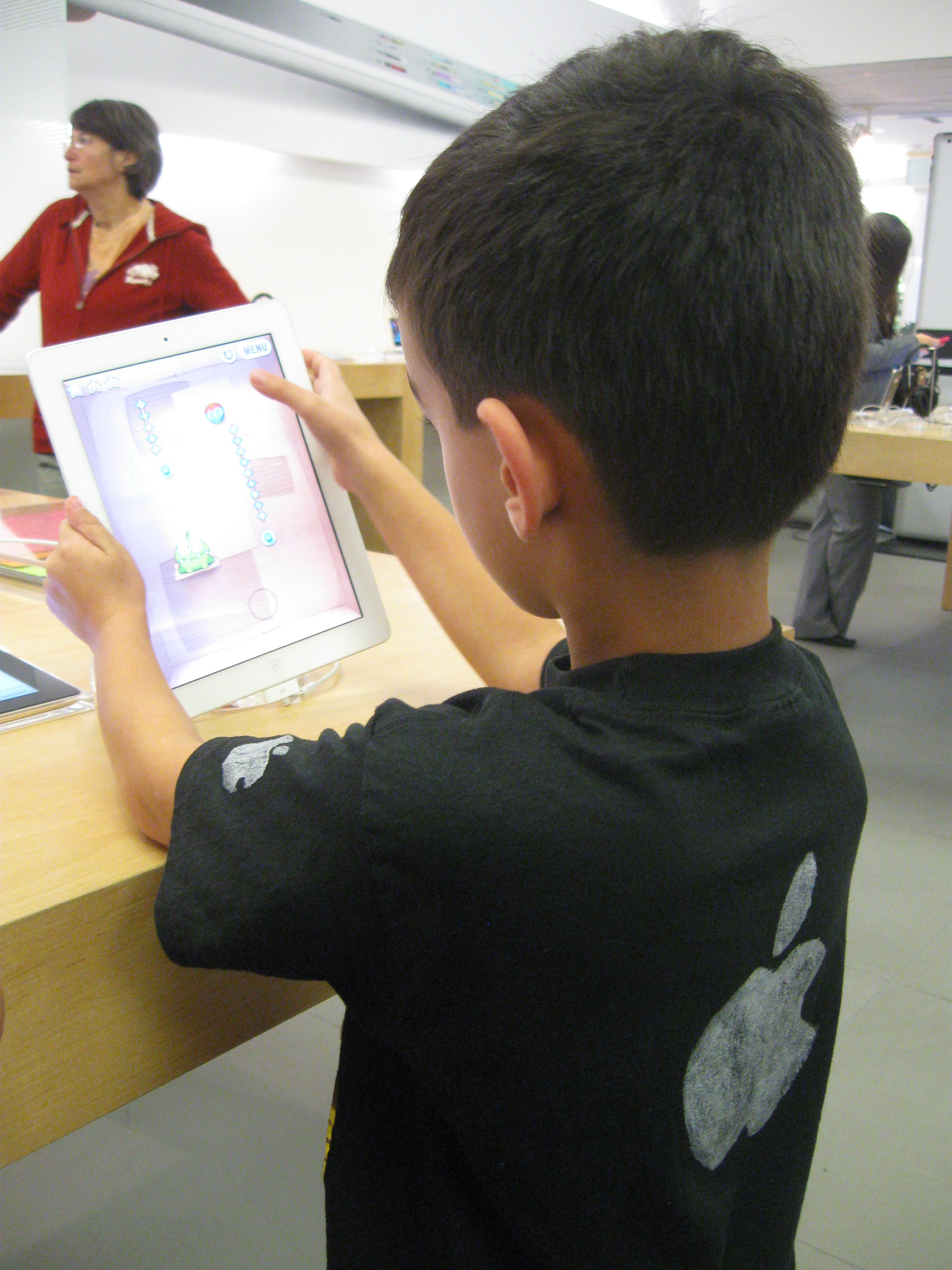
The Wolvog is mourning in this very strange way; it’s the loss of a hero, but not the loss of a family member or friend. He is not someone he saw every day, but he’s someone who affected my son’s mind every day. Harry Potter is magic, but Mac is magic too — perhaps more so because while the Wolvog watched or read about how others utilized wands, he was able to place his own hands on the computer and control what he wanted to do; where he wanted to let his imagination go.
That is all a wand is — a computer that is rolled into a tight, little stick. And a computer is just a wand that has been rolled out into a rectangle, both objects capable of changing the world in the right owner’s hands.
This is what the Wolvog learned when he saw all the notes (and thanks to BlogHer sending it out, they came from strangers all over the world, all touched by his story):
That people shouldn’t mourn alone. That being sad together somehow spreads out the burden of grief. That we should always reach out to someone who is mourning and take part of their load simply because it is the right thing to do as humans. That coming together is better than dividing apart. I hope what he retains from this is that he should never dismiss someone else’s grief; that he should always give the hug, say the kind words, ask what he can do.
You taught him that, so thank you. Which feels like two too small words to convey how you drove home the humanity we’ve been trying to instill in them in birth. That it’s always better to connect, to reach out a hand, to not ignore, to give empathy.
Some people mourn by talking about the person. Some people mourn by cleaning or trying to control their environment. The Wolvog backed away from scary thoughts about the unknown and death — ideas he couldn’t wrap his mind around — and returned by morning to the orderly computer world, where everything is black-and-white; where a command always creates the same action. If I brought up Steve Jobs, he’d look at me and then say, “I need to talk to Tim Cook about why they keep changing the thinness of the iPhone. I need to understand that.” And then I’d tell him that his kindergarten teacher wrote to say she was going to find him at school and give him a hug, and he’d say, “do you know that they released the iOS5? Do you understand how this is going to change the iPad?”
Coincidentally, I went to a discussion on Tuesday night about children and anxiety, and one of the things the speaker covered was how children have no perspective or context. In other words, an adult hears that someone died of pancreatic cancer, and our thought it how rare that is. And a child hears that someone died of pancreatic cancer and all they know is that there is “happen” or “can’t happen.” There is no context, no in-between. So part of last night’s discussion was trying to give them that context, the idea of rarity, the knowledge that just because something can happen doesn’t mean that it will happen.
On Wednesday night, the twins learned that heroes die. And they made the jump to the idea that one day Josh and I would die. And finally they traveled to that space where they learned that they would one day die. We spent an hour and a half before tuck-in standing on that very scary patch of mental ground. And I didn’t know what to do the next morning, so I put cartons of chocolate milk in their lunch box. I hoped that chocolate milk said to them everything I wished I could find the words to say.
* Again, to understand the backstory about the Wolvog and Steve Jobs, it is here and here and now here.
October 6, 2011 22 Comments
Goodnight Steve Jobs: A Hero’s Goodbye
Josh called with the news, 15 minutes from home, while we were watching Harry Potter. “Keep him up,” he told me. “Wait for me to get there.”
We sat down in the Wolvog’s room; me in the rocking chair with the Wolvog on my lap, and Josh on the Wolvog’s bed holding Chickie. It was the wrong formation, the wrong order of things; they are usually in the other parent’s lap when we start tuck-in. There was this moment, a second before I told him that Steve Jobs had died, when he still didn’t know and he was in his Star Wars pyjamas, Harry Potter on his mind, reading homework tucked into his school binder, that I wanted to freeze indefinitely.
I have never had to kill someone’s hero.*
Because that was what it felt like to destroy whatever ideas my son had constructed in his mind about immortality. That yes, old people died, and people who stopped eating died, and people who ran into the street because they weren’t hold their mother’s hand died, and bad guys died. But being named someone’s hero; that protected you, infused you with the ability to live forever because you need to by necessity of the fact that you are someone’s hero. People need their heroes; we can’t have them die.
The Wolvog’s face crumpled and first he cried in this shattered sort of way, and finally he entered this place where he was very very quiet. His sister asked 1000 questions, trying to understand cancer, trying to understand what would happen next at Apple, suggesting different things her brother should do — or we should do — in order to process this. I finally motioned with my head for Josh to take her to her bedroom, and the Wolvog curled up against my chest, his hand over his eyes as if he was saying the Shema.
We rocked for a long time, so I had a good ten minutes to formulate what I wanted to say. And this is the gist of what I told him:
Bad guys die, and heroes such as Steve Jobs die, because both bad guys and heroes are simply humans who have touched our lives in an enormous way. It’s important to always remember that heroes are people; that they don’t have powers that the rest of us don’t have the chance to possess: they simply make choices that lead them in one direction or another. We all have the ability to become someone’s hero, and I fully suspect that one day, the Wolvog will be someone’s hero. And that while heroes themselves die because they are human, what continues to live on are their ideas, the actions they took while on earth, the people who remain alive who think about them and love them. That he will never be fully gone from this earth because there are tangible reminders of him in our very house with our iPad or our iPods. And the way we really honour our heroes is to emulate them; to grow up and similarly repeat (while putting our own flair on it) the good things they did. Following his computer bliss would be the best way to honour Steve Jobs’ life. Finally, I told him that the chicken he had eaten at Rosh Hashanah had been my grandmother’s recipe, and I had made it to feel close to her since I was having my parents over for dinner too. So while she is gone, we still are connected to her through her recipes — these cooking ideas that were so important to her while she was living — and we will still be connected to his hero via enjoying his ideas, his inventions.
And then I put the saddest boy in the world to bed.
I love everyone who took the time while we were talking to him to call our house or send an email or write a note on Twitter or Facebook. I’m going to gauge his mood in the morning and then read them to him when it feels like the right time. I asked him what I could do to help him with this, and he asked me to take him to the Apple store tomorrow — his holy space. And I told him that I thought it not only was a great idea, possibly more healing than a funeral, but it probably would have made Steve Jobs happy to know that we are going there and enjoying his inventions, keeping his ideas alive.
So that’s where you’ll find us until he’s ready to come home.
* To read the backstory about the Wolvog and Steve Jobs, it is here and here.
October 5, 2011 64 Comments