

The ALI Time Capsule
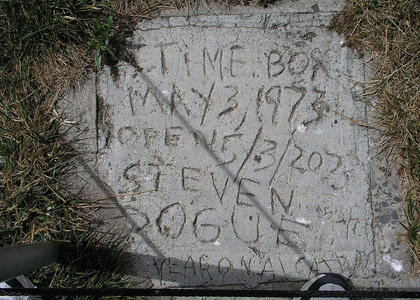
Image: inajeep via Flickr
I read a post last week in HuffPo that the lost time capsule buried on the grounds of the Aspen Institute during the International Design Conference in 1983 had been unearthed, 13 years later than expected. It had gotten lost in the ground when markers disappeared. Steve Jobs — who had been at the conference — contributed a mouse from the Lisa computer.
The rest of the listed contents were all things you think of when you think 1983 (sort of): “a Rubik’s Cube, an eight-track recording of The Moody Blues, a June 1983 copy of Vogue magazine and a six-pack of Balantine beer meant for whoever dug up the capsule’s contents.”
The mouse was sort of the remarkable item in the set.
I guess the largest problem with time capsules is that you have no clue what people will be nostalgic about by the time they’re opened. Things we take advantage of today and largely ignore could become elements that define the era. For instance, after the zombies come and we’re all living in below-ground caves (in order to avoid the zombies roaming earth’s surface and living in our abandoned houses), we may feel nostalgic about things such as kitchen sponges. Or paint samples. Things we used back when we were above ground and had more light and our eyes could discern colour. And we actually obsessed over the which shade of brown to paint our walls.
Or we could go with the items that clearly define this moment in time: an iPhone, dirt from Ground Zero, a bottle of Viagra. But the things that have sticking power — such as the Rubik’s Cube — will most likely still be around either in use or in museums. And the things that don’t have sticking power will become these things we sort of shake our head and laugh at, saying, “I have no clue why we thought that was important.”
I always wanted to plant a time capsule growing up, but I was really impatient AND I didn’t want to bury any cherished items in the ground. But if I wasn’t going to bury cherished items, there didn’t seem a point. Instead, every New Year’s Eve from age 8 until college, I copied over the same poem (one I wrote at age 8, so you can imagine…) and the alphabet, so I could see how my handwriting changed each year. Those papers are somewhat buried at the moment in our storage room, which is sort of like having a huge time capsule in your house if you never deal with that room. And I never deal with the storage room, hence why it’s like geek hoarders in there.
I guess I am interested in the idea of time capsules but have no desire to bury things that actually mean anything to me in this time period. (What a waste!) And the reality is that it’s the intangible that means more to me overall.
In the interest of not actually burying anything, I propose a verbal time capsule post to be returned to in a set amount of years down the road. In this comment section, I’d like to bury the blog posts and the header images and the site titles that mean a lot to you from the last ten years or so of the ALI community’s existence. All you have to do is list them, though if you could provide a link, it would be even better. Feel free to put in anything that means a lot to you; that will be something you’ll remember when you look back at the ALI community many years from now.
I’ll kick off the box with these items:
- The old sperm nudging header of A Little Pregnant
- Chez Miscarriage and Getupgrrl (as a whole)
- The very first Creme de la Creme
- Cyclesista
- The post “Returning to the Well” by Lavender Luz
What are you adding? Since we have infinite space in which to contain them, which whole blogs, posts, headers, memes, ongoing projects, wise words, or videos from the ALI community should go in our virtual time capsule to remember the first ten years?
October 2, 2013 9 Comments
Pump and Dump Writing
Writing begets writing.
Put down words on a page or screen every single day, think about future blog posts or storylines while you’re taking a shower, read a lot of other people’s words so your brain can pick up creative ways people string them, and it pretty much follows with few exceptions that the words you want — the ones that will go into your own blog posts or short story or novel or memoir or self-help book — will come to you when you need them. It’s not that daily writers don’t get writer’s block, but when they do, it is usually tied to not knowing how to move the plot forward or structure the chapter. Writer’s block like that is akin to staring at the chess board, trying to figure out your best move. So I’m talking about how daily writing will stave off the sort of writer’s block where you stare at the screen, wanting or needing to write, and not knowing how to get started or get back into a long-standing project.
That’s what I mean by writing begets writing.
I approach writing in the same way breastfeeding women deal with their milk supply while on a business trip: pump and dump. (Well, I imagine since I wasn’t actually able to make breast milk.) If they don’t pump, their boobs will hurt and their supply will go down. But they have no place to store the milk or transport it home, so they dump the milk. That milk is only expressed in order to get to the good breastfeeding later. While they may have feelings of regret over the waste, they know going in that a pump and dump is what they need to do to get through the trip.
I do pump and dump writing all the time. This post would have been pump and dump writing except that I ended up posting it.
Even when I don’t have time for it, I sit down for fifteen minutes and just write. Whatever. I don’t think about the quality, I don’t pluck at the words. If I don’t know what I feel like writing, I grab ideas for posts by looking at other blogs or news sites. And then, for a minimum of 15 minutes, I write (usually a blog post, but sometimes the beginning of a short story). And then I dump those words. They served their purpose: to keep the writing fluidity in my mind so I don’t get writer’s block down the road.
Pump and dump.
*******
How long I can go without writing and then still easily write the next time I sit down at the computer depends on how much momentum I’ve built with blog posts or the book. I rate my writing mood on a 10-point system. 1 – 4 means I can’t write or it’s very painful to write. I’m just sitting there, staring at the screen, feeling as if I’m wasting time. 5 – 6 mean that I maybe got a paragraph or two out of a four-hour writing session. 7 is one of those days when I stop and start a lot, but ultimately get a page or two. An 8 is writing at a decent clip. 9 is a fantastic day when I churn out 10 pages (fine, most of it is dialogue, but it still counts) and I know I’m going to keep most of it. 10 is the best writing day ever.
I’ve never reached a 10.
I try to spend most of my time at an 8. 8 is my goal. I find that when I push myself to have a 9-sort-of-day, I usually end up stressed out and not actually reaching a 9. So a 9 comes about unexpectedly. I aim for a good, solid B when it comes to writing.
If I’m consistently writing at an 8, I can take the weekend off and not stress it, and I’ll continue writing at an 8 on Monday. If I’m writing below an 8, I need to spend some time with the project every day of the weekend to keep the momentum going. If I don’t, that level 7 on a Friday becomes a level 5 (or lower!) on a Monday. I would rather take a half hour on Saturday and Sunday to plug away at the scene than waste much more than an hour on Monday not getting writing work done. It’s a trade-off.
I’ve been writing my blog for so long that I could probably take off a week without losing momentum. More than a week without writing a post and I feel a little rusty. Maybe it takes longer to write the next post than it should. So I rarely take a week off. I may not post anything that I write during that week (pump and dump), but I still tap out something in the Notes section of the iPad.
So yes, when people talk about how difficult it is to get momentum going with their blog after taking a break for a bit, I get it. If I took time off, I could write a post here and there, but I wouldn’t be able to have control over my space, filling it somewhat daily. I’d be at the mercy of ideas, and ideas don’t necessarily come when you want them to. So I write daily posts even when I don’t publish daily posts just so I don’t enter that more-difficult-to-write zone.
My advice, if you want to keep a daily blog and are having trouble starting or finishing posts, or you want to write a book but are feeling stuck every time you sit down at the computer: write daily.
Put down the Candy Crush, Facebook, and Twitter and just sit there in front of the screen, even if all you do is stare at the cursor for a half hour. Regardless of what comes out, when the half hour is done, get up from the computer and let it go. Don’t stress about what you wrote (or didn’t write) nor feel too good about what you did write. Good writing one day doesn’t necessarily mean good writing the next, so don’t be too proud of yourself. And a terrible writing experience one day doesn’t necessarily mean that tomorrow will suck too. Just treat writing as if it’s a task you must do to keep up supply: pump and dump, or pump and use. But suck those words out of your brain so that your brain will in turn generate more words for you to use down the road.
That’s really the only way I’ve found to keep writing projects going and not have them become mentally painful down the road. And during the times when I don’t take my own advice, I pay for it when I sit back down to write again. Then I have to slog through levels 1 – 7 before I hit 8 again, though I know the only way to reach 8 is to put in that time, stare at the screen, pump and dump my words.
October 1, 2013 19 Comments
Everything Will be Okay
Last week, I was feeling unsure of something; that lack of ease that makes you feel as if you are skating along the bottom of the ocean floor with only a scuba tank to connect you to everything you know; the world of oxygen and light and easy movement unslowed by water. Recognizable animals moving through a recognizable landscape. When you’re on your belly, skirting the ocean floor, there is only this vague feeling of coldness coupled with a sensation of not knowing exactly where you are. Your location is obviously exactly where you are, but really, where are you? Sentences then get inverted like that, moving from statement into question. And around the blackness, you have no clue if you’ll encounter a benign school of seahorses or a slithering pile of sea snakes.
I don’t do well here.
I sent a quick email and got back an immediate response: all is okay.
It’s such a simple thing that human beings can do for one another; send a response back and put another person at ease. It’s amazing how quickly I was transported from the figurative ocean floor back into a familiar landscape where I felt comfortable. Where I no longer felt as if I was struggling to breathe.
If only the universe could do that for us too. With so many big and small things in life, I don’t need to know how everything turns out. I don’t need to know the fine details, the where-when-who-what-why and how. I just need to know that everything will be okay.
When things are clearly not okay, when life is unlivable in the moment, I just need the universe to throw an arm around my shoulder and say, “no spoilers but I promise, it will all be okay, Melissa. Around the corner is just seahorses.”

Image: Alex Griffioen via Flickr
September 30, 2013 15 Comments
Advice to Pass Along: Level 180 and 182 of Candy Crush
Once again, here are two more levels that people keep emailing me about — level 180 and 182 of Candy Crush. Thank you for emailing me or sending me Facebook status with level requests. There is a lot of happiness that comes from the straightforward simplicity of crushing candies when the rest of life feels amorphous, twisty, and difficult.
For people who have already emailed me about these, I don’t think there is anything new in this post that I didn’t already tell you. For everyone else, the tips are here if you want them.
Many fewer people have emailed me about level 181, but that one seems straightforward to me: just make a lot of horizontal ones in the right place. At some point, you will make that happen. It’s annoying level, but it’s at least clear what you have to do in order to make the ingredient drop.
Level 180
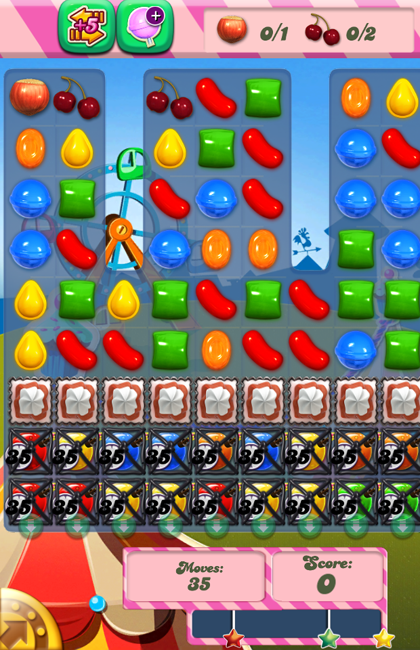
This level is so trick-sie. You think you need to clear the bottom, so you waste valuable moves clearing all that licorice and whipped cream so you can explode the bombs. But look at that — they are set to 35 moves, and you only have 35 moves. In other words, they’re a distraction and don’t really matter.
Only clear the lines that have ingredients in them.
Here’s my advice: play this level on a mobile device, since you can exit when you don’t get a good starting board and try again without losing a life. What you’re looking for is an opening move that either (1) creates a horizontal break against the whipped cream (three across) or (2) makes a doughnut. That’s it: if you don’t see one of those two opening moves, exit out and try to have it reshuffle and present a better board.
This board you would play, right, because you can make those three reds pop the whipped cream? NO. Because that moves opens up whipped cream that isn’t under an ingredient. See, I told you it was trick-sie. Exit the board and try again until you get one that has a decent opening move.
Level 182

This is one of the worst timed levels ever.
You have four quadrants. The one on the bottom right is the “lowest” (meaning, the candies will cascade there). The top right is the second “lowest.” The top left is the highest, which leaves the bottom left as second “highest.” In other words, the candies move from top left to bottom left to top right to bottom right. If you want to create a cascade effect, make matches in the bottom right.
So you have three bits of craziness all demanding your attention at once PLUS there is a timer. For the love. So here is how you need to focus your attention: break the chocolate, explode the colour bombs, and then break the whipped cream. Once the chocolate is gone, it’s gone for the rest of the level. Same with the colour bombs.
But the big thing to get points is to break that whipped cream and have those candies cascade. Without that, you won’t be able to make enough matches and build up enough points to get to that 40,000 point target.
So, your focus is chocolate (bottom right), then colour bombs (top left), then whipped cream (bottom left), and then cascade, cascade, cascade from the bottom right or top right.
You may need to use my timer trick once again, which only works on a mobile device. When you can’t instantly see a move, give yourself a break by double tapping the home button at the bottom of the device. This pauses the timer and slides the game up on the screen to make room for the apps row at the bottom. You can then scan the board for a moment and look for the best move that will net you the most points. Then touch the screen to make that move and the screen will drop down and return to normal.
Currently: I’m on Level 213, and I’m happy to go backwards and explain how I did any board before that. Sometimes it was stupid luck but other times, there was actual thought involved. Let me know the level you’re struggling with.
September 29, 2013 35 Comments
Siri’s Voice Changed on iOS7
It is so tiny, so subtle. A shift so miniscule that you may not pick it up unless you hear the old Siri once again and remember that her voice was originally a little more metallic, a little more hesitant, gravelly. It is the difference between a photo taken with a 4 megapixel camera vs. an 8 megapixel camera. The voice — like a photograph — is crisper. It has focus, fluidity.
Normally we strive toward things that are better, improved. But this change threw off the Wolvog. A voice — something so personal, so identifying — was different. He could deal with the visual changes to the operating system, shifting his eyes in a way that he couldn’t shift his ear.
She no longer sounded like his Siri. He wanted to go back to iOS6.
Except that we never made a backup of his iPod before we began.
So he is stuck with the imposter Siri. He is trying to like her; trying to give her a chance. But she wasn’t just a half-forgotten program rarely used on a phone. She was the receptacle of his web searches, his mindless tasks. He has a fondness for her that one usually reserves for an old neighbour, someone who used to tell you great stories or pass out particularly good candy on Halloween.
Jony Ive, if you’re reading this, there is one little boy who really wishes he could have five minutes with the old Siri; just to say goodbye.
September 28, 2013 17 Comments