

Blogging without Stats
I read a post on Slate about the Pirahã who live in Brazil and have no words in their language for numbers. The article explains:
The language contains no words at all for discrete numbers and only three that approximate some notion of quantity—hói, a “small size or amount,” hoí, a “somewhat larger size or amount,” and baágiso, which can mean either to “cause to come together” or “a bunch.”
I was fascinated by the idea of anumeracy because I couldn’t imagine a world without numbers. A world where I wasn’t constantly keeping track of time, measuring ingredients, or focusing on word count.
 Image: Denise Krebs via Flickr
It made me wonder how social media would change if we had no sense of our stats. Numbers dominate social media; rule it — more than quality content when we take things away from the personal. We are numerically-focused on how often we post. We consciously or unconsciously count up the number of comments, subscribers, daily readers. We are reminded of our number of followers or friends every time we log into Twitter or Facebook. And we internalize those numbers even when we don’t want to internalize those numbers. They mean something to us. They change how we view our space on the Web; especially when other people’s numbers are readily available for comparison.
How would social media change if we had no sense of how many followers we had? If we had no sense of who or how many were reading our words? Would we be more careful, mindful of the fact that we have no concept of our reach and therefore cautious about what we say lest it bite us in the ass? Or would it be freeing to not constantly focus on whether blogging or the like is worth our time based on the number of people our words reach?
Short of closing the comment box, not installing blog metrics, and staying off of other social media sites, it’s impossible in our number-driven world to be completely clueless of your blog’s reach in the same way that you may not have a sense of just how many people in this world care about you but you certainly can count up the people you consider friends. We always know the minimum amount even if we don’t always know the maximum. But sometimes knowing that minimum can affect the quality, the scope, and the frequency of our posts.
How would you blog if there was no focus for anyone on numbers?
November 3, 2013 7 Comments
Advice to Pass Along: Level 275 of Candy Crush
It hit my three email threshold: I was asked multiple times how I solved level 275 of Candy Crush. So here is the answer. It is What it Is, avert your eyes. Or run screaming. Whatever you need to do because the world wants to know how I beat the chocolate and the bombs and emerged triumphant from level 275. Or… at least a few people do.
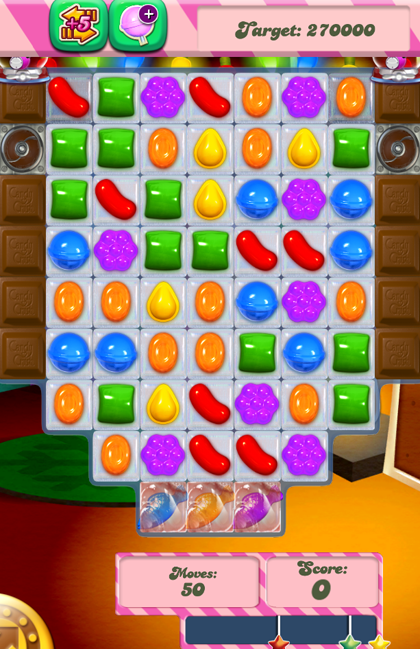
This level figuratively asks the player a thought-provoking what if: if you were to, let’s say, to have your hard drive crash, would you rather have it happen before you’ve written your Great American Novel, or after you’ve written 300 of the best pages that you’ve ever written? If you’re someone who doesn’t care if you’ve just done a ton of work for nothing, play this board however you wish. On the other hand, if it would be more maddening to not only lose your hard drive but lose all of your hard work, then follow my advice.
You need to work the top half of the board before you work the bottom.
So look at those two pieces of chocolate in the top two corners of the board. They are holding back 3-move bombs. You do not want these bombs to drop; ever. So don’t break that chocolate. There is no jelly beneath, so you’ll never have to touch it.
Every other square on this board has jelly.
What you want to do is get rid of those two squares next to the chocolate machines first. In the picture above, there are green candies in the two squares. Do NOT worry about the two squares next to that chocolate — currently the red candy and the orange candy. Those will likely get wiped out by cascading candy at some point or you will get them with a vertical stripe. Either way, there are ways for that jelly to pop that will not break the chocolate and release the bombs.
You want to clear those green candies first because if you mess up and the bombs drop, you only wasted two seconds of your time. If you wait until the end and try to clear them and those bombs drop, you just erased your hard work. So do them first and get them out of the way.
Next, clear the top half as best you can while holding the chocolate at bay. At some point near the beginning of your game, open those fish at the bottom and release them so they eat a little jelly too. You want to do this early-ish because you have no control where those fish go. And they could end up inadvertently releasing the bombs too. Even better is if you can combine a striped candy (and colour) with a fish. Again, no control, but it can clear a lot of jelly.
This is a level where vertical stripes (and if we’re talking about beneath the chocolate machines, horizontal stripes) go far.
So that’s it. That’s how you beat level 275.
Currently: I’m on Level 288, and I’m happy to go backwards and explain how I did any board before that. Sometimes it was stupid luck but other times, there was actual thought involved (here are the other advice posts I’ve written). Let me know the level you’re struggling with.
November 2, 2013 39 Comments
466th Friday Blog Roundup
I eat my kids’ Halloween candy. I’m not even discreet about it. I tell them when they wake up in the morning. I leave the wrappers at the top of the rubbish bin. We have a fairly symbiotic relationship in that I like what they don’t (for instance, huge fan of Mounds, whereas no one else in the house likes coconut). But I also have no shame in taking what they do like. My feeling is that as long as I am willing to replace said candy by purchasing them more candy in the future, then I should be able to dip into the sweet loot they collected last night.
I do this knowing that I would have been upset if my parents had eaten my candy.
This probably makes me a terrible person. I would spend some time thinking about that, but I’m too busy eating through their Kit-Kat bars.
*******
I love the creepy haunted doll reading your mind video:
*******
The 2013 Creme de la Creme is trucking along. There are currently 56 on the list with over a month and a half left to go until the hard deadline (December 15!). So, are you on the list yet? Extra love to people who submit early!
*******
And now the blogs…
But first, second helpings of the posts that appeared in the open comment thread last week. In order to read the description before clicking over, please return to the open thread:
- “The Weight of Being Interesting, and Pumpkin Spice Cookies” (A Half Baked Life)
Okay, now my choices this week.
Bits and Peaces has a post about the fear that comes at the end of a pregnancy; both for the labour and delivery, but also that time after when you are responsible for this other person’s life and you don’t know if you’ll be up to the task. Her son was born since she published this post, so it makes for an even more interesting read since she is now in that next stage she feared.
A Little Bit More has a great post about actually rescuing a kitten from a tree — yes, it really happens! I loved this post just because it’s a really good story well-told with kitten pictures to boot. Enjoy!
Birds, Bees, and Medicine has a post about her world slowing down during a power outage. I bookmarked it, thinking, “maybe I should declare certain evenings ‘power outage’ evenings and act as if we have no power.” And moments after thinking that, I heard a strange snap and then OUR POWER WENT OUT. This post must be extremely powerful because it cut out power to my entire town for about a half hour… And guess what? Being without power is really hard, especially when you have stuff you need to get done. So rethinking power outage evenings.
Cracked up reading Sweetest in the Gale’s post about the art in her RE’s office. She writes, “Paying out of pocket for my monitoring appointments is so worth it because it’s not just a trip to the doctor–it’s like a trip to the museum. It’s a chance to experience art, people.” It’s worth clicking over just for the mer-family.
Lastly, I read two posts back-to-back about the same idea: that not every parent has a birth story. A+ for Effort and Family Building with a Twist both talk about being with other parents bonding over their birth stories and not being able to participate. Both posts serve as either a great reminder or a brand-new way of viewing that bonding practice, depending on your life experience thus far. And both are incredibly well-written.
The roundup to the Roundup: I eat the twins’ candy, and I feel no shame. Love the creepy mind-reading doll. The 2013 Creme de la Creme opened: is your post on the list? And lots of great posts to read. So what did you find this week? Please use a permalink to the blog post (written between October 25th and November 1st) and not the blog’s main url. Not understanding why I’m asking you what you found this week? Read the original open thread post here.
November 1, 2013 12 Comments
Selfies at Funerals
I’m going to admit it: I’m totally fascinated by the on-going discussion of selfies at funerals kicked off by the Atlantic post this week, just in time for Day of the Dead. It almost feels like they created this trend JUST to have Halloween/Day of the Dead programming. I can just imagine writers covertly nudging teens in graveyards and whispering to them through their tears over their loved one’s coffin, “this would be an excellent time for a selfie, don’t you think?”
Not that I’m cynical in any way.

Image: Elvert Barnes via Flickr
The Atlantic article introduced the aptly named Tumblr site, Selfies at Funerals, which posts selfies taken on the way, at, or after funerals. I’m sort of enthralled that there are enough people doing this to build a site around it. I’ll admit that taking a selfie in general is the last thing on my mind, but especially at funerals. I mean, in Judaism, we don’t even look in mirrors while we’re in mourning. I can’t imagine thinking, “I would love to capture these swollen eyes and runny nose for the world to see.” Though no one looks very tearful in any of the images on those sites. I’ve personally never been to a funeral and not cried. So I think I may be on a different playing field.
Which is why I was glad to see Jezebel tackle this topic with a defense of the funeral selfie. Finally, someone was going to make sense of this for me. And I’m not being sarcastic when I say that Jezebel gave me a very different way of viewing the act of self-documenting your life by snapping a photograph at a funeral (which, when you think about it, isn’t that far off from writing poetry or non-fiction or blog posts about funerals).
The Jezebel article points out that we as a culture created our disengagement from death and subsequent inability to deal with mortality. The author asks,
Funeral homes come and immediately take our dead bodies away. Would these teenagers have the time to take a selfie in Japan, where after the cremation the family members gather around the bones and place them in the urn with chopsticks? Or in traditional Jewish culture, where the body is washed, purified with water, and dressed by men & women of the community? Or in Madagascar, where the whole family disinters the corpse, wraps the bones in new cloth, and dances with the bones to live music?
I don’t buy the whole argument since I have never prepared a body and yet understand the gravity of a funeral (and have since a young age). But I do agree, as I said yesterday, that I think on a whole, the vast majority of the secular, Western world is so squeamish in discussing death that we sometimes can’t even tell strangers the truth about our lives lest we distress them. We are disengaged; and cameras, computers, blogs, Twitter — they’re all ways of documenting, but they’re also ways of disengaging from the moment with the idea that you will revisit later. I am a notorious documenter; taking photos everywhere I go and thinking up how I want to write about it as I live it. Life is huge, messy, emotional, overwhelming. Taking that step back helps keep the world in perspective.
Or they’re just self-absorbed jerks.
I also liked the New York Times piece on selfies a few days ago, which sums up the trend thusly:
Rather than dismissing the trend as a side effect of digital culture or a sad form of exhibitionism, maybe we’re better off seeing selfies for what they are at their best — a kind of visual diary, a way to mark our short existence and hold it up to others as proof that we were here. The rest, of course, is open to interpretation.
The rest, I’m assuming, is context. Selfie on top of a mountain to mark that you got to the summit, okay. Selfie at a funeral… maybe not so much.
Of course, for all we know, the deceased who are being buried in those photos could be HUGE selfie takers (as grandparents usually are these days) and love the thought of other people marking their passing in that manner. Maybe they expressly asked their loved ones to take pictures of themselves at their funeral, and then don’t we all have egg on our face for judging another person’s dying wishes?
I am being only a little tongue-in-cheek because the conversation this week around selfies and funerals reminded me of Kathy’s post about live tweeting a funeral; something done with the widow’s permission and love, allowing people who lived far away to be there in spirit and know what was happening at the service. Social media is in the delivery room, marking the moment of birth. It seems fitting then on some end to have social media at the funeral, marking the death.
Though I sort of hope my loved ones leave technology at home for the shiva. Just be present in the moment so you can appreciate the totally awesome soundtrack I put together to mark the occasion.
How would you feel if you saw someone taking selfies at a funeral? Would you not care if people took selfies at your funeral or would you haunt them from beyond?
Happy Halloween, everyone.
October 31, 2013 12 Comments
The Unfairness of Bringing Up Loss
I read the David Sedaris piece in the New Yorker about his sister Tiffany’s suicide. I found it very moving but difficult to get through. But it’s good to be challenged; it’s good to read something that shakes you to the core every once in a while.
The article begins and ends with a thought that resonated with me. He explains that part of his identity is that he is one of six kids, and his sister’s death took away that part of how he defined himself. He writes (and in the interest of space, I replaced sentences with ellipses, so you’ll need to click over to read the whole passage on the first page),
“Six kids!” people would say. “How do your poor folks manage?”
…
Now, though, there weren’t six, only five. “And you can’t really say, ‘There used to be six,’ ” I told my sister Lisa. “It just makes people uncomfortable.”
I recalled a father and son I’d met in California a few years back. “So are there other children?” I asked.
“There are,” the man said. “Three who are living and a daughter, Chloe, who died before she was born, eighteen years ago.”
That’s not fair, I remember thinking. Because, I mean, what’s a person supposed to do with that?
First and foremost, I would argue that he’s still one of six, even if one of the six is no longer here in the same way that he is a child born to two parents, even if his mother has since passed away.
Death is common. In fact, every single person on earth will experience death, even if they live completely separate from the rest of society. 105 people die in this world every minute. In the time that it will take you to read this post, there will be hundreds of people gone from this planet. And there will be people who will know those people.
I guess his sentence gave me pause because I couldn’t see how bringing up death isn’t fair; how not discussing death got chosen as a societal norm.
He asks what are they supposed to do with the news that his sister is no longer here? They’re supposed to understand him better. They’re supposed to think about mortality. They’re supposed to be clued in to the realities of this world. People die. Sometimes people die because they take their own life. Sometimes people die before they’re even born. Sometimes people die of old age. But in all cases, those people deserve to be discussed, because being discussed is a way of being counted, of saying, “they were here” whether it was only for a few months inside a woman’s womb or for 80 years, walking around this planet.
He ends his piece with a conversation with a realtor, returning to this idea of now being one of five.
“So is that one of your sisters?” she asked, pointing to Gretchen.
“It is,” I said. “And so are the two women standing on either side of her.”
“Then you’ve got your brother,” she observed. “That makes five—wow! Now, that’s a big family.”
I looked at the sunbaked cars we would soon be climbing into, furnaces every one of them, and said, “Yes. It certainly is.”
It is his choice whether he chooses to bring up Tiffany or not, especially with a stranger. But it makes me sad to think that he felt it was polite to refrain from explaining that there was someone missing from their group. No one should ever feel that they need to refrain from bringing up someone they loved.
This concept of shifting identity is familiar to those experiencing infertility or loss. Everyone who experiences death experiences a loss of their personal definition; of who they are in relation to the world. Sedaris says that he was one of six and now needs to redefine himself as one of five.
The childless mother requires a similar redefinition: especially if in your head, you have been thinking of yourself as a mother-to-be-to-a-live-child for months or years. The definition may come about early on: I thought I would be a mother, but this is not happening as I thought it would. I thought I was fertile, but I’m actually infertile. The definition may grow in length as much as it loses in specifics: I am now a mother to a child via adoption. Or it may change completely: I was a mother-to-be-to-a-live-child and now I am a woman living child-free after infertility. The definition may be written by circumstances beyond your control, or you may rewrite the definition yourself. These are only three examples; any life crisis requires the person to redefine themselves over and over again.
Sedaris’s article is a beautiful piece if you’re up to reading it. And its existence and this post prove that we should talk about death when we want to talk about death; because in doing so, we start important conversations. I would have never written this if he hadn’t brought up the fact that he used to be one of six. It’s okay to make people uncomfortable; to shake them up a bit. It makes them think.
October 30, 2013 18 Comments