

I Don’t Know How I Feel About Glow
I’m certain that you’ve seen it popping up in the news as well; a new-ish app called Glow that helps you pinpoint your fertile days. It operates in the same manner as the long-standing FertilityFriend: you input data, the program starts to see the pattern, and it helps you to read your fertility signs. What is newsworthy is that they’ve added a new feature which they’re calling a type of fertility insurance. Smithsonian reports on how it works:
Couples or women trying to get pregnant pay $50 to the company each month. Then, if they have not become pregnant at the end of 10 months, they receive at least $500 towards infertility treatment services. The money from all the couples who were contributing to the pool is split among those who did not become pregnant, so the more people participate, the more money the couples who don’t conceive will receive.
Unless I’m doing my math incorrectly, you give Glow $500 over 10 months. If you don’t get pregnant, they give you your $500 back (or, perhaps more if enough people join along AND get pregnant!) so you can pay for one vial of injectable medication. If you do get pregnant, you’re out $500. Wait, can we back up again to that if you don’t get pregnant thing? Do they know anything about fertility clinics? Do they know how little you can do with $500? Even in a mandated state with decent insurance, we were still paying several thousand out of pocket. Our testing was covered down to the obscure thrombophilia panel they tacked onto the normal thrombophilia panel, and we still paid thousands upon thousands of dollars. If you don’t have coverage, that $500 isn’t going to get you in the stirrups.
And that money is designated solely for fertility treatments. So if you decide to pursue adoption or not pursue treatments at all, you’re out of luck:
After 11 months, Glow First will pay an accredited infertility clinic (check list) of your choice when you submit proof of your medical costs.
In other words, you need to submit more personal information about yourself to this app-maker in order to be reimbursed. And after they’ve collected heaps of information from your medical records… they’ll give you enough to pay for an ultrasound or two. Because even if thousands of people become pregnant, leaving their contributions behind, we’re still talking about a relatively small pool of money to be split amongst the people who have jumped through the hoops and remembered to log their cycle 10 months in a row.
It’s a nice idea and I’m sure the app is great. I personally am partial to FertilityFriend just because I started there about 12 years ago, but there’s room for others to get in on the telling-you-when-you’re-ovulating game. I’m just not sure how I feel about Glow First. It seems like people would be better off paying themselves $50 per month so they’d definitely have $500 in hand at the end of 10 months. Then they wouldn’t need to pass along their medical information to a third party. And while they may not hit the jackpot, they can rest assured that they also didn’t gamble with their fertility. They didn’t wait 10 months just to capitalize on a program, they didn’t have to jump through hoops to get it. That money is simply back in their pocket, where it belongs. Because if there is a problem, they’re really going to need it.
What do you think of Glow? Has anyone tried it yet?
February 27, 2014 10 Comments
Paparazzi, Celebrity Kids, and Exploitation
Back in January, I first read about a group of celebrities who were imploring fans to stop reading magazines that use paparazzi-taken photos of their kids. The boycott points out our role in the harassment of people related to the celebrity; Kristen Bell states that if we stop buying these magazines, the demand for these photos will go away. Of course, the magazines won’t know if we’re not reading them for the baby photos, the insipidness of the articles, or the perfume samples they slip inside the pages. But still, as someone who is incredibly squeamish about overstepping lines, I’m in favour of Kristen Bell’s requests.
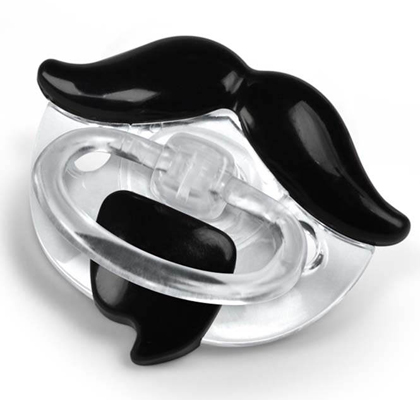 Good binky for disguising young children
Image: US CPSC via Flickr
I like to think of my life like one of those divided plates where I’ve put myself in the largest protein portion, offering myself up for consumption. But the kids and Josh are like the separated out peas and carrots and corn. They’re right beside me, but they’re clearly not mixed in with me. It’s my decision if I want to give up some of my privacy. But it’s not my decision to make as to whether the twins give up their privacy. And it certainly isn’t my decision to give up someone else’s child’s privacy, hence why I am so wholly against people putting up pictures online without permission; and that includes class pictures, group shots of the sports team, or party photos.
Unless you’re cool having your privacy invaded, don’t invade someone else’s.
But I digress.
People magazine put up a statement yesterday about their use of celebrity children’s images in the magazine. They are moving toward only using posed photos from events or ones taken with permission. A step in the right direction though I’d caution all those celebrities releasing photos of their kids that their kids may not be thrilled to have that picture of them playing in the park in a national magazine.
But what gave me pause was a snarky little sentence in the middle of People’s statement:
And there’s always the tough balancing act we face when dealing with stars who exploit their children one day, and complain about loss of privacy the next.
Exploit their children? While there are celebrities and non-celebrities alike who make parenting decisions that I would never make, I can’t say that I can point to one celebrity who exploits their child. Can you? There are celebrities who sell baby photos of their children and donate the money to charity — such as Angelina Jolie. The reason usually given is that by providing the images, they hope to stave off paparazzi who are trying to steal an image by bothering them in public. Bring children to events? Sure — but is that exploitation? To me, exploitation is using a child for gain. And I’m not sure what is gained that wouldn’t be gained otherwise by attending an event without your child. Is the child being used to get the parent work? Money? Do I think some people see their children as accessories that they put on when they’re in the mood? Sure, I’m sure there are people out there like that. But that isn’t exploitation. That’s just crappy parenting.
Accusing someone of exploitation is a character assessment. And while I think there are child celebrities who are being exploited by their non-famous parent — pushed into privacy-stealing positions without being properly prepared for the pressure — and child celebrities who are being exploited by their celebrity parent a la the children of reality television shows that feature children on-air, I can’t think of a celebrity parent who is exploiting their non-celebrity child. It’s a fairly charged word. I’d be really curious if People magazine is privy to behaviour that shows clear exploitation from celebrities who are complaining about their child’s lack of privacy. I would be very curious to learn who they believe exploits (meaning; derive benefit from) their child AND complains about a lack of privacy.
What do you guys think of the boycott of paparazzi photos of celebrity kids? And can you name a celebrity that exploits their non-famous kid?
February 26, 2014 14 Comments
Nancy Kerrigan and Samuel Sheinbein
Twenty years ago, Nancy Kerrigan was clobbered in the knee by Shane Stant. After the attack, she didn’t know if she would get to go to the Olympics, skate again, even walk ever again, and the world held its breath as the details emerged tying the attack to a rival skater’s husband. Every few years, the story is trotted out again: Nancy Kerrigan and Tanya Harding. And this year was no different. Before the closing ceremony for the Olympics, they aired old footage coupled with new interviews of the skaters who both expressed disbelief that people were still talking about this story even though it took place in 1994. They had both moved on with their lives; why couldn’t the general public?
We watched some of the documentary while we waited for the closing ceremony to begin, even though I rolled my eyes when it came on.
“Again? We need to hear about Nancy Kerrigan again?” I asked.
“Who is Nancy Kerrigan?” the ChickieNob questioned.
“Every generation needs a retelling of the Nancy Kerrigan/Tanya Harding story,” Josh intoned. “Every generation gets the retelling it deserves.”
“Exactly, who is Nancy Kerrigan,” I pointed out. “She’s a skater. Just like any other past Olympic skater that we can’t really remember because we’re not ensconced in the skating world. This coverage belongs back in 1994.”
I’m done. Nancy Kerrigan. Tanya Harding. I don’t need the 24-year recap at the next games.

Image: Maria Cabello via Flickr
*******
Seventeen years ago, Samuel Sheinbein and Aaron Needle killed and dismembered Alfredo Enrique Tello, Jr. It was a gruesome crime. The killers were students a few years behind me at one of the local Jewish Day schools. Aaron Needle killed himself in jail. Samuel Sheinbein fled to Israel, utilizing the Right to Return law. And since Israel had a policy of not returning criminals to places that had the death penalty, they kept and tried Sheinbein, sentencing him to 24 years in an Israeli prison.
It was a very tense time here both because everyone was local, the families were known, and it brought up the Right of Return. The law was meant to make immigration easier, not to protect criminals. But it was being exploited by a murderer, and the community was up in arms. Scratch that: the country was up in arms. It was a case that gutted us on so many levels: affluence vs. poverty, troubled teens not being reached, Right of Return, murder.
This weekend, my mother and I were looking up something else online when I saw the front page of Yahoo announcing Sheinbein’s death. He had been involved in a shootout in the jail after he got hold of a gun. He fired on the prison guards, and he was killed by a SWAT team. It felt surreal to see his name pop up again in the news, to be reminded of all the discussion that surrounded the first crime.
I spent the night reading articles online about the shoot out, going back to reread old newspaper clippings online from his first crime.
*******
That need to return to a story is so personal. I don’t even mean on a crime level. I’m talking about our need to rehash personal slights, old fights. To keep bringing up incidents years after the fact; to remind the other person that we haven’t forgotten. And then there are the stories that penetrate our collective consciousness; the Tanya Hardings and the Samuel Sheinbeins. There are people who never want to think about either one again. There are people who want to have the story retold.
And then there is the conflict that arises from those who need to look backwards from those who want to move on. It’s usually the person who has done the harm that wants to move on. Who doesn’t want to be reminded of how they messed up. But sometimes, when we talk about these stories, we have a gut reaction to the retelling. We have enough of Tanya Harding. We want to hear more about Samuel Sheinbein. Or vice versa.
Both stories continue and both stories are done.
And the newspaper cycle goes round and round.
February 25, 2014 6 Comments
When Does Your Fertility Decline? Uh… Sooner Than You Think?
So there was an announcement made last week by the American College of Obstetricians and Gynecologists (you know, that ACOG acronym after your doctor’s name) saying that fertility now starts declining at 32 and picks up speed like a rolling snowball at 37. So that old 35 advance maternal age line is now more like a hotel swimming pool that has a nice shallow end, then a little dip, and then a big drop off so people can dive head-first without breaking their necks. Except it’s the opposite. It’s more like, dive in when the water is shallow because… well… this analogy isn’t working.
The point is, they just took 3 years from your midlife plan.
Except, of course, they didn’t. This fact has always been there whether we want to recognize it or not. And a decline is just that, a decline. If you were going to be infertile at 27, you haven’t suddenly gained years of fertility, and if you were going to be fertile at 40, then you get to keep going with the babymaking. And a decline is a nice way of saying, “maybe or maybe not.” It’s sort of the equivalent of the word “nice.” What does nice mean? Well, you can make it means sort of anything you want. You know it’s not bad. But it certainly doesn’t sound effusively good. It’s just sort of there. And that’s what this fact is too. It’s just sort of there, something you’ve known your whole life: if you want kids, don’t wait.
The Daily Beast has an interesting article on how OB/GYNs walk a fine line in passing along this statistic to their patients. It’s not difficult for a general practitioner to let their patient know how that case of sugary soda they’re drinking daily may kill them. It doesn’t present a conflict when an eye doctor tells their patient about advances in laser surgery or a dentist broaches the topic of teeth whitening; especially when there is no pressure in the offer and it’s being held out as a possibility. I don’t even think it’s a problem if an OB/GYN brings up the idea of egg freezing despite its success rates, the difficulty of IVF, and the cost (emotional and financial). I look at it as education; placing the ball in the patient’s court.
But what about counseling a person to build their family before they’ve started to build their family?
Encouraging a person to take on responsibilities they may not be prepared to take? To raise another human being? To telling them that if they wait it may be too late, but perhaps in turn pushing them before they’re really ready due to a fear of the unknown (which may or may not affect them)? That’s really tricky. This advice doesn’t just affect the patient; it affects an unborn human being who may then be born into a situation where the parents are ill-prepared.
And what sort of judgment call do the doctors make? Do they tell it to all women, regardless? Tell it only to women above a certain age (and then, what age)? Tell it to only married women? Only those they think would make a great parent, or do they tell even the ones who are barely holding their own lives together? And how do they decide that when all they really know about you is whether or not you shave your legs for the appointment or how your cervix looks?
But if it’s not the OB/GYNs job to counsel on family building, whose job is it? And if no one is passing along the information, how do we expect women to know it?
It feels like in an effort not to offend or cajole, to not place women in an uncomfortable position socially or over-assume their intentions, everyone is dropping the ball on having this conversation, and in turn, there are plenty of women who feel blindsided when they discover that fertility declines; maybe even sooner than they thought and therefore didn’t know there was a problem they should address in a timely manner when they do start family building.
Do you think OB/GYNs should discuss family building with all women who walk into their office and if so, should it be every appointment, after a certain age, in various situations?
February 24, 2014 23 Comments
The Most Popular Curse Words on Twitter Depress Me
A study was done looking at what, how often, and when we curse on Twitter, with the top 20 curses on Twitter being listed. Curse word is used loosely in this case. Yes, the ones you’d suspect are on the list, but also, a bunch of words that we’d deem “could get you sent to the principal’s office” — such as whore — are also on the list and aren’t curses insomuch as they are descriptive terms. I mean, perhaps your sister really is a whore, as in that’s her job. So technically, by writing something like, “gah, my sister caught a VD at her job!” And having one of your Twitter followers tweet back, “what does she do?” And you respond, “my sister is a whore.” Well, then, you cursed. According to this study. Just kidding. They even looked at how we use curse words online.
The researchers were able to find 788 curse words to research. That’s a lot of curse words. Which means that some of them are less curse-y than others. I started trying to construct a list of the curse words I know in my head, but I petered out before I hit 100. So well done, researchers.
So, first and foremost, you should know that research has found that “0.5% to 0.7% of all the words we speak in our daily lives are curse words.” On social media, it’s 3%. So we curse a lot more when it’s going to be on the screen for eternity than when we’re saying something in passing to a single person that will not be recorded. Interesting. One out of every 13 tweets contains a curse word.
Over 90% of the cursing on Twitter is done with the top seven words: fuck, shit, ass, bitch, n*gga, hell, and whore.
Yes, I put as asterisk in that word. While fuck, shit, ass, bitch, hell, and whore don’t bother me in the least, that last one does. Everyone should have a personal bar, and that one doesn’t clear mine.
Nor do a few others on the 20 most popular swear words list:
- Fuck
- Shit
- Ass
- Bitch
- N*gga
- Hell
- Whore
- Dick
- Piss
- Pussy
- Slut
- Puta
- Tit
- Damn
- F*g
- Cunt
- Cum
- Cock
- Blowjob
- R*tard
Three of my least favourite words hit the top 20, two of which are lecture-worthy to me. In other words, when I hear kids saying them in public, I say something to them. While I try not to make it a habit of lecturing other adults, I have no problem trying to shape the youth of America. So I have been known when I hear kids shout out things such as “that’s retarded!” or “that’s so gay!” to paddle up to them in the pool and cheerfully let them know how much their misuse of the word affected me. My hope is that I startle the use of that word right out of them. And, at the very least, they will never forget the day that woman in combat boots came up to them in the mall and told them how she feels when she hears those words misused. And they have the image of my smiling face in their brain every time they say it.
Again, we all have our own bars and no one has to listen to me and elevated their verbalizations to reach mine, but these are cases where I am not a delicate flower and cursing stings my precious ears. This is a case where I can explain the etymology of the word, how it came to be used negatively, and why it offends me to hear someone use it so flippantly.
So it depresses me to hear that my two pet peeves — #15 and #20 — made the list.
Back to the cursing breakdown, fuck covers 34.73% of the cursing done on Twitter. It really carries a heavy weight in comparison to the work done by the next most popularly-used words, shit. Shit only occurs 15.04% of the time. Followed by “ass (14.48%), bitch (10.34%), n*gga (9.68%), hell (4.46%), whore (1.82%), dick (1.67%), piss (1.53%), and pussy (1.16%).”
Why we curse is mostly to vent our frustrations: “Not surprisingly, cursing is associated with negative emotions: 21.83% and 16.79% of the cursing tweets express sadness and anger emotions, respectively.” Though the rest of the story is one of using curse words to express love: “However, we also find that 6.59% of cursing tweets express love. One reason is that curse words can be used to emphasize emotions, including positive ones such as love: e.g., “fucking love you.” Another reason is that certain curse words are used between close friends as a playful interaction, e.g., close female friends call each other whore.”
The study goes on to look at when we curse and where we are when we curse and who curses more when it comes to men or women.
You may wonder about who funded this study. “This research was supported by US National Science Foundation grant IIS-1111182: SoCS: Social Media Enhanced Organizational Sensemaking in Emergency Response.” Thanks, US National Science Foundation. Money well spent.
Are you more or less likely to use a curse word online vs. in regular speech considering the possible permanence of the Internet?
Note to my mother: I had to write curse words in this case because I’m reporting on research. It’s not my fault.
February 22, 2014 18 Comments