

I Spent the Day with a Robotic Giraffe
So the White House hosted their first Maker Faire today, and I got to attend and see the exhibits after the President spoke. And I fell in love with the robotic giraffe.
It’s a robot! But it’s a giraffe! And it’s as big as a giraffe. And it was the coolest thing I’ve ever seen.
There were other mind-blowing things on display. I watched a 3D printer create a prosthetic ankle while I chatted with the inventor. I went in the traveling Fab Lab and saw laser cutters. Makey Makey was there with a banana piano.
But that robotic giraffe. How could anything compare to a robotic giraffe?

You can read more about the day over at BlogHer.
On a totally unrelated side note, I learned an interesting piece of White House trivia from one of the photographers today. There is a piece of marble underneath a window when you walk in that is discoloured.

It is the only piece of marble that wasn’t replaced from the 1814 fire. That chunk of burned marble is 200 years old this year. I’ve walked by it dozens of times — I have a picture of the twins in front of it! — but I never noticed that it was a different colour until today.
June 18, 2014 5 Comments
Opt-ions Two
So… yeah… still looking closely at the blogosphere and social media world.
Image: Ali T via Flickr
The twins know that for the next several years or so, we have set up their accounts so we can see all of their online activity. They don’t have social media accounts, but they do have email that runs through my email account. And I can see their outgoing and incoming text messages. I check their iPod regularly, and peer over their shoulder while they’re typing. On one hand, they’re starting to balk at the lack of privacy. And on the other hand, they love that they never have to worry about going through anything alone. We are there to guide them as they socially make their way online, and the option of trackability is out of their hands. They get the safety net afforded by parenting while still being able to roll their eyes with their friends and complain about us. Win-win!
We know that in the future, we’ll have to turn over their accounts to them and remove these features. Hopefully, by then, they’ll know how to comport themselves online. They’ll know how to be clear to others how they want to be brought online. And they can always ask us to step in and help them solve a particular problem while keeping the rest of their communication private. But right now, we’re responsible for them, and if we’re going to be responsible, we need to be comfortable. And part of our comfort comes from tracking their online movements; knowing the sites they visit, the people they write to, and what information they are sharing.
What becomes tricky is knowing the age we pull back. It will obviously be different for each kid, but it’s hard to know when they’re really ready to be on their own. I can see that they’re not ready now, and I can assume — based on what I know about teenagers — that our particular kids will likely be ready by 16 to be on their own online. But it’s sort of like trying to figure out where the ocean meets the sky — where does the blue lighten into that shade we associate with the upper atmosphere vs. the darker blue closer to the water?
All I know is that it’s not emotionally healthy for a kid to be online at the twins’ age without any guidance, and it’s not emotionally healthy for a young adult to be online without any privacy. That in between is sort of murky.
*******
Let’s say that you could put a device in your child that tracked their movements. You could look at a screen and know they were in school or at daycare or at their friend’s house. You could let them wander a bit more, feeling comfortable that you could find them again if they wandered too far or summon them home without panic. And if the worst ever did happen — they were kidnapped, let’s say, or separated from you in a crowded space — you could find them again with relative ease. If this device wasn’t something external that could be tossed aside but rather something internal (with proven safety in regards to health), like an RFID chip (though one that couldn’t easily be removed) it would be a priceless parenting tool.
If it were proven through years of research to be 100% safe in terms of health, I think a lot of people would opt for an RFID chip and the peace-of-mind it would bring. I mean, your child could never be lost. You would never have to go through needless worry.
But when would the right time be to remove said chip? To let them wander freely in the world without that oversight? I imagine most people would keep it through the teen years because it can be nerve-wracking to not know where your teen is, especially once they start driving. Would it be when they graduated high school? College? Would you only track your child in a worst case scenario, or would you leave it on all the time, monitoring that they got to school, got to their friend’s house, were coming back home at night? And what would you do with a child who often got into trouble? Would you simply never turn off their device, especially if they had no clue it was in their body but you could use the tracking ability to stop them from making poor decisions?
If it was 100% safe, would you ever place an RFID chip in your child’s body? Would you let them know it’s in there? And when (if ever) would you turn it off in order to give them autonomy of their movements — online and off?
June 18, 2014 9 Comments
Opt-ions One
There are seven more posts about the book. I’m not sure if I’m going to write them all back-to-back, or pause sometimes to talk about something else, but they all relate to the blogosphere and social media. In other words, by being online, you can participate in the discussion. The book itself is irrelevant in that regard.
All the posts are labeled “Opt-ions.” The reason I divided the word as I have will make sense with the last post, which is the only other one I’ve written at this point. So… uh… that’s how I know that it will make sense.
Image: Ali T via Flickr
So we’ll start with the concept of accountability.
When you sign up for Facebook, you agree to use your real name:
Facebook is a community where people use their real identities. We require everyone to provide their real names, so you always know who you’re connecting with. This helps keep our community safe … The name you use should be your real name as it would be listed on your credit card, driver’s license or student ID.
A bunch of people on my Friends list aren’t using their real names, and they’re clearly not using their real names, unless they’ve legally changed their name to match their blog’s title. Some people are less clearly not using their real name. I had someone send me a friend request, and I had no clue who it was until I saw the picture. She was using her middle name as her last name since it was the sort of name that sounded a little last-name-ish.
I’m not sure how/if Facebook enforces their name rule; if people who aren’t using their real name as it appears on their credit card or driver’s license will have their name automatically changed on the site once the algorithm can link you to your real name based on an online purchase, since Facebook tracks you on non-Facebook sites. If they’ll bump you from the site entirely, which I don’t think will happen because they need users. Or if they’ll let it slide, figuring what harm does it do if people can’t identify you.
Except that they claim that using your real name keeps “our community safe.” Well, that isn’t a small thing. Safety. I mean, if they believe this really comes down to safety, then shouldn’t they enforce that rule?
The Verge had a post a few years back about just that: the enforcement of Facebook’s rules and why they need you to be using your real name. It’s an interesting read.
Facebook depends on its users to be honest. With 239,000 users for every Facebook employee, it’s logistically impossible to verify all the information that is submitted. Fake names, fake ages, fake interests — all these inaccuracies interfere with the company’s ability to accurately target advertisements. Facebook wants to build the world’s most comprehensive database of people. If the information is current and correct, Facebook could eventually become a place where people bank or vote or even file taxes. If it’s filled with errors, it nears uselessness — at least, as far as advertisers are concerned.
So, yeah, real names matter to Facebook. Instead of focusing on the financial benefits for the company, one of the arguments made is that if we are all operating under our real name, accountable for our behaviour, it will help us make better choices. We’ll think before we speak. We’ll own our words and actions.
And that good behaviour could travel offline, ensuring that we won’t commit tiny crimes like stealing toilet paper from work, or larger crimes knowing that our actions will be tied to our names in a huge, transparent way. How many people would have an affair or purchase porn knowing that in the interest of full transparency, everyone they know and love would know about their actions? If all your activities were listed on your Facebook profile, and your profile was linked to your name, then it would follow that it would be a deterrent — at least with smaller, embarrassing-if-discovered actions.
But here’s the thing: if we know that idea is possible, even if it’s not in effect, why do we still continue to make bad choices? Why don’t we live our lives as if everyone can know everything we say and do, in the same way that people drive slower through areas that could be policed by speed cameras, even when speed cameras aren’t there?
The Verge article sums up an interesting idea: “The real-name resistance could be significantly reduced, however, if real names benefited users as much as they benefit Facebook.” And in the case I listed above, knowing how much you can trust the people around you, would go a long way in being beneficial to users. You’d no longer need to guess whether someone is trustworthy. You could look at their profile and know.
Do you think people should have to use their full, real name online — to comment, to use social media, to make purchases — and do you think in doing so, would it curb behaviour and make us into better versions of ourselves? Do you think the comment section of certain posts would be filled with the same kind of bile if people were forced to be accountable for what they say under their real name? Do you think anonymity brings out the worst in us? Do you think you act differently when you think you’re being watched and monitored?
June 17, 2014 17 Comments
Four Books by Forty
My fourth book, Apart at the Seams, went on sale on Saturday. It is once again taking time to roll out on various sites and in bookstores. I’ll have another post when it is up everywhere that will include a scene I loved that ended up on the cutting room floor. But I’ve gotten emails and status updates from people saying they are reading it, so… it’s out of my hands and into yours.
With this moment, I hit an arbitrary milestone I made for myself: four books published by the time I turned forty.
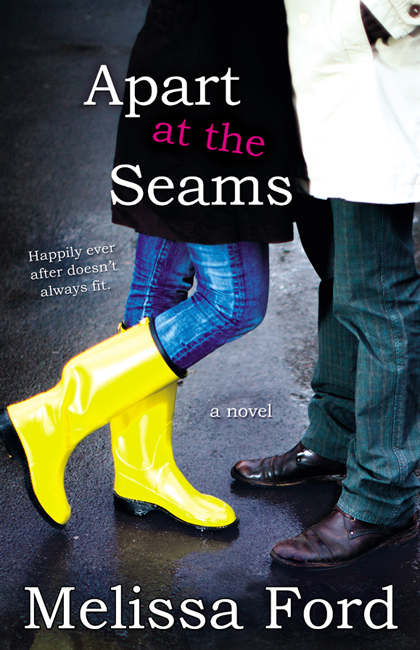
Fine, so the fourth one came in the first two weeks of my forties, but I’m still counting it since I’m not forty-one. I mean, if it had happened last month, it would be four books before forty. But I’ve arrived at forty so I need to use the preposition “by.”
I don’t know why I had that arbitrary goal in mind. I mean, do I now set it for five books by fifty? I sure hope I get to publish another book in the next decade. I mean, I’m partly through writing a new one now. Or am I merely noting the symmetry of the moment: four and forty? Maybe it’s not an accomplishment at all, but more a recognition of a moment. Holy crap. I did it. I published four books.
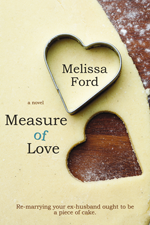
I really hope you enjoy the book. No, you don’t have to have read the first two books in order to understand this one, so feel free to jump into Apart at the Seams even if you haven’t read Life from Scratch or Measure of Love, which follow the same characters. It’s hard to rank your own books, and each has felt like reaching the top of a small mountain. But this one holds a special place in my heart because I worked the hardest to bring it to life.
And in case you don’t read the thank you page until the very end, you are all in there. Because you mean a lot to me, and without your support, I’m not sure these books would have come to fruition. I want to especially thank April, Kathy, Kathy, Jessica, Jessica (why do so many of you have the same name?), Michelle, Jona, Kim, Wendy, Kasey, Pepper, and, of course, Josh for ensuring that when I popped online this weekend, I was greeted with an outpouring of love. Thank you thank you thank you.
And that thank you goes — in advance — to everyone who reads it in the future.
June 16, 2014 20 Comments
Guess What? Your Facebook Account Isn’t as Private as You Think
We’ve long suspected that nothing you put on Facebook is truly private, and a startup company just threw that idea wide open. Others have been proving the flimsiness of the privacy features for a while, but Five Labs just inadvertently underlined the fact that you may want to comport yourself on Facebook as if everything you write and every image you upload is accessible to everyone. Meaning, everything you put on your profile page, everything you put in your secret group chats, everything you put on that site. Period.
Okay?
I read about Five Labs tool in the New York Times. You sign in with your Facebook account and give them access to “your public profile, friend list, email address, custom friends lists, News Feed, relationships, status updates, current city, photos and news activity and your friends’ status updates and current cities.” You know, just a little bit of information. And they in turn will tell you about your personality. Just in case you didn’t know about your personality simply by being the only person in the world actually privy to what goes on inside your head.
Did you catch that?
“Your friends’ status updates and current cities.”
In other words, if I use this tool and give them access to my Facebook feed (an act that many people have done since the story appeared in the New York Times), they have access to your status updates and where you live. And really, I’m getting the feeling that Five Labs may have been modest when they stated how far they could reach into the site. Can they see my friends’ images? What about my friends’ likes or anything on their about page such as their place of employment?
But here’s the thing. Five Labs reach shouldn’t be possible. I have the strongest privacy settings on my account. According to Facebook, those status updates should only be accessible to my friends. Except that we’ve long known that isn’t the case.
And my friend proved that this week.
She used the Five Labs tool. And she discovered that I was one of the ten friends on her list that she was most closely aligned with, personality-wise. They determined this by analyzing my feed and rating me (by which, I mean, that they rated all of her friends) so they could rate her against her friend list. Except I have those pesky privacy settings which should stop someone who is not my friend from seeing my status updates. Yet this app clearly could access my updates because they told her that she was closely aligned with me based on my word choice in my status updates and what I often write about. She posted the results to her timeline, tagging me in the process. And I looked at the screen, seeing what I knew in theory based on reading the New York Times article come true in actuality: my privacy settings were like a flimsy piece of cardboard in lieu of the metal door with the deadbolt lock that Facebook implied I had when I ticked off that “only friends” box.
And that sort of sucked.
And this comes on the heels of Facebook letting us know that, hey, they’re going to share your Web browsing history in order to bring you better ads. As well as the company’s comment that “the privacy of [your] Friends List is actually dependent on the privacy settings of [your] connections.” In other words, Facebook could not say this any clearer: treat their site as you would any public forum. Don’t upload images you wouldn’t want everyone to be able to see, don’t write status updates you wouldn’t want everyone to read, and for the love, don’t put one iota of trust in privacy settings.
But at its heart, Five Labs hits on the catch-22. They’re giving you this information about your personality so you can see how and why certain companies market certain items to you. But because I know this is how Facebook operates, I only offer up the most basic, insubstantial fluff from my brain; the sort of things I wouldn’t mind anyone in the world reading. So how close can a site like Facebook get to knowing the full me, the true me? As it stands right now, I have ads for a restaurant chain I would never eat at, two clothing stores I would never shop at, and an offer for diapers which… I think we all know… is not really necessary in my world. I could give them better information about me so they could serve me better ads, but… I don’t really want better ads.
Which is to say that I don’t mind ads at all. As I said on Neil’s recent post, there are cases — such as ads for books — where I would welcome ads. There is an ad on the left side of my blog, paying for this site. I am sometimes grateful for ads for letting me know about a product I may have missed otherwise. When I’m at BlogHer, I always swing through the sponsor room, mostly because the sponsors know their demographic, and there is usually a handful of businesses I’m deeply interested in hearing from. But Facebook, general sea of every single person I’ve encountered in my life? You have no clue what to serve up. And by default, you’ve lost my attention. I have a much greater chance of seeing an ad that matters to me when I visit a personal blog (because, again, advertisers tend to know their demographic) vs. Facebook where they’re trying to use fancy algorithms to analyze content that doesn’t matter deeply to me.
If my words matter deeply to me, they end up on my blog.
My words on Facebook are easy come/easy go.
This algorithm and Facebook’s algorithm (and by that matter, all these algorithms out there that we’re putting stock into proving something about ourselves or our reach) simply analyzes what we thought to put on a screen. It analyzes an incomplete picture and assumes that it hits something close to the truth, even though what we put online may have nothing to do with what is most important to us off-screen.
Companies want to use algorithms to know what can’t be known. It can’t really be known by two people living in close proximity for years and years. The elusiveness of motivation, the incomprehensible why… all the unknown elements of a personality that drive us to make the choices we make. I really fear the weight we give these things. I don’t mean that I fear Facebook or Twitter trying to figure me out. I just fear regular human beings believing that an algorithm can reveal something as complex as a personality. That we can analyze a bunch of numbers and figure out someone’s reach.
For the love, please don’t log into Five Labs. You don’t need to give away your privacy and your friends’ privacy to have someone tell you something less accurate than what you already know.
And you may want to rethink what you post on Facebook.
June 15, 2014 15 Comments