

How To Tell Children About Third Party Reproduction
How to Tell Children About Third Party Reproduction
by Eric
Before any decision can be made as to how to tell a child or individual that they were conceived via donor conception, the parent must first decide that they themselves are ready to tell. I say this not to provide the parent ammunition to procrastinate but more so to ensure that they are committed to telling. One of the few things I have learned about parenting is that kids can read the mood you are in and if you are not committed to telling they may assign a negative connotation to the news your are giving them that may very well color their perception forever of their conception story.
When I was asked to write this post I knew I was asked to do so based on my commitment to this issue and my knowledge of the resources out there on this topic. Because I am only a parent and not an expert on these matters I encourage you to seek out the sites and books I recommend as resources as no one book, pamphlet, or website site is tailored to meet your individual needs and you must yourself decide what and how you can begin to tell the child their story.
The one general proposition that all the experts have come to agree on is that the earlier the individual learns their story the better. In my own case, we began telling our son at age two and we remind him of his story at various points throughout the year and at various life events where it is appropriate to do so. Our daughter is about 2 ¼ years younger than her brother and started hearing the story almost from her birth as it was already a normal part of our routine to refer to the donor when our son questioned how his new baby sister had come into the world. I must be honest–even as they each approach ages 5 and 3, they do not fully understand the donor’s role but they do know a common donor was integrally involved with their creation / conception and their half sibling is here due to the same donor.
No child understands what the “birds and the bees” story fully represents at these young ages but we tell this story to lay the groundwork. Obviously for older children, young adults or older individuals this approach is inappropriate and for those scenarios I am not equipped to provide useful advice other than complete and utter honesty and the decision to not hold anything back.
Resources
The UK Donor Conception Network has produced what I believe to be the most comprehensive program titled “Telling & Talking” which is comprised of 4 pamphlets and a DVD film to assist parents in their decision to tell and how to tell. The pamphlets are designed for 4 distinct age ranges 0-7 years old, 8-11, 12-16, and 17 years and older. Each pamphlet is free and can be downloaded as a PDF file right from the DCN website. The companion DVD offers a 45 minute film of 10 families sharing their experiences of “telling.”
http://www.donor-conception-network.org/tellandtalk.html
A website put up by the Harvard Medical School for Mental Health and Media
titled “Talking to Children About Assisted Reproductive Technology” offers a mix of commentary and instant audio clips from varying families offering their experiences. The site, beyond offering general advice, focuses on two distinct age groups–kids and teens.
http://www.artparenting.org/index.html
Donor Sibling Registry
Books for Reading with Children:
- Before You Were Born… Book Series from XY and Me Books (Janice Grimes) http://www.xyandme.com
- My Story / Our Story Series from the Infertility Research Trust http://www.dcnetwork.org/ (link through Online Bookshop)
- Tell Your Child Series – Rozanne Nathalie and
http://www.beaverspondpress.com - Let Me Explain: A Story About Donor Insemination by Jane T. Schnitter and Joanne Bowring. Perspectives Press, 1995.
- Mommy Did I Grow in Your Tummy? Where Some Babies Come From by Elaine Gordon. E. M. Greenberg Press, 1992.
July 26, 2006 1 Comment
Prenatal Screening and Diagnostic Tests
Prenatal Screening and Diagnostic Tests
by Jessica
[While pregnancy screening may not seem tied to infertility, we felt that women who have experienced infertility or a prior pregnancy loss uniquely approach these tests with difficult decisions to make. Not everyone chooses to take these screening or diagnostic tests. And not everyone who takes these tests receives the results they want to hear. Some women who have worked hard to become pregnant may not want to take any unnecessary risks and choose not to test. Other women may know that they are at risk for a chromosomal disorder and may want to know whether or not the fetus has that chromosomal disorder. Regardless, diagnostic testing can be a very emotional experience. Make sure you have a good support system in place as you decide whether or not to embark on testing that will remain with you no matter what decision you make based on the information gained from these tests.]
Test or Not to Test?
Once pregnant, you are faced with an entirely new set of decisions. One of those is whether to do prenatal screening and/or diagnostic tests such as the Ultrascreen, AFP screen, CVS (Chorionic Villus Sampling) or Amniocentesis.
These tests normally tell you that your baby is just fine – that you don’t have to worry about Down Syndrome (Trisomy 21) , Trisomy 18 (Edwards Syndrome), neural tube defects , or other serious conditions that these tests can screen for or diagnose. On the other hand, these tests may tell you that your baby does have one of these conditions, giving you the opportunity to decide whether to terminate the pregnancy or, if the condition is compatible with life, the opportunity to prepare for a special needs baby.
Maybe it took a long time to get pregnant, or you’ve experienced pregnancy losses in the past. These experiences could influence your decisions on prenatal testing.
Screening tests (Ultrascreen or nuchal translucency test and AFP) don’t pose any kind of risk, but they only give you odds of whether or not there is a problem. They can’t give you a yes or no answer. And many women lament so-called “false positives” – when the tests tell you that your baby’s odds of having a particular condition are higher than they would normally be for a woman of your age. Hearing that your baby may be sick, but not knowing for sure can be scary.
In fact, the idea of hearing news like this which is not definitive is why some women skip the screening tests and go straight to the diagnostic tests. Diagnostic tests (CVS and amniocentesis) are invasive and do pose a risk of complications and even pregnancy loss. The odds of complications are usually said to be 1 in 200 or 1 in 300. But while these tests do carry a risk, they have an advantage over the screening tests — they provide a definitive yes or no answer. If the amnio says the baby is OK, that means you can be absolutely sure the baby is free of certain conditions. Both screening and diagnostic prenatal tests, performed in the first and second trimester, look for abnormalities of the fetus. Some of these abnormalities include neural tube defects, the most well-known of which is Spina Bifida; others are chromosomal problems such as Trisomies (Trisomy 21, Down Syndrome and Trisomy 18, Edwards Syndrome are the most common of these); or some other defect. Some defects will inhibit the baby’s quality of life and some of these conditions are incompatible with life.
What to Expect
Ultrascreen and AFP are screening tests. The Ultrascreen relies on a blood draw and ultrasound. The AFP also relies on a blood draw, which is sometimes supplemented with a Level II ultrasound. The Ultrascreen is performed at the end of the first trimester. The ultrasound measures the nuchal translucency, the fluid under the skin at the back of the fetus’s neck. The blood test measures the levels of two substances in the mother’s blood – free Beta-HCG and PAPP-A. By looking at these values together, doctors can determine the risk of certain disorders. According to Genecare, the Ultrascreen detects 91 percent of Down Syndrome and 97 percent of Trisomy 18. In addition, Genecare says Ultrascreen reduces so-called “false positives” to 2.5 percent.
The AFP (Maternal Serum Alpha Fetoprotein test, also known as the quad screen because it measures four substances in the mother’s blood) is performed during the second trimester, between 15 and 20 weeks. It is less accurate than the Ultrascreen (with the exception of neural tube defects). The AFP test is 80 percent accurate for neural tube defects, 60 percent to 80 percent accurate for Down Syndrome and 60 percent to 80 percent accurate for Trisomy 18. When women complain about “false positives” it is usually from the results of the AFP.
These screening tests pose no risk to the developing fetus, but they are also not definitive. They give the patient “odds” of whether their baby is healthy or not. For example, the screening tests will tell you that there may be a 1 in 400 risk of having a baby with Down. But they can’t tell you for sure. Still, because there is no risk, they are a popular first step for many patients.
Diagnoistic tests include CVS and amniocentesis. The diagnostic tests are invasive and can pose a risk of complications. These diagnostic tests are generally recommended for women 35 and older because that is when the odds of having a fetus with one of these conditions cross over with the risk of complications from the tests.
CVS is performed at the end of the first trimester and is considered a little more invasive and more likely to cause complications than amniocentesis, which can be performed starting at 16 weeks. However, there are a handful of practitioners across the United States who are considered to have similar complication rates for CVS as for amnio – i.e. 1 in 200 or 1 in 300. If you are considering a CVS, it is worth seeking out one of these physicians.
During a CVS, an ultrasound technician performs an abdominal ultrasound to show the doctor the location of the fetus and placenta. Depending upon the location of the placenta (which is what the doctor wants to access), the doctor will insert the needle either into the woman’s abdomen or through the cervix to reach the placenta. A local anesthetic is used to numb the area. Then the doctor inserts the needle. Once the placenta is reached, the doctor performs a pumping action with a device attached to the needle to “sample” a bit of the tissue. It takes a minute or so once in place. The doctor will show you a vial of the pinkish fluid that should be labeled with your name. Then they will clean you up and you are done. You are on bed rest for the rest of the day.
An amniocentesis uses similar techniques – local anesthesia, ultrasound, a needle through the abdomen (never the cervix for this one). With this test the doctor retrieves a sample of amniotic fluid. Again, the doctor should show you a vial of the liquid labeled with your name. And again, you are on bed rest for the rest of the day.
Whether to pursue any of these tests or screenings is an individual decision. Keep in mind that odds are only odds. If odds are 1 in 400, somebody has to be that one, whether its odds for a genetic defect or odds of complications from one of the diagnostic procedures.
It takes a week to 10 days to receive the results back. For amnio and CVS some practices offer a preliminary result called FISH for an additional fee that comes back in about a day for those who are extra anxious about the results.
Personal Tips
If you are considering a CVS instead of an amnio, it’s a good idea to schedule it as
soon as you see the baby’s heartbeat on the six week ultrasound. The top-notch CVS doctors’ schedules fill up quickly.
Keep in mind that you can always cancel the appointment later – for example, if you get excellent Ultrascreen results, or even if you just change your mind. But it will be tough to book a last minute appointment with someone who is really good, and you want someone who is really good.
If it is important to you to know the results in at the end of the first trimester instead of the middle of the second trimester, the Ultrascreen and CVS are the way to go.
For my IVF pregnancy, my RE didn’t have a lot of information to give me about prenatal testing and by the time I got in to see my OB at 10 weeks or so, it was too late to schedule a CVS. So I opted for the amnio. I was afraid of false positives so I skipped the screening tests. The amnio came back positive for Trisomy 18 which is a condition incompatible with life. We ended up terminating the pregnancy. And let me tell you, there’s a big difference between terminating at 12 weeks and terminating at 18 weeks, and I’m just talking about emotionally.
For our FET pregnancy we did all the screening tests, the Ultrascreen and the AFP. And we did the CVS. I did a lot of research on who to go to for the CVS.
When searching out a doctor for CVS, call the perinatologist practices that perform the procedure and ask to speak to a genetic counselor. Tell the counselor about your infertility, how long and hard you fought for this pregnancy, etc. Then ask the counselor how many CVS procedures each doctor performs each year. The higher the number the better. (The doctors who did my IVF pregnancy amnio did 50 CVSs per year while the ones I eventually went to for my FET pregnancy CVS did 300 a year. With this information in hand, I chose to take the hour drive to the more experienced doctor rather than the 20 minute drive to the 50-per-year doc.) You can also ask the genetic counselor about the loss rates for the practice for amnio and for CVS. (They probably won’t tell you each doctor’s loss rates.) Finally, ask the counselor who she would go to (or who he would send his wife to see.)
Whatever prenatal testing path you decide to take – Ultrascreen, AFP, amnio or CVS – you may be scheduled for an appointment with a genetic counselor before your screening test or your diagnostic procedure. The counselor will ask questions about your family health history, any drugs you’ve used during the pregnancy, and similar questions. The genetic counselor will also likely tell you about your odds of various conditions and what those conditions are. And the counselor is the one who will call you with the results.
July 26, 2006 4 Comments
Medical Management of Miscarriage (non-surgical means)
Medical Management of Miscarriage
by Dr Spouse
Why You May Use Medications to Bring About Miscarriage (rather than waiting for a natural miscarriage or using surgical means)
If you’ve had an incomplete miscarriage or if a loss is imminent, a third option (after natural miscarriage or a D&C) is to use medications to enable the uterus to push out an remaining tissue. Medications given include RU 486 and misoprostol. Methergine may also be given.
What to Expect (My Experience)
In my 10th week of pregnancy, I noticed some spotting. I called my GP and he put me into the end-of-the-day emergency slot and booked me in for a scan later in the week. He tried to reassure me it was nothing to worry about. The next morning, I had more spotting but it was brown, so I didn’t worry. By the afternoon I’d had some red spots and was starting to panic so I took myself to A&E (emergency room).
They asked me how much blood I thought I had passed, and what it was like – I now know they were trying to work out whether I’d had a complete miscarriage. The A&E doctor told me my cervix was open, but then they took me up to the gynecological ward. The gynecologist told me the other doctor didn’t know what he was talking about–my cervix was closed and it could be a threatened miscarriage. We were booked for an earlier scan the following morning (Wednesday) and went home.
At the scan, we had the news that you can never forget. The sac was empty. They sent us upstairs to the ward to consider our options. They asked me when was the last time I ate and a female gynecologist came and discussed the options with us. She asked us if we’d like a little time to consider them, but it didn’t take us long. They were willing to let me go away for a week to try and miscarry naturally, or to offer us medical or surgical management.
The doctor explained the “evacuation” procedure and the medical procedure. I was also told that if I chose expectant management (natural miscarriage), they would probably ask me to have surgery if it didn’t work. As my cervix had been closed and the spotting hadn’t gotten any worse, I didn’t want to wait and possibly miscarry at work or hang around at home waiting for it to happen. I wanted some kind of connection to what was happening. So that was why we chose medical management. We were also told that, in the days before scans, women like me with a threatened, but incomplete, miscarriage would not have been able to have any confirmation of the embryo’s death and could have clots travelling round their bodies etc.
The bed I’d been put in at the hospital was reserved for me; if I’d needed to come back earlier it would have been there for me. At my current stage of pregnancy (10 weeks), I was given some tablets orally, told to go home for 48 hours, then given more as vaginal pessaries. I know that it changes depending on how far along you are, so other people’s treatment may be different.
The intervening 48 hours (between first dose and second dose – I believe they are different drugs but I’m not too sure) was pretty uneventful though my husband took the Thursday off to be with me at home, and take me in to hospital if necessary – it can happen pretty quickly at home before you go back. Friday morning, he took me in and went to work. My anaesthetist friend told me to take some paracetemol and codeine before going in and I’m very glad I did.
Within a few hours I had very bad cramping, slightly relieved by walking around. Around midday, I had passed the sac. I had a better idea then of what the nurses were trying to get me to look out for earlier in the week. Finally around 3pm the blood flow lessened and although my blood pressure was pretty low I started to feel a little better. Basically I had been through a very short labour.
My husband came to pick me up about 5 but they got me to stay in overnight, partly because it had only been a couple of hours since the bleeding had begun to ease off, and it had by no means stopped. I was asked to use horrible non-absorbent hospital pads, and to use a cardboard bedpan every time I went to the loo, so they could check what I had passed.
It took about a week for me to stop feeling sick and my breasts to go down. I gather that can be even longer if you have surgery. I have since had natural miscarriages as well, but at a much earlier stage.
Problems That May Arise and Ways to Troubleshoot
There are two reasons why I’m not sure I’d have this treatment again. One is that having had more miscarriages, I know they’d now offer analysis of the embryonic material if they could get any. I’m not sure they could do that if I had medical management.
The other is that I do feel that I’ve had a valuable experience, but you don’t need to have every valuable experience more than once. I’ve also now had surgery (a lap and dye) which I’d never had before the first miscarriage, and so I feel a bit more confident about having a general anaesthetic than I did before.
Personal Tips
I think the worst part was the pretty ineffective pain relief. The nurses seemed to need to keep checking with each other and the doctors and then forgetting they had checked. I am very glad I did choose that method of managing the miscarriage; the only part I’m not sure about is whether I’d do it again. I am glad I did have some sense of what was happening and that it was over.
July 26, 2006 12 Comments
Basal Body Temperature (BBT)
Basal Body Temperature (“BBT”) Tracking
By Cassandra
Why would you track your basal body temperature?
Your basal body temperature is your body temperature taken immediately upon waking. This temperature, when taken daily and plotted on a chart, can help identify the status of your fertility at various times throughout your monthly cycle. Women often use BBT tracking to assist them in becoming pregnant. It may also help determine inconsistencies in a woman’s cycle which may be affecting her ability to conceive. Finally, women also use BBT tracking to aid in their efforts to avoid pregnancy.
What you can expect
BBT Tracking is relatively simple and inexpensive. You will need a thermometer that shows temperature with at least one decimal, paper, and a pencil. Digital thermometers are often the most accurate and reliable but you may use a glass thermometer if you wish, so long as it is a “basal body” thermometer. Ear thermometers are not recommended as they are often not as reliable.
You may begin charting at any time in your cycle so long as you are sure to record the temperature on the correct cycle day area of the chart you are using. Cycle Day One is always the first day of your period.
Each morning upon waking, prior to any activity, take your temperature and note the result on a sheet of paper. It is preferable to take your temperature even before speaking as your temperature will be higher if you move around first. This will skew your charting results. In addition, you should try to take your temperature at approximately the same time each day and always after at least 5 hours of sleep (3 hours uninterrupted sleep minimum). Your temperature rises approximately .2 degrees per hour throughout the morning (or will be approximately .2 less for each hour earlier). This change in temperature (due to inconsistent timing) will skew your charting results.
When writing down your daily temperature, it is helpful if you also note any other symptoms you may have such as breast tenderness, headache, moodiness, consistency of cervical mucous, and cervical position. You can note anything that seems to be a part of your monthly cycle. Although technically not required to use BBT tracking, these additional notes will help you read your charts with more accuracy.
It is easiest to see the patterns in each cycle’s temperatures if you chart them on a graph. Most women use a chart something like the sample below. The following websites offer printable, downloadable or online charts:
http://www.fertilityfriend.com
http://www.tcoyf.com
http://conception.parenthood.com/bbt_chart.html
There are many more websites out there that offer similar charts. You can find them by searching the web for “basal body temperature” or “basal body chart”.
Sample BBT Chart
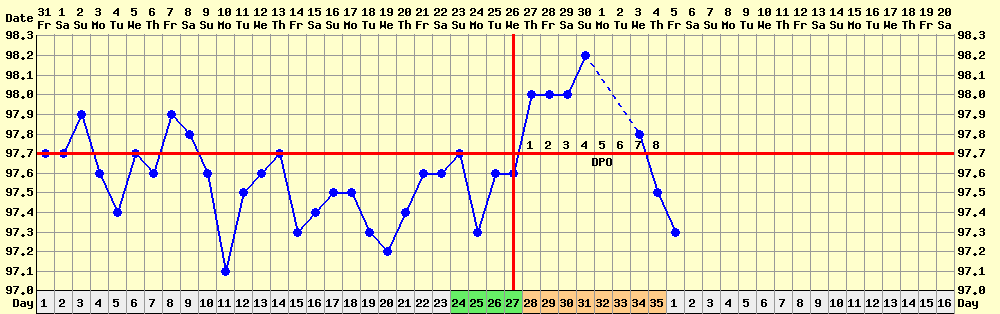
After you have charted your temperature for a month or s,o you will probably begin to see a pattern arise. What you will be looking for is a temperature increase of at least 0.4 degrees over a 48 hour period. This shift usually coincides with ovulation and marks the end of the follicular phase of your cycle.
Usually, the temperature will then drop and rise again during the luteal phase of that cycle (as shown in the sample chart). Most often the temperature will drop around the time of onset of menses. If your temperature remains high during the latter portion of your cycle for 18 days or more, you should test for pregnancy.
You may be able to see the shifts between cycle phases easily on your chart. However many women also draw a “coverline” on their chart to help them identify the cycle shifts. This is done by looking at the highest temps taken during the end of your period and looking for the first day your temperature rises at least 0.2 of a degree higher than the end of period high temps. The cover line is drawn one-tenth of a degree above the highest of the high days preceding the rise. (See sample chart).
Note that recording of additional symptoms such as cervical mucous and position add additional clues as to the status of your facility at any given time during your cycle. This article does not address those items but you may want to check the websites above for more information on this.
Problems that may arise and ways to troubleshoot
The birth control pill, coming off of the birth control pill, and recent miscarriage or childbirth may affect your chart and make it appear irregular or inconsistent.
Illness and/or fever may also skew your results. Unusual events such as travel, alcohol consumption, a restless night or extreme stress may also have an effect on your results. If you have a temperature on your chart which you think may be artificially high or low because of these circumstances or due to taking your temperature at a time outside of the norm for you, it is sometimes helpful to highlight or circle those temperatures on the chart so that you remember not to look as closely at them as you interpret your chart.
If you experience extremely erratic or unusual temperatures be sure to double check that you are taking your temperature at the same time each day and prior to any activity. You may want to note the time you took your temperature on your chart each day to help with this.
If you wake up an hour or two before you usually take your temperature and just have to go to the bathroom or something, it is better to take your temperature at that time rather than getting up, and then going back to bed until it is time to take your temperature. Getting up and going back to bed for an hour or two will interrupt you sleep/temperature pattern (remember – your temperature should be taken after at least five hours of uninterrupted sleep).
If you notice that you are not finding the ovulation spike in your temperatures or that your charts are not making sense to you, it may be helpful to take them to your OB/GYN and seek his or her input.
Personal Tips
Until you get used to taking your temperature regularly, it may be difficult to remember every morning. I place the thermometer right on top of my alarm clock when I go to bed so that I can’t even hit “snooze” without grabbing the thermometer.
A great resource for learning to chart your basal body temperature is the book Taking Charge of Your Fertility by Toni Weschler, MPH.
I have found that BBT charting is great for getting a handle on approximately when you ovulate each month but is more of a look backward. So basically, you don’t know you’ve ovulated until you’ve already charted it and passed it. I often use the charting in combination with ovulation predictor kits when trying to get pregnant.
If you are seeing an OB/GYN for help with a fertility issue you may want to take your charts to your next appointment. My OB was able to use my charts to help determine how to treat me.
July 26, 2006 5 Comments
Diagnosis: Male Factor
Diagnosis: Male Factor
by Bea
What Male Factor Infertility Means and Its Impact on Fertility
Male factor infertility (MFI) means, simply put, that a man has a lower than normal chance of fertilising an egg without assistance. “Lower than normal” may mean anything from slightly reduced to zero chance.
MFI is common. Statistics show 30-40% of infertile couples suffer exclusively from male factor infertility, 30-40% exclusively from female factor infertility, and the rest from unexplained or combination factors involving both partners. This serves to highlight the fact that infertility is far from being a female-only problem–in fact, the problem is equally likely to rest with the male. The reason behind a man’s infertility is mostly elusive and unlikely to change the options for treatment.
Happily, MFI carries a generally good prognosis as long as some sperm are being produced. Amongst IVF patients, only those with tubal infertility are more likely to conceive. On the downside, if MFI is severe enough there is no hope of a “surprise pregnancy”.
Sperm may lack the ability to fertilise an egg for one of a number of reasons:
- Count: Contrary to what you were told at school, it actually takes a minimum of between half and one million healthy, rapidly-motile sperm to fertilise a single egg. This equates roughly to a post-wash count of five to seven million sperm per ml. This is because sperm work together to navigate their way through the inhospitable environment of the female reproductive tract. It’s physcially impossible for a single sperm to make a successful journey all by itself. So much for “it only takes one”. Count may be reduced because of lack of production in the testicles, or failure of sperm to get from the testicles into the ejaculate (for example blockage/previous vasectomy).
- Motility: Only rapidly motile sperm can reach and penetrate an egg. Even if fertilisation happens in vitro, motility is required to get through the “shell” of the egg.
- Morphology: This is much less important than you might think, especially if you are using ICSI. The DNA contained in the head of abnormally-shaped sperm is just fine.
- Anti-sperm Antibodies: Antibodies can cause a loss of motility, the clumping together of sperm, and the inability for the sperm to fertilise an egg. This is much more common in men who have had vasectomies.
- Sperm DNA Fragility: This means the DNA carried in the head of the sperm is damaged. The somewhat controversial belief is that higher levels of DNA damage will lead to greater numbers of genetically abnormal embryos being formed, resulting in implantation failure and early pregnancy loss.
Diagnostic Process
Standard Semen Analysis: This will give an indication of count, motility and morphology. It will also give details of any other cells – for example white blood cells – which may indicate infection.
Post-wash Semen Analysis: Some specialists like to analyse the sample after washing, as if for an IUI. This will give a more accurate indication of whether the sample is good enough for IUI or whether IVF will be needed.
Antibody Tests: This is most reliably done on a semen sample. Tests include the immunobead assay and the mixed agglutination reaction. Results are given as a % of sperm with antibodies attached.
Sperm Chromatin Structure Assay: This is the test for DNA fragility. It’s performed on a semen sample. Results are given as a DNA Fragmentation Index which aims to indicate what % of the DNA is damaged.
TESA/MESA/testicular biopsy: If no sperm at all are found in the ejaculate, an aspirate or biopsy may be taken to hunt for sperm in the epididymus or testicle. There’s a big difference between a few sperm and no sperm at all.
Hormone assays: This is a blood test. FSH means much the same thing in men and women. High FSH indicates poor response by the testicles (or ovaries). Testosterone is usually also measured, and sometimes other hormones such as LH and prolactin.
Karyotyping: Some males have abnormal genes which affect fertility, such as the XXY karyotype which is known as Klinefelter’s Syndrome, or the cystic fibrosis gene which can cause anatomical defects in the sperm transport system. Balanced translocations can also occur in males as well as females.
Physical examination and ultrasounds: You may be referred to a urologist for physical examination and ultrasound of the testicles and prostate. Two of the most common things to look for are varicocoeles and prostatic disease.
Treatment Options
Treatment of MFI is centred on IUI, IVF, and ICSI. IUI can be used to give a marginally poor ejaculate a “head start”. IVF is used for more severe male inferility, and ICSI is used where the severity is such that sperm are no longer able to penetrate the egg by themselves at all. TESA/MESA or testicular biopsy are sometimes used to retrieve sperm, especially if none are present in the ejaculate. Some couples use donor sperm with IUI or IVF.
Many other options have been suggested. It’s important to note that because it takes a while for sperm to be produced, any treatment which aims to improve semen quality will take three to six months to produce results.
Lifestyle factors such as overheated testicles (sauna/hot baths), smoking, or drug use can affect semen quality. These must be eliminated. In a few cases, this might be enough to resolve the problem.
Many dietary supplements, naturopathic remedies, and alternative therapies have been suggested over the years, including arginine, B vitamins, coenzyme Q10, SAMe, ginseng, vitamin C, zinc, L-carnitine, co-enzyme Q10, vitamin E and selenium, omega 3 fatty acid supplementation, and acupuncture. Sadly, studies fail to consistently support any benefit. However, when used as recommended there seems to be no harm, either.
Hormonal supplements are used by some specialists. Supplementing directly with testosterone seems to actually reduce male fertility, but clomid and FSH have been used to stimulate testicles into production. A limited number of studies show a marginal benefit, but not enough to replace the use of IVF/ICSI.
Sperm DNA fragility is treated using ICSI, which seems to produce a higher pregnancy rate than plain IVF in this group, and also TESA/MESA, the aim of which is to use the freshest sperm possible, based on the theory that most DNA damage happens whilst the sperm is being stored in the body. Men may also be advised to ejaculate frequently (ie daily) to reduce storage time.
IVF is the most successful treatment for antisperm antibodies, with ICSI used if fertilisation fails to occur. IUI is also an option in some cases.
Variocoelectomy remains controversial. Some studies show benefits and others show no benefit at all. Some specialists believe there are select groups of patients in which the surgery is worthwhile. Be sure to discuss the pros and cons fully with your doctor.
Vasectomy reversal is most successful in cases where modern techniques have been used, and where the vasectomy was fairly recent (less than a couple of years). A succes
sful reversal produces sperm in the ejaculate but count, motility and antibodies may still warrant assisted conception. Discuss the pros, cons, costs and chances of success carefully with your doctor prior to surgery.
Infections, prostatic disease or other conditions should be treated as indicated. If there has been prolonged or severe insult to the testicles, assistance may still be needed to achieve pregnancy.
Personal Experience
It’s pretty clear from our semen analysis that IVF/ICSI is the only way we’re going to be able to achieve a pregnancy using our own gametes. Obviously this is not good news, but at least we have the chance to try. Our other options are sperm/embryo donation or adoption. No good reason has been found for our diagnosis, but the chicken pox Mr Bea contracted for the first time at sixteen years old is a possible culprit.
The biggest thing that strikes me about male factor infertility is the stigma. There are few men who are confident enough to talk about their diagnosis openly, and I find myself restricted from talking about our problems with friends and family at the express request of my husband, who wants his diagnosis to remain private. If I do tell someone we’re doing IVF, it’s automatically assumed we have a female factor problem.
July 26, 2006 13 Comments