

Category — Uncategorized
Thin Envelopes Require Thick Skin
I applied for a grant. When I got the thin envelope in the mail, I knew it was a rejection. Nothing good comes in a thin envelope, right? It was a ridiculous reach that I wasn’t really counting on getting, and it cost me nothing but time and ego to apply. But still.
It hurt to see the thin envelope.
No one wants the thin envelope.

I texted Josh a picture of the rejection letter so he would know what a loser he was married to that I didn’t get the grant, and he wrote back all of the other things I have achieved recently. And he’s right — I am only focusing on the thing I didn’t get vs. the things I did get — but thin envelopes do that to you.
*******
We’ve started taking the twins to college campuses. I know this seems ridiculously early, and we’re certainly not making special trips to see schools. But if we happen to be near a college they may want to apply to one day, we swing by the campus to get a sense of the space. They’re mentally making a list of what they like or don’t like.
I think a lot about their senior year and how they’ll have to apply to schools. They’ll get into some — I hope — and they’ll likely get rejected from a few. Those rejections are going to suck. This grant — it was nothing, a little ego massage and money — but not getting into a school? That’s like having someone torch a bridge, cutting off one of your possible life route.
I know I would have been a different person if I had gone to a different school.
There’s no way to protect them from that, unless they don’t apply at all, which doesn’t sound like the best way of dealing with the problem. You’re probably going to tell me that rejection is a life lesson they need to learn and it will make them more resilient and yadda yadda yadda.
But here’s the thing: I’ve experienced this life lesson, and I have learned nothing from it. Thin envelopes still hurt, even when they’re low stakes. Even when they come the same week you sign a new book contract. If resilience is not hurting when rejection comes, I have not learned resilience.
J.K. Rowling just posted two of her rejection letters online. You don’t save things that are meaningless to you. I’m not inside J.K. Rowling’s brain, but I would hazard a guess that if she saved those rejections, they probably bothered her at the time. Regardless of what else she has accomplished in life; despite moving millions of copies of her books. Rejections still hurt.
So, no, I don’t believe you can learn anything from rejection except that after you lick your wounds you need to be like Hercules Mulligan and get the fuck back up again.
Licking my wounds now. I’ll get back up soon.
April 5, 2016 20 Comments
Fan Mail
I am more than a little smitten with the story that Abbey National Bank, which acquired the address 221B Baker Street, hired a secretary for many decades whose sole purpose was to answer fan mail addressed to Sherlock Holmes. Mental Floss writes,
Rather than simply throw away mail addressed to a fictional character, the bank decided to hire someone to answer Holmes’s mail—as his secretary. Until Abbey National moved its headquarters in the 2000s, the bank continuously employed a series of secretaries to respond to fans, letting them know that Holmes had retired to the countryside to raise bees, or even replying occasionally as Holmes himself, using quotes from Doyle’s books.
Isn’t that brilliant?
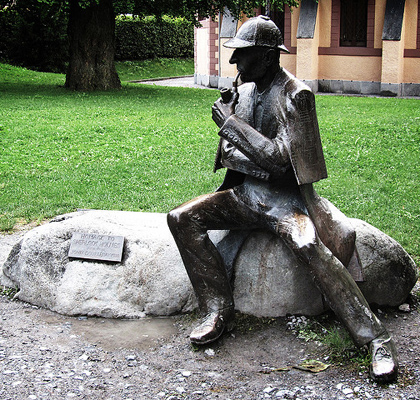
Image: David Jones via Flickr
Fan mail is now answered by the Sherlock Holmes Museum, which isn’t as good a story.
Which makes me wonder whether other fictional characters get fan mail. What happens if you mail a letter to 4 Privet Drive? I’m assuming it ends up here, but does anyone answer it? Can you write Leopold Bloom at 7 Eccles Street or Phileas Fogg at 7 Savile Row? Will I reach the Steadmans if I write to 1710 Bryn Mawr Avenue, Philadelphia, PA?
It sort of wouldn’t matter to me if it was just a secretary writing me as long as I got a letter back.
Which fictional character would you want to write?
April 3, 2016 10 Comments
Do You Have the Same Job as One of Your Parents?
I was fascinated by the study outlined on Mental Floss using Facebook to see if children go into the same careers as their parents. The Facebook study also looked at whether siblings choose the same field. The study found that,
15% of siblings share an occupation, which is higher than the 8.6% rate for any two same-gender, same-age individuals in the population. Twins’ tendency to choose the same occupation, at 24.7%, is even more striking.
Still, the study also found that “in absolute terms the vast majority of kids strike their own path and choose a profession different than that of their parents or their siblings.”
In my family, two of us are in the same field, and the other three are in three different fields, yielding four career fields for five people.
But then I went ahead and married a writer, therefore, my kids have two parents in the same field. One wants to be a writer, too, and one doesn’t. Though, of course, they’re young so that may change many times over before they settle on a career. After all, I wanted to be a fish researcher or a cardiologist when I was their age.
How about you? Same career field (not necessarily same job, but same area of work) as one of your parents? As one of your siblings, if you have siblings? As your partner?
March 30, 2016 29 Comments
Is Quidditch the Ultimate Feminist Sport?
25 teams. 525 broomsticks. 75 chasers. 1 golden snitch.
Quidditch World Cup. This summer. Frankfurt, Germany.
It’s on, like Donkey Kong.
Okay, maybe that’s more like “It’s on, like Hermione and Ron.” Ooooooh!

This summer, 25 teams from around the world will meet in Frankfurt, Germany on July 23 – 24th for the IQA World Cup. IQA, if you’re a complete Muggle, stands for International Quidditch Association, and it’s the international governing body for the sport. Yes, sport. It’s played at the college level and beyond, across the world, and while the broomstick regulations have changed over the years to prevent injury, it is as close as you can get to J.K. Rowling’s in-air vision of the game while on the ground.
The US National Team is sending 21 players and 7 alternates to the games, and I got to talk to one of them — Julia Baer — who normally plays chaser for Quidditch Club Boston, a community team in Massachusetts.
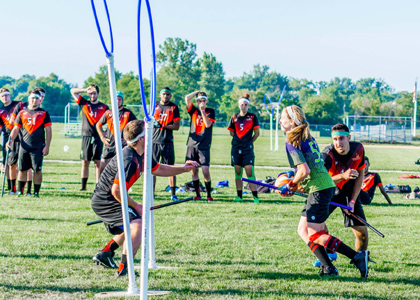
She, like probably you, scratched her head when she first noticed Quidditch listed as a sport while applying to college.
I thought it was a joke at first, admittedly. I’m a competitive person and I adore the Harry Potter books (my application essay drew comparisons between Neville Longbottom and I), but I knew nothing about the sport. About one week into freshman year at University of Richmond, I was returning to my dorm room after class when one of my hallmates ran up, grabbed my hand and told me to change into gym clothes because it was time for Quidditch tryouts. I followed her and fell in love with the sport from the first practice.
She ended up playing 4 years for the University of Richmond Spiders. Despite the fact that the sport was born in a book description, it’s not for the delicate or faint-of-heart. Baer has weathered sprained ankles, a separated shoulder, and temporary blindness in one eye. Concussions remain the number one Quidditch-related injury. Yes, in case you doubted: This is a real sport.
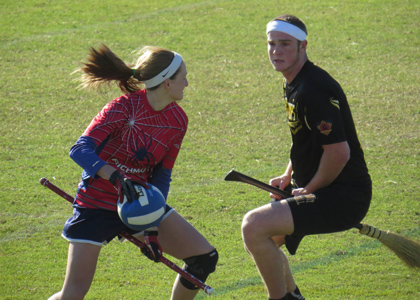
It’s also possibly the ultimate feminist sport, with a mission statement that outlines numerous times the importance of gender inclusivity. While other sports maintain separate teams based on sex (and often times don’t even have a team for one sex), Quidditch teams are always co-ed. That focus on gender inclusivity is what drew Baer into the sport.
I find [the fact it’s co-ed] so fitting for Quidditch because it’s the kind of sport that requires basic open-mindedness from the very beginning. And Quidditch has a great way of being gender-inclusive in that it has developed the “four maximum” rule. This states that there may be no more than four people on the pitch for a team (a team fields seven at a time, including seeker) that identify as the same gender. This ensures inclusiveness across the gender spectrum, not simply for those identifying as female.
Making the game about skill in the sport rather than sex or gender changes the conversation. Baer points out the ways that Quidditch is truly leveling the playing field.
[Quidditch] is a great opportunity to showcase the power of the gender minorities. I personally love having the chance to outplay male opponents and silence society’s little voice in my head that says all men are better athletes than I could ever be. I’m one of the best players on my team. I’m not one of the best girls on my team and I’m not good “for a girl”. It’s so refreshing to be in a sports community where gender minorities not only compete alongside men, but thrive.

You don’t have to love Harry Potter to play Quidditch. In fact, the sport has strayed so far from the story that it’s likely that there are people on every team who have never read the books. Baer admits that it has been a long time since she has thought about Harry Potter when taking the field.
It’s hard for outsiders to separate the sport and the series, however, and that tends to drive them away from giving Quidditch a shot. Personally, I’ll give a nod to J.K. Rowling for creating my favorite sport of all time, but when I’m on the pitch, Harry Potter is the last thing on my mind.
Probably the most important lesson Baer takes away from Quidditch is the idea that if you haven’t found your sport, create your sport. (And that advice extends beyond sports to all areas of life.) There is nothing stopping you from leaving the well-worn sports path and trying something new.
I’ve played sports all my life. I’ve played softball, soccer, field hockey, basketball, horseback riding and lacrosse. I’ve been above average at most sports I’ve played, but never once played for a varsity level team. Quidditch is the sport that I excel at. It’s the sport in which I’m (apparently!) one of the best players in the country. I’m extremely grateful to have had the ability to play this sport throughout college and after college. And this sport didn’t exist ten years ago. If you don’t think you’re great at any existing sport, invent or try a new one!
So who is with me cheering on the US National Quidditch Team this summer?
This post first appeared on BlogHer, but I had to post it here, too, because I am so freakin’ excited about the Quidditch World Cup.
March 29, 2016 6 Comments
Games in Cars
Somehow the topic of Boston’s rap battle situation came up while we were driving, and I informed the kids that if someone pulled up alongside our car and challenged me to a rap battle, I’d have to politely decline because (1) I’m not really good at speaking off the top of my head, (2) I’m not really good at rapping in general, and (3) I really like to pay attention even at red lights, and I wouldn’t want to be distracted by their rhymes.
I told the twins that when I was younger, the thing to do was to pull up alongside a car in traffic and motion for them to roll down their window. Of course, that meant taking off your seat belt and leaning across the seat because most cars had windows that had to be manually rolled. It was truly a pain in the ass unless someone was in the passenger seat.
Anyway, once they had the window down, assuming you needed directions or that you were going to warn them that their tail light was out, you would say, “Do you have any Grey Poupon?” And then drive away.
We were such cards.
*******
I asked the twins if kids still pump their arm up and down whenever they pass a truck while they’re on the school bus. It used to be a huge game to get truck drivers to pull their horn for you, and I remember mostly doing it on the bus but also in the car on long trips.
I asked Josh, and he did this as well as a kid, and we didn’t grow up in the same area. Anyone else?
Unfortunately, getting truck drivers to honk their horn no longer seems to be a thing.
*******
Of course there was also punching the person next you — hard, in the arm — whenever you saw a Volkswagon Beetle. Yes? No?
Punch buggy!
March 27, 2016 17 Comments