

Category — Uncategorized
1 Simple Thing You Can Do to Strengthen Your Blog
I wrote a post over on BlogHer about 5 lessons you can take away from long-writing bloggers, and while I think all the lessons are worth reading, I’ll pique your interest with a single idea that you can put into action today:
Separate your posts into two categories: current events and evergreen topics.
Current events are things happening in your life or the larger world right now. It makes no sense to post them two weeks from now because you need the support today. It doesn’t make a lot of sense to post about Christmas menus in August, and once NIAW is gone, the #StartAsking posts will drop off. Those are all current events.
Evergreen topics are posts you could write that aren’t really connected to time. You could post them this week or you could post them next week, and it really makes no difference. Like this post. I mean, I’m posting it today because the post went up on BlogHer, but if that post went up in October, this post would have gone up in October, too. Responses to articles (unless they’re currently a hot topic), ideas you want to explore, moments you’ve noticed: Those are all evergreen posts.
So this is how I explained it on BlogHer:
High-traffic bloggers tend to mix up their content, balancing evergreen topics with current events. Why do they do this? For lasting Google juice coupled with traffic surges.
Evergreen topics are ones that you put up and they keep getting hits long into the future. They aren’t time-sensitive — you could run them on any day of any month. They’re the things people Google for all the time: How to Make Your Own Baby Food, 5 Reasons You Need to Stop Playing Candy Crush, 10 Things You Need to Know About Hulu.
Current events are whatever is on peoples’ minds today. Look at what is trending on Twitter. That is what people want to know about today. Or talk about today. Those posts tend to temporarily spike your traffic and then fizzle out after the moment is over. And that’s fine: They engaged people when you needed them to engage people.
Do you do this? Are you going to start now?
You can read the other 4 lessons in the main post.
May 1, 2016 7 Comments
Vote
The twins have come with me to vote in every election since they were born. When they were newborns, just out of the NICU, I put them in a double baby carrier and walked down to the polling place feeling like an opossum. When they were toddlers, they ran in two different directions as I tried to quickly enter my choices. When they were young kids, they shouted out my voting choices to everyone else in the room. When they entered preschool, they entertained the other voters standing in line, bouncing up and down while they clapped and shouted, “My mommy is an Obama-mama-mama-mama!” And in elementary school, they thoughtfully discussed marriage rights with other voters as we waited in line.
Throughout it all, the one constant was that I had them press the button for all of the major offices: president, senator, congressperson, governor. (And, later on when they had more patience, all the offices up for election.) One child would push the button, and I would erase the vote. Then the other child would push the button, and I would erase the vote. And finally I would push the button and keep the vote. Even when they were newborns, I touched their tiny fingers with their translucent nails to the machine interface. For 11 years, this is the way we’ve always voted — primary or general election — each of us able to say we participated in the experience.
And then Maryland went to a paper ballot this year.
When I heard about it, I started fretting. What were we going to do? I couldn’t have them fill in my card and erase it. You had to use ink or my vote wouldn’t be counted at all. Everyone hold the pen at the same time?
We finally decided to split the tic-tac-sized bubble into thirds, each of us filling in a tiny sliver of the ballot. We practiced a few times at home. Once we trusted that no one was going to fill in more than their share of the bubble, we went to the polling place and continuously passed the pen so we could each vote for each person. This year, we aligned to all want the same person for each office. Let’s see how many elections we’re able to do this.
I’ve always taken them with me because I want to lead by example and hopefully have them follow suit later in life. I want them to vote. I don’t want them to apathetically throw up their hands and say, “Everyone sucks, there’s no point in voting.” I don’t want them to toss away this yearly experience as if it’s an empty candy bar wrapper. This is their right, and there are so many people who don’t have this right. People who live in this country and are affected by the laws but can’t have their voice heard.
If they don’t like the laws, I want the twins to change the lawmakers. Better yet, I want them to be the lawmakers or help the lawmakers or report on the lawmakers. I want them to be involved with life; to tangle with it, not just allow it to flow passed them.
People, get out there and vote this fall. Go vote this spring if your primary is still coming up in May or June, but, moreover, get yourself into a voting booth for the general election. Make sure your voice is heard.
April 27, 2016 11 Comments
Skull Ring
The ChickieNob and I had a Girl Scout trip on the Eastern shore, so we decided to go a bit early and spend the afternoon together at a nearby beach. I had called ahead to find out if our favourite arcade would be open, and while I was told that it would be, when we got to the beach, the metal garage door was pulled over the entrance. Closed.
We walked down the boardwalk to a different arcade, a much smaller one with nary a classic game in sight. The ChickieNob was bummed and didn’t really want to follow my suggestion that we play a few rounds of ski ball, but she half-heartedly fed a quarter into the slot and started rolling the balls towards the hoops. At the end of the game, two tickets slid out of her machine.
“What is this?” she asked, ripping off the tickets.
“You get tickets when you play, and then you can trade in the tickets at that desk and get a prize.”
She wandered over to the desk and saw that they had brightly-coloured metal rings. She really wanted one, but they were 60 tickets each. That’s fine, we have all afternoon.
I should add at this point that we are pretty much the only people in the arcade with the exception of the clearly stoned teenage boy who was manning the space. He was listening to our exchange since he had nothing else to do.
So we played side-by-side, cheering each other on, and we were almost at the necessary 60 tickets when the ChickieNob shyly informed me that what she really wanted was a skull ring. But that was 110 tickets, an enormous number considering how long it had taken us to get to 60. But I promised her that we could do it. We just had to play harder, play faster, perhaps not cheer and dance for five minutes every time we got anything over 20 points in a roll.
So we worked hard and finally had 112 tickets. Brilliant. We turned them over to the stoned boy who fed them into a machine. “You know,” he said, “each ticket is actually worth 5 points, so you had enough tickets about a half hour ago. In fact, you have over 500 points right now, which means you can get… 5 SKULL RINGS!!!”
Yes, he shouted it and pumped his fist.
And we stared at him.
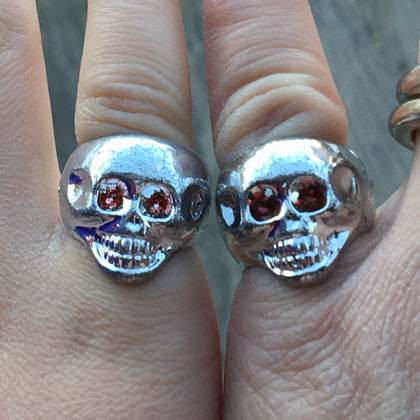
Okay. So this was great. We could get two matching skull rings. The skull rings were awesome, and we clinked them together and said to each other “memento mori” (from A Series of Unfortunate Events, and not, let’s say, the Hermits of Saint Paul of France). The stoned boy pulled out a calculator, and announced, “YOU STILL HAVE 300 POINTS!!!”
Yes, he once again excitedly shouted it, as if our name had been called on the Price is Right and he wanted to psyche us up as we made our way down the carpeted steps.
Okay. So she picked out a few things for the Wolvog and Josh and one of her friends. Every time, he would punch the number into the calculator and excitedly tell us how many more points we had. You know what? We learned that it is really hard to use up 300+ points. We ended up with a spider ring, little plastic poppers, a handful of marbles. Finally, I told the boy that we had to give up, and he gave me our last points in arcade stickers.
The skull ring is pretty sweet. Totally worth the gargantuan effort to reach the requisite number of tickets. Sure, we went over that amount 5-fold and we had to engage in an extended conversation with the stoned boy about the DC Universe, the polar bear challenge, and his home town. But we learned an important lesson about team work and having a goal and celebrating the small milestones along the way.
Cheers.
April 26, 2016 9 Comments
Small Family
Though I’m usually a pick-whatever-is-there person, this year I decided to call ahead to the kosher butcher and put in my order for the seder so Josh could run in and pick it up for me. “Small order,” he commented after he wrote it all down. What was he talking about? I bought meat for 12 people despite the fact that some of us are vegetarians and won’t be eating it. It was certainly more meat that I purchase on an average day.
“I’m only hosting one seder,” I explained. “My cousin is hosting the other one.”
“Oh,” is all he said in response.
Later that week, Josh went to pick up the order, and when he dropped it off at home, he said that when he started to say my name, the butcher said, “Oh, yeah, the small order.” He went back into their refrigerators to get it.
“What is he talking about? It’s a totally normal order for 12 people. And we’re having vegetarian dishes and a bunch of side dishes…”
“Mel, he’s used to big orders from big families.”
It didn’t occur to me until that moment that he was making a comment on our family size. That it wasn’t the amount of meat or the fact that some of us are vegetarians. He was commenting on the fact that in a community where a couple brings 10 people to the seder table before they start adding in their extended family and friends, we have two children. Small family. Small order.
I couldn’t stop thinking about that the entire time I cooked. That tiny comment wiggled under my skin.
How we look to others from the outside. How we know a different story from the inside.
[Aside: I clearly took his comment as a negative remark, but maybe it was the opposite. Maybe he is jealous that we have two kids instead of 10. I guess no one knows how it looks on the inside.]
April 24, 2016 10 Comments
Does the Pain Olympics Stem From Emotional Exhaustion?
In June, I’ll mark 10 years of blogging. That’s a lot of blogging, right? That’s pretty much a fourth of my life. I’ve spent a quarter of my life blogging.
Whoa… that just gave me pause.
Anyway, 10 years ago, I was a new blogger, and I’ve seen 10 years worth of new bloggers arrive in the community. Some of the people I started with are still around. Many more have stopped writing but hang out on other forms of social media. Others have slipped away entirely, and I have no clue where they are or how they are.
One thing I’ve noticed — though there are clearly exceptions to this rule — is that most people who join the infertility blogosphere utter some form of “I am so glad I found all of you.” Maybe they have no support in their face-to-face world and they find it online, or maybe they have been thinking they’re the only person in the world experiencing infertility while everyone else around them pops out baby after baby. And suddenly they have tapped into a well of knowledge and collective empathy and realized that they are definitely not alone. There are a lot of us out here.
And then something happens over time.
This… thing… I think manifests in two different ways:
- People start to play the Pain Olympics, silently or not-so-silently, writing off other people’s experiences as being lesser than their own. They start thinking “at least you…” statements as they read another person’s blog.
- Or I’ve also seen it emerge as the person detaching from the community, writing less but also commenting less. They come in strong, full of enthusiasm, and then seemingly burn out and a lot of the time, slip away.
Maybe they stem from the same place.
Mental Floss recently had an article on empathy and why we get empathy burnout. The research found a few interesting things about empathy.
- Empathy is susceptible to suggestion. In other words, we can tell someone not to be empathetic to someone else, and it can override their natural tendency to be empathetic. The same is true in the other direction: we can get the message from watching others and follow suit.
- So empathy then is given or not given depending on the context and whether we think the other person is “worthy” of empathy.
- We are stingy in giving empathy when we don’t think empathy is a renewable resource. If we think of it as something to budget and allocate, we’re less likely to give it others.
We see the same thing happen in the microcosm of the infertility blogosphere. People enter feeling a sense of relief having found a group of people and look for similarities because they want to feel as if they fit in themselves.
Then, once they are certain they fit in, they start looking for differences so they can allocate their empathy better. Once you’ve comforted several hundred other people, it wears on you and you start budgeting you empathy. To do so, you have to dehumanize the situation by thinking about comparative pain (they’re not in as much pain as this person because that person’s situation is worse). Which leads, eventually, to the Pain Olympics.
Right?
Moreover, empathy is something we give others, but it’s also something we give ourselves. I think we inwardly get empathy exhaustion, being gentle with ourselves in the beginning and then growing harder and harder on ourselves over time. We want to write every second of the day about our journey, and then we burn out and post irregularly or not at all. It’s as if we’ve stopped allocating ourselves empathy.
We can’t control whether other people give us empathy, but we can control whether we are empathetic to ourselves.
I guess the interesting thing I took away from the post is that there are other options beyond empathy exhaustion and comparative pain (or, in the case of self-empathy, minimizing our own pain and telling ourselves that we should suck it up). If empathy is a choice, we can decide that it’s going to be one we make rather than withhold.
Zaki suggests we have an essential, automatic component to empathy—a built-in biological leaning toward caring for the suffering of others—but that our empathetic response is at the same time highly contextual.
So, yes, maybe we are strategic in where we place our empathy at the subconscious level, but can we tell our subconscious that we want to keep empathy always flowing at a lower, continuous rate rather than having it gush and then dry up over time? Can we set the speed and intensity in which our empathy flows so we don’t get burned out and cynical over time? Can we keep a continuous flow moving outward towards others AND inward towards ourselves and not have our empathetic energy dry up completely?
I don’t even know if this is possible; if we can tell our hearts not to go all out in the beginning because we need to pace our empathy so we always have it to give. This isn’t unique to the infertility community, and I know caregivers deal with burnout all the time. I’d be curious to hear what you think of the article and study.
Your thoughts?
April 20, 2016 22 Comments