

Category — Uncategorized
Your Failure Resume
Piggybacking on Sunday’s post about presenting the whole picture and not just the highlights reel, Lifehacker had an interesting idea a few weeks ago about creating a failure resume. So think the opposite of your actual resume. It’s a document that catalogues all the times you’ve failed.
But there’s a point!
By doing this exercise, you stop telling yourself a messed up version of life where you pretend everything came to you easily. Instead, you remember how far you’ve come and the times where you’ve had to navigate a difficult path to emerge out the other side.
I was trying to think about how I would arrange my failure resume, similar to the way people highlight different aspects of their experience depending on their job. My chemical pregnancies and preterm labour should probably go toward the bottom of the document at this point, similar to the way I tuck my degrees towards the bottom of my resume.
I guess I would start with not getting into my first choice college. That sucked. I remember crying so hard that I couldn’t breathe, and my friend, Matt, taking me out to see My Own Private Idaho for the sixth time as a condolence prize. I was miserable about this fact until October of my freshman year of college when I decided that it was okay that I wasn’t where I wanted to be, and I was going to be happy where I was. I had a fantastic four years, and zero regrets in retrospect, though… at the time… it sucked.
And I would currently end with all the agent rejections followed by the publisher rejections that I’ve collected over the years. Connecting with my current agent took a lot of time and a lot of “no, thank you,” emails from other agencies. And then landing all of my publishing contracts also came with a heaping dose of “not for me.” It wouldn’t be that hard to crawl back through my email folders and start listing all the names and places as a reminder.
I really love this line from the article: “The notion that any person can achieve meaningful success without experiencing setbacks and disappointments seems hopelessly naïve.” Have I learned from all of my mistakes? No. There have been plenty of setbacks that haven’t taught me anything about myself or how to navigate life. But there are plenty that should be listed, if only to remind myself that sometimes shit happens, and sometimes we even get through it.
What do you think of making a failure resume?
May 24, 2016 16 Comments
Closer to Reality
Thank you for all the kind words about the new book. I am really proud of it. If I was flippant when people offered compliments, it was only because my insider view of my life doesn’t sound like it matches the outsider view of my life.
When we only talk about accomplishments, you get a skewed view of who I am. So, yes, I did work really hard on the book, but…
I dread writing pretty much on a daily basis. I will put off actually getting down to work as long as possible, filing emails or reading blog posts, because writing is hard and I’m not really a fan of hard things. The only thing that gets me working is a fear of running out of time in the workday and a healthy dose of berating myself.
On that note, I didn’t finish my PhD. And I threw out all of my research about 13 years ago. So it will never happen, and I’m okay with that.
I can’t tie my shoes. I not only never mastered it as a kid, but I still can’t figure it out as an adult. Even when the twins patiently sit with me and try to teach me. When I need to tied a pair of shoes, I do so slowly, with bunny ears. Most of the time, I slip my untied laces into my shoes and walk around with untied shoes.
I lie about how many popsicles I eat and hide the sticks in the bottom of the trash can. I know in admitting this that Josh now knows, but I will continue to hide the sticks because I’m ashamed of my junk food jags.
I am a horrible flyer. I pretty much plan my life around trying to get out of flying.
I think we’ve also established that I suck at getting and staying pregnant. I also suck at carrying children to term.
Besides the popsicle consumption, there is nothing on this list that the people in my life don’t already know. And that’s sort of the point. We should have these healthy, well-rounded versions of our accomplishments and foibles. But so many people only see the really good stuff online. It’s up to us to balance it out. Not to put ourselves down, but to present something closer to reality.
Care to admit anything?
May 22, 2016 17 Comments
When You Open Up a Box of Your Book
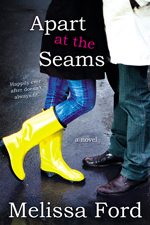
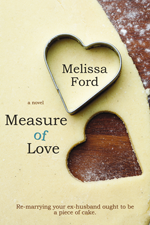
My box of author copies still hasn’t arrived, but my friend, Chris swung by a bookstore and snapped a picture of my new book on the shelf.
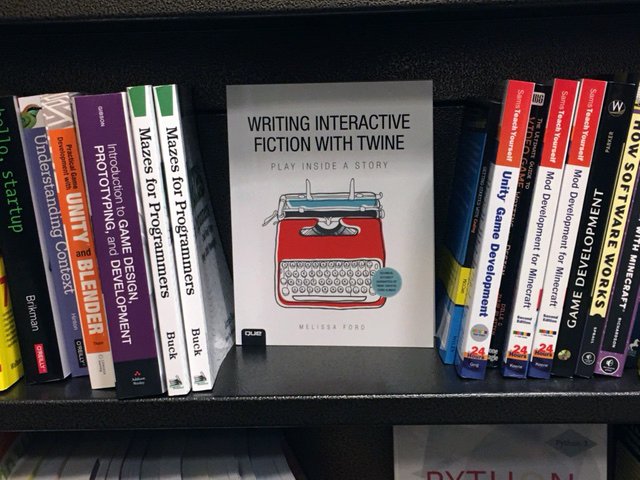
I thought about swinging by a bookstore myself, but it has been continuously raining. I know that’s a bad excuse. I guess I’ve been waiting for my copies. I guess I want to hold it for the first time at home.
*******
Before I wrote my first book, I thought that holding your book would be the most exhilarating experience in the world, like that first kiss with Josh when every hope got funneled into a single, perfect moment. But it’s a lot messier than that. No matter how many times it happens, it feels the same.
There’s relief: You’ve done it. The project has been completed and there is tangible proof. It was a slog, filled with ups and downs, but no one can take away the fact that you have physical evidence of a job well done. There’s sadness: It was such a huge part of your life for months or years, and now it’s over. There’s anxiety: Now I need to tell people about this project and ask them to support it. There’s worry: Fuck. What if it isn’t good enough? There’s pride: I accomplished this! There’s embarrassment: What if no one likes it, and I look like an idiot? There’s calm: Being in my hands means that it’s completely out of my hands now.
It’s all of that, rolled into a single moment. So not really like the kiss at all.
I hope you like it. This particular book was a labour of love; a book that almost didn’t happen, that means so much to me on so many different levels. I feel like I’ve been on a roller coaster for the last year and a half, and I’m finally getting off the ride and looking back at it, thinking how happy I am that I got to be at the amusement park at all. That I was brave enough to stick with the ride even when it started rocking on its tracks. That I’m sad the ride is over, and, at the same time, happy to keep exploring what else is at the park. A year and a half is a long time to be on a ride.
But it was a great ride.
It’s at bookstores, but if you don’t want to leave the house (as I often don’t):
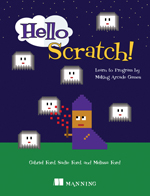
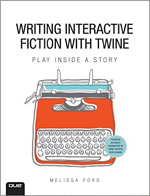
Thank you for being there the last year and a half while I mashed this out. It is everything I know about fiction writing, between two covers.
May 18, 2016 17 Comments
Need vs. Noise
About two weeks ago, all schools in the area were put on shelter-in-place status due to a gunman. He shot his ex-wife outside of a school. The next day, he went to a nearby mall and shot three people in the parking lot. A little while later, he shot another person in a grocery store parking lot. The incidents kept getting closer to home.
My rational brain knew the kids weren’t in danger. That it was more dangerous to go out while the gunman was on the loose than for all of us to stay in our respective buildings. My irrational brain wanted to run out of the house, screaming until I reached them and could shield my body around them.
I stayed home and listened to the updates broadcast from the school while following a hashtag on Twitter. I wanted to know whatever there was to know the moment there was to know it.
Have you ever followed a hashtag on Twitter during a frightening situation? I’ve only done it once before, years ago. That time, all the tweets were people either in the heart of the situation giving first-person accounts of what was going on, or people asking questions, sending words of support, or repeating to their followers what they learned from following the hashtag.
This time, it went like this: About 10% of the tweets were useful. They either contained information I already knew or contained new information. About 20% of the tweets were people saying they were praying for the victims. A lovely sentiment, but one that clogged the hashtag and stopped people from getting information quickly. 30% of the tweets were people talking about their connection to said locations. (“I once met my sister for lunch at that mall!”) Again, unhelpful and since most of us have been to the mall, not remarkable.
20% of the tweets were offensive, stating that the gunman must be… fill in the blank. Take every offensive thing you could say — from all angles — and add it to the hashtag. Anti-something? You could have found your kindred spirit in this hashtag. 10% of the tweets were hurtful, selfishly pointing out how the gunman’s actions impacted the Tweeter’s day. The remaining 10% of the tweets had nothing to do with the situation at hand. They slapped the hashtag onto their musings about wanting pie or how they hated all of the candidates for president.
When you’re in a stressful situation, you are doing anything, including trying to gather news, to wrest control from the events because you feel so impotent. For two hours, I waded through everyone’s noise to get to that 10% of useful information. Doing so meant I knew the gunman had been caught a few minutes before the shelter-in-place status was lifted. It meant I also knew how everyone in my state felt about the mall and presidential candidates. I walked away from the computer feeling as if I had been listening to static for two hours and it was finally quiet.
*******
A day later, I was listening to an episode of Note to Self about the “Lonely Web” titled “What Happens to the Videos No One Watches?”
The episode is about the blog posts and videos and tweets that few read, and the people who like to dive into random places on the Web to find these commentless blog posts and YouTube videos with 2 or 3 views. When you find these places on the Internet, you find (as Manoush Zomorodi states), “real, unfiltered people lay themselves bare.” They’re not performing. There is nothing slick or polished about these videos. No one has combed their hair and applied another coat of lipstick and checked that the angle is flattering. This is about as real as it gets; just people recording life.
Joe Veix, the guest on the show, thinks deeply about how we find what we find on the Web. Do we go for the low-hanging fruit; the stuff that has gone viral and therefore is showing up as a link in our feed because everyone is sharing it? Do we go for the huge name bloggers knowing they must be good or why would they be so popular? Or do we walk along this more personal route, listening to the people who have few people listening to them?
The “Lonely Web,” according to Veix, comes down to this:
How we access content. Most of it is through social media, now, and too much content is getting posted every day … [Stuff posted] is getting lost in the noise … [The noise is] the product of the social media site’s themselves, which encourage us to post everything from our thoughts on an election or what we had for breakfast. So it creates a tremendous amount of noise … The more information, the posts that they get from us, the more money they make. So it’s in their best interest [to have us post a lot].
Yes, the noise, I thought as I drove. That is exactly it. My head was filled with noise while following that hashtag as everyone felt the need to say something even though they had nothing to say. They had no information to disseminate, so they wrote themselves into the story, pointing out that they had once been to the mall or were thinking about the victims.
But buried in that is judgment. Who decides what is noise and what is need? To me, all those tweets about mall visits were noise. To the person writing it, who wanted to indirectly state that they felt scared by pointing out how close this hit to home, it was need. Or maybe need is too intense a word. Maybe it’s just want. But they got something out of writing and posting those words, in the same way that I am getting something out of writing and posting these words. Perhaps these words are noise to someone else on Internet.
The beauty of the Internet is that we are all allowed to post as much as we wish, whatever we wish. There is no one stopping you from using or misusing a hashtag as long as you stay within the legal bounds of speech. Anyone can start a blog, post their thoughts. Anyone can make a video. The Internet has unleashed and fed our collective creativity. There are so many voices I have gotten to hear that would have otherwise never reached me if not for Web.
These words that we say collectively about the Internet or to ourselves when we’re trying to find things online — that there is too much content, too much noise — becomes a statement about worth. No one ever says that there is too much love or too much happiness. We only point out the surfeit when we’re judging: Some content is worthy of being here, but some content should have never been made.
It made me see those 90% of tweets in a whole new light.
May 17, 2016 10 Comments
Your Fiction Ideas Are Shriveling Away
I’ve had an article open since March about how all of my unused skills are shriveling up, becoming liver spotted and hunched over from disuse. I’m totally at peace that guitar is on that list. Printmaking is on that list, too. Horseback riding. Despite being archery trained, I fear that archery is being pencilled in on that list since I haven’t picked up a bow and arrow since the training.
The only thing that I have regrets about is fiction writing.
I know what you’re thinking: Melissa, you write every day. How can fiction writing be on that list?
All types of writing are different, and while I’ve completed 1 1/2 non-fiction books, I haven’t worked on a novel in a long time. I’m midway through a book, but I set it aside when life got busy. The arc of the story feels a little muddy from sitting outside of my brain for so long. I only meant to be away from it for a week; let me just get myself settled with this new project and I’ll return to it on Monday. But that Monday was last summer, and I’m nearing the one year anniversary of setting the project aside.
I keep meaning to begin.
But I don’t.
It’s not that I don’t love the story; I do. I love the story, and I think about it all the time. I think about the characters; not just the fact that they’re all frozen in place, waiting for me. I think about what they would do in various situations. I miss them like friends. And I want to sit down and visit with them. But then I think about how I first need to do X and then Y and then I’ll definitely get to them after I finish Z…
I never finish Z. There always seems to be a new Z.
But this article scared me; the idea that something I’ve done all my life, for which I’ve gotten multiple degrees and taught and published 3 novels won’t be there forever if I let that skill sit there, unused. I know why I’m not working on the book: Because it’s hard. If I wanted to make time for it, I would. But it’s easier to point out reasons for why I can’t work on the book than it is to sit still with a project and go through that terrible re-entry period.
You know those days: You sit staring at the screen, trying to find your groove. Sometimes it only takes a day or two to find it. Sometimes it can take weeks before I find my rhythm again.
But that’s it. It has to happen. I need to make a half hour for it every day. Just 30 minutes. Not that much time, when you think about it. This skill matters to me. I need to snatch it off the endangered skill list.
What will you snatch off your endangered skill list?
May 15, 2016 11 Comments