

Category — Uncategorized
The Unspoken Secret of Online Dating
I’ve been trying out new podcasts, and I downloaded a December episode of Gimlet’s Undone because it sounded interesting. It was the story of online dating, beginning with Operation Match in the 60s.
The episode opens in the here and now with a woman talking about her frustration with online dating:
[Man’s voice: We live in this moment in history when computers seem capable of finding basically everything we want.] If you have a problem which is like, “I’m hungry,” you can open up Seamless and food arrives. If you have a problem like, “I need a bed frame,” you can open up some apps and just do some online shopping and find a new bed frame. Get it delivered. No problem. But I have this problem, which is that I am looking for someone to love. If I wanted to, I could fill an entire page of my phone with dating apps, but I don’t think that’s made dating better. I actually think it might be getting worse.
Replace dating with infertility and you can see why I sat up straighter in the car as I listened. Here are two problems that are seemingly straightforward — find someone to love, build your family. Situations that are commonplace and experienced by nearly everyone; either without trouble or with great difficulty. There are so many obscure problems out there with good solutions. And then you have dating and infertility that have solutions, but they’re mostly hit or miss.
Later in the episode, one of the founders of OK Cupid admits the secret of online dating. Those questionnaires you fill out? They’re sort of pointless. They don’t really encapsulate a person’s personality or what they’re looking for. Those things all fall in the je ne sais quoi category of life, unable to be touched by an algorithm.
What online dating does is get you out there, dating. That’s it. That’s the whole point. And the idea is that if you keep doing it, keep plugging away, keep meeting someone, statistically, you will most likely meet THE person, though some people may never find their mate. So that’s the point of dating apps; they’re just to get you out of the house and connecting with another person so you have the chance of finding them.
Okay, so perhaps that wasn’t the most profound idea to you, but it blew my mind. Because I really thought there was a point to the algorithm and the questionnaire and all of that stuff. Nope. Not really. It’s all spaghetti thrown against the wall, and the point is just to get you to keep boiling pots of spaghetti vs. sometimes have spaghetti but most of the time feeling frustrated and staying in to have rice.
In some ways, that thought is freeing.
Because it’s actually helpful to not be given an unrealistic promise. To hear that it’s just about getting you out of your house. Because THAT I can get behind. What has always made me upset is the idea of promise: If you’ll sign up for the dating site, you’ll meet someone. (Or the equivalent “if you do treatments, you’ll have a baby.”) It filled me with peace to hear someone say, “It may happen or it may not happen, and the solution only covers nudging you on your way so you can see if it will happen.”
Somehow hearing the stark reality of life makes me feel better instead of worse, even if it means that not everyone will meet their life partner or build their family. It acknowledges that some things are beyond our control, and our job is to put ourselves out there so things may happen but also realize that when it doesn’t, it wasn’t because of something we did or didn’t do.
In fact, maybe we did all we could humanly do.
Thanks for making me think, Undone.
February 12, 2017 12 Comments
Newsletters and Reunions
A newsletter used to come from my graduate school department twice a year. The front of the newsletter was information about the program — visiting writers, major accomplishments of faculty — but anyone could add an update about their life to the back page of the letter. Most of them were announcements about novels or poetry books, but sometimes people mentioned random life stuff like getting married or having kids or moving or a particularly memorable evening of getting drunk. There seemed to be few guidelines for what was back page worthy.
I loved reading this newsletter, and it even moved me to travel eight hours to go back to campus for a Grace Paley reading. And then it stopped. I guess the department decided it wasn’t the best use of anyone’s time since it only came out twice a year and Facebook held those sorts of announcements in real time, every single day.
I miss the newsletter.
I didn’t go to my last high school reunion for the same reason. Everyone I wanted to know about was reachable via Facebook or Twitter or their blog. But those first two reunions at the five-year and ten-year mark? I loved hearing what everyone was doing, where everyone had ended up. There was something about getting a clump of information, a deluge of news in one evening, that felt different to the here-and-now; the drips and drabs of updates and pictures and announcements in a scrolling feed.
*******
Atlas Obscura had an article a while back about Chap Records and the switch from courting (in which the families of the two people arranged their meeting and hopeful marriage) to dating (in which random people met and decided whether they liked each other enough to spend eternity together). Chap Records, in this case, were small books where women could write about their male suitors. (Presumably, everyone in ye olden days only liked the opposite sex.)
But towards the bottom of the article, the writer talks about the contents of the remaining Chap Records:
Perhaps most telling about the Chap Records that survive on the dusty shelves of the small museums throughout the country are just how unexciting they are. The entries are always brief, seemingly rushed, the work of people who feel obligated to write something but can’t quite muster up the enthusiasm. As such, they reveal only unimportant slivers of the writers.
The Facebook memories feature bubbles up my old updates from random years, and while some of them are funny things that the twins said as babies, most of them are boring reminders of old blog post links or notes about something I ate. Why did I post these things in the first place? Because I feel obligated to write something when there is really no obligation at all?
Whereas here, in my own space, I think I provide something a little deeper than the online equivalent of the high school reunion/dinner with current friends. At least, while I don’t go back and re-read many posts, my perception (perhaps just due to the number of words?) is that it goes a little deeper than whatever ends up on Facebook.
I think, even if it’s a short post — only one sentence long — it still feels a little deeper over here. I don’t know if it’s just that I’m more comfortable in my own space, or if blogs feel less like a Facebook, a space where I write something because I have the account and I should probably fill it out.
February 8, 2017 6 Comments
Brain Hackers
I don’t have a lot of secrets. By “secrets,” I mean things I tell no one. Josh will attest that I like to tell him everything I’m thinking and feeling (usually beginning around 11 pm). If he is out, I will tell my parents, siblings, or friends. The things I don’t tell are pretty boring, and I wouldn’t call them secrets.
And this article about brain hacking still gave me pause.
There is a difference between choosing to tell Josh my thoughts or choosing to write about events here, and having someone else pluck those opinions or beliefs out of my brain. Like the technological equivalent to a steaming mug of veritaserum (“Three drops of this and even You-Know-Who himself would spill out his darkest secrets.” –Snape)
The article explains how it could happen… now:
At the Enigma security conference here on Tuesday, University of Washington researcher Tamara Bonaci described an experiment that demonstrated how a simple video game could be used to covertly harvest neural responses to periodically displayed subliminal images. While her game, dubbed Flappy Whale, measured subjects’ reactions to relatively innocuous things, such as logos of fast food restaurants and cars, she said the same setup could be used to extract much more sensitive information, including a person’s religious beliefs, political leanings, medical conditions, and prejudices.
Okay, so not exactly the same thing as knowing that I purchased a chocolate bar this week (by the way, Josh, I purchased a chocolate bar and didn’t share it), but still. This is especially true if that data was mined unknowingly: if companies or organizations used signals from wearable technology, timing the images with information from the device.
Except… it’s not as if they have to do anything that drastic. At any given moment, Facebook can look down my wall, see what I’ve posted or liked or read or lingered on, and deduce my political leanings, future purchases, or medical conditions. And I’ve knowingly given those secrets away, if we can call them secrets.
We give away our thought privacy every time we interact with Facebook content, so why did this article give me pause?
It was a bit of perfect timing because I just signed up for Note to Self’s Privacy Paradox with the kids. I’m a Believer. Take the quiz and find out your privacy personality.
February 5, 2017 12 Comments
Everyday Issues
A long time ago (at least, it feels like a long time ago), every once in a while, something would happen and we would all react to it. Sometimes it was something good — Princess Kate’s wedding — and sometimes it was something horrible — a mass shooting — but in all cases, we were hungry for connection; we were hungry to read each other’s words and feel comfort or collective joy.
But now the issues come fast and furious, every single day.
There is something new to write about every day; a new fear, a new outrageous action, a new protest. It feels like this administration is strangling out everything else in the world, smothering out the day-to-day moments until the online world feels like one, enormous, on-going scream.
*******
When we first brought Linus home, ChickieNob whisked him away to her room and closed the door. When I came up a little while later to check what was happening, I found them curled up together, watching an episode of Buffy. Linus was attentively listening to her explain the basic plotline for the show, and the names and relationships of the various characters.
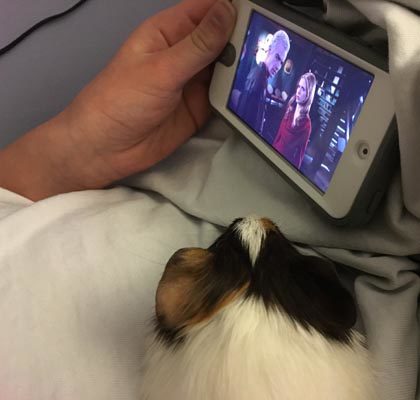
I don’t want that memory smothered out by someone else’s hate. But it’s hard to remember to write about it when I peruse the news sites prior to opening an empty blog post. Every sweet moment flies out of my head, replaced by the enormous, on-going scream.
*******
I finished Prep by Curtis Sittenfeld (so good — it made me think back to my own, albeit-non-boarding-school high school experience) and started American Wife. I borrowed the book from the library, and it smells like someone kept the copy in a nest of old pantyhose for several years.
I wanted to read it because my understanding of the book is that it’s a fictionalized account of Laura and George Bush, or a more liberal first lady speaking about her husband, a Republican President.
I know very little about Laura Bush. My only Laura Bush story involves a wedding registry at a Crate and Barrel. We had just come from the doctor’s office — this was before we started treatments — and we were trying to get a referral for the RE. I was miserable, but we had to take care of a wedding gift. It took about twenty minutes to get the registry up on their ancient computer, and we were just about to scroll down and see what they wanted when the Secret Service came in and said we had to leave because they had to sweep the store so Laura Bush could shop.
This is a pretty common occurrence in DC, like traffic stopping for the motorcade, but it’s annoying when you have one errand to run and you can’t complete it. She browsed for all of five minutes, and then left without buying anything. In the meantime, while we were standing outside for the sweep, the computer reset and we had to start from scratch bringing up the registry. We gave up after a few minutes and our friends got a crepe pan — out go-to gift at the time. So, sorry friends who got a crepe pan that wasn’t on your registry.
Anyway, I got this book because I was hoping that it would give insight into how we can live in this world for the next few years. How we can get along with family and friends who have different views. Maybe it’s only fiction and I’ll be disappointed to learn the answer is just suck it up. Or maybe there will be a kernel of something useful in the pages. Because right now, my instinct is to join that enormous, on-going scream every single day.
What other sound can you make right now?
There are so many stories out there that tell you how to vanquish hate. You throw the ring into the fires of Mount Doom or you destroy all the horcruxes. But fewer stories that tell you how to keep someone close that stands on the other side of a deep divide.
Right now, that divide is so wide, I fear that not only will our hands never stretch and reach over that space, but that divide will remain for generations to come; the echoes of it repeating long after the original scream is gone.
February 1, 2017 17 Comments
Sea of Time
I once dated a guy who had served in the army. He said that whenever they were returning to base from a break, they would get to the central meeting point and then toss their bag on the floor and lie down, using it as a pillow for their head. Even if they only had five minutes before they needed to get on the bus, everyone would grab the chance to zone out. They would say in Hebrew “sea of time,” poking fun at the idea that five minutes off in the army is like hours in a spa in the day-to-day world. Who was going to turn up their nose at five minutes? Give up 300 whole seconds to relax?
I don’t think I’d do very well in the army.
I’m currently in the second week of taking a lunch break. I set the timer for 20 minutes and read a book while I eat my cereal. On one hand, I love it. On the other, it makes it that much harder to return to work when the timer sounds.
Rather than appreciate my small sea of time, it feels harder to drag myself back to creating books rather than consuming books.
The break means a loss of momentum. Sure, I “recharge” but at the expense of interrupted energy. If I imagine my work energy sans break, it’s sort of like traveling through sections of Ohio. It’s flat road without a lot of excitement, but it’s relatively easy to move forward. My work energy with a break is like navigating a city… a hilly city like San Francisco. There’s a lot of stopping and starting. There are steep hills to climb but also big drops where my car can coast. Which option helps me cover more ground? I can’t decide. I only know that there are days when I need to talk myself back in the desk chair, and I never had to do that back when I never left the desk chair.
The bulk of my work day is a seven hour stretch. I also return to work an hour or so at night, and often put in time over the weekend. At different jobs, I have needed the break more than others. But in this line of work — thinking and writing — it feels like the break is both a welcome oasis in the day and a real energy disrupter.
Are you more productive with or without breaks?
January 31, 2017 10 Comments