

Category — Uncategorized
The Magic Play
Some people have a normal love of magic. I have an unusual love of magic. That’s like… 12 notches higher than normal love.
Every time I get a new bullet journal, I transfer my list of things I love and the top two items are
- Magic (real)
- Magic (illusions)
I’m just setting the scene so you can understand why I almost passed out when I got to go up on stage during a tech rehearsal for The Magic Play.
*******
What is The Magic Play? The way I described it after seeing it is that it’s the turducken of theater. It’s a magic show inside a play inside a much larger question: how do we trust one another?
(Side note: I am really trying to get someone to fall in love with calling this the “turducken of theater.” So far, every time I’ve said it, people have stared at me blankly and then treated the moment as if I blurted out that I love streaking.)
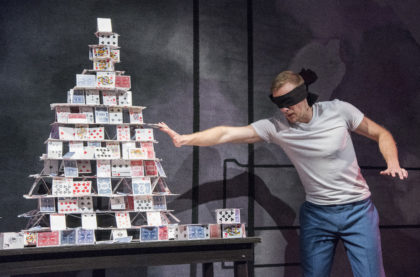
It’s a new play having a rolling world premiere, and DC was picked as one of the cities (specifically the Olney Theatre). The magician in the show is also an actor, and as he performs the various tricks, he’s telling the story of how he broke up with his boyfriend. So you’re seeing real magic tricks (and they’re amazing — more on that in a second) while hearing a story and then considering this larger philosophical question. There are three actors in the play — the magician, his ex-boyfriend, and the magician’s father.
After we saw the show, I learned that Jim Steinmeyer consulted on it. THE Jim Steinmeyer, the guy who created David Copperfield’s disappearing Statue of Liberty trick. The guy who adds magic to Disney shows. Magical historian and magical inventor extraordinaire. If you have an unusual love of magic, you know Steinmeyer.

Anyway, the magician pulls members of the audience up on the stage a few times, and I got chosen for the first trick in the play. I don’t want to ruin it for anyone in case you get a chance to see the play, but it is such an emotional moment in the show — a mind-blowing trick coupled with a story about how the magician’s ex-boyfriend left him — that I started getting teary. And I forgot there was anyone else in the theater in that moment because I was holding onto a pack of cards (oh! And he let me keep the cards at the end of the trick so they have entered prize possession land) and staring into the magician’s eyes. Chills, people.
Brett Schneider is incredible. Jon Hudson Odom dives from a 9-foot diving board on the stage. I spent the whole night gasping.
It has been to Chicago and it’s in DC for the next few weeks, and I have no clue where it is going next. But if you get a chance to see it, run, don’t walk to the theater. Beyond seeing Josh’s plays, which are the best written plays I’ve ever seen (and I’m not just saying that because I once inspired a line in one of his plays), this was my second most emotional, favourite theater moment.
I love real magic. I love illusionary magic. I love The Magic Play. That is a lot of love.
Images by Stan Barouh (used with permission)
April 16, 2017 2 Comments
De-faulting
We accidentally wake up the kids in the middle of the night on a regular basis, putting laundry back in their drawers or checking on them. Usually they roll over and go back to sleep, but every once in a while, we hit their sleep cycle at the wrong moment and they sit up in bed, wide awake. This happened last week to the ChickieNob, and she informed us in the morning that she needed to snap at us because she was overtired.
We apologized and she forgave us, but she kept bringing up the fact that she was overtired and it was our fault. When Josh pointed out that she had already accepted the apology, she said, “I accepted the apology. That doesn’t mean it de-faults you from what you did. You still woke me up in the middle of the night. I’m still tired in the morning. And it’s still your fault.”
I don’t know why, but I thought about this all day because granting forgiveness doesn’t really let the other person off the hook. Forgiveness is just acknowledging that you heard them and believe them when they express their regret. It doesn’t mean, as the ChickieNob stated, they are absolved of blame. They still committed the action, the end result is exactly the same. Apologies don’t erase; they just move things forward.
Plus apologies may come before the other person is ready to stop discussing their feelings. Clearly she was willing to accept our quickly given apology, but she still wanted to vent the rest of her frustrations over the situation. Just because we were ready to apologize and she was ready to accept that apology didn’t mean that she was also ready to stop feeling whatever she needed to feel about having her sleep interrupted.
I don’t know — it just was sort of a brilliant revelation for me. Both the fact that apology does not equal absolution on all fronts, just some, and that the timing of an apology doesn’t knock the possibility of more discussion on the subject. If not, after all, a person could apologize quickly just to get past the discussion part where the real work of acceptance is done.
Plus I liked the word “de-faulted.” You can’t un-fault yourself, can you?
April 12, 2017 13 Comments
You Were a Child Once, Too
The topic of DC restaurants banning kids came up at a meeting last week. Josh and I personally don’t patron restaurants that ban kids any more than we would patron a restaurant that banned Jews. (Well, technically, if they banned Jews, we wouldn’t be allowed to patron the restaurant. But you get the point.) Ban a behaviour — such as screaming and crying — fine. Ban a group of people — no.
But I’m also of the ideology that the moment I leave my home, I am no longer an individual in my individual space, but I’m now an individual who is operating as part of a greater community. There are plenty of benefits of being part of a community but there are also drawbacks. Leaving my home means that I don’t get everything my way. I don’t get everyone to stop talking on their mobile on the train. I don’t get people to stop wearing perfume. I don’t get people to walk faster on the sidewalk.
When I can’t handle the fact that other people are going to impede on my world with their sounds and smells and space-grabbing measures, I get carryout. But when I can handle the fact that I can’t shape the world around me to my personal liking, I end up having interesting experiences when my own existence bumps up against the people around me.

*******
I think the reason we discriminate against kids is because we have no chance of ever becoming a kid again. Whereas we don’t discriminate against the elderly (even though, as a society, we treat them like crap) because we know that we will one day become the elderly.
Esquire recently had a piece on Mr. Rogers, a series of connected stories about the man. He was asked to write a chapter in a book for ophthalmologists about how to interact with kids in their office. His chapter started with this sentence: “You were a child once, too.”
I think if we all start from that space, remembering that we were once children, it would not only help us to not be frustrated with them but would also give us the door to reach them.
I’m going to guess that you interact with kids on a somewhat daily basis. Either you are a parent or an aunt or a teacher or a member of a community who encounters kids when you exit your house.
Spend one week saying to yourself before every interaction, “I was a child once, too.” When you come from that mindset, you realize that just as you never purposefully tried to annoy the people around you when you were a child, the kids you’re interacting with are not trying to negatively impact you. Their crying is not personal to you. While it may be affecting you, it’s not about you at all.
Your child or your niece or your student or the kid in the grocery store may be annoying you. But this isn’t their intention and if they were guided toward a different way to act and if they had the ability to choose that different way to act as their default state, they would act in a different way.
The only way that can happen — that crying, screaming kids turn into functioning members of society — is to keep them around and teach them a better way to act. They won’t learn it by being kept out of spaces. They’ll learn it by the adults around them silently saying to themselves, “I was a child once, too.”
*******
People think that because I’m a parent, I must enjoy being around babies. I don’t. I like the babies who belong somewhat to me — nieces or nephews or cousins or close friends’ children — but all the others are just tangible reminders of what my body can’t produce. My family is not the size I want it to be, and while I accept that and am at peace with it, I don’t want to be around babies and think about it.
So I understand all the arguments about wanting a baby-free space. But I still can’t get behind discriminating against kids any more than I can get behind discriminating against a person for their sex, race, or sexuality.
Image: Lars Plougmann via Flickr via Creative Commons license
April 11, 2017 10 Comments
Dots and Stripes
One of the rooms at the Yayoi Kusama exhibit is a series of enormous pink blow-up balls covered in black polka dots.

Kusama really loves polka dots — they are everywhere in the exhibit including the final white room that is covered in colourful polka dot stickers.
And you know what — I don’t. I don’t love polka dots. Given the choice between polka dots and stripes, I would take stripes almost every single time*.
Which are you? Dots or stripes?
* The one exception is the shower curtain in the twins’ bathroom. It has dots in vibrant shades of blue against a white background. I really like it. Not enough to put it in my own bathroom. In ours? We have stripes.
April 5, 2017 14 Comments
The Oven
Last week, Josh walked into the kitchen while I was taking care of ordering stuff for the bathroom renovation. “Our oven clock is out. No. Wait. Our oven is out.” The burners on the stove top would turn on, but the oven itself remained cold.
Shit.
We had to get to the Yayoi Kusama exhibit (really, the timing of it made me think that the universe reeeeeeeeeeally didn’t want me to see this installation), but my parents saved the day by running to the store to look at the oven we wanted and even ordered it for us so it would be delivered the next day. (Thank you, Mommy and Daddy.)
All was going to be fine.
Except the first oven they delivered ran abnormally hot. Like we flipped the burner on low and then turned it off 5 seconds later. And 10 minutes after that, it was still too hot to hold our hand over the burner. The store agreed this was likely a fire hazard and delivered a second oven the next day.
Great.
But here’s the thing… I make up most of my recipes, and the temperatures are all estimated because (1) I designed these recipes on a 24-year-old oven that didn’t work very well and (2) the numbers weren’t very clear on the knob so in my head I said things like: “You bake the bread at a generous twisting of the dial.” It probably would have been a smart idea to buy an oven thermometer and test the temperatures BEFORE the oven died. But I didn’t, which means that I’ve spent the last week guessing on things.
My first challah was a little burned on the bottom. But my chocolate chip cookies (that was my biggest recipe fear — the inability to recreate my cookies) turned out fine. I learned that I bake them at 350 degrees. Who knew?
This was the last piece of the old kitchen. Everything (well, except the floor) has been replaced. It was bittersweet to see it go. I folded my hands over the oven’s door handle and talked to it before the delivery guys took it away. “Thanks, friend, for being such a great oven for so many years.” I like to think that the oven knew — even in its dormant state — that love.
I’m not the only one who speaks to inanimate objects, right?
April 4, 2017 11 Comments