

Posts from — December 2011
The Phantom Tollbooth and an Interview with Norton Juster
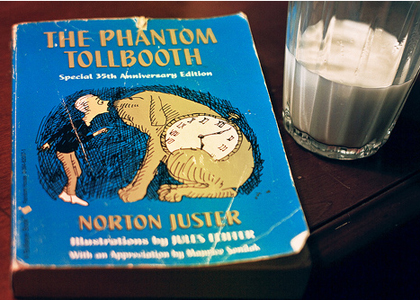
It is the 50th anniversary of the seminal work of children’s literature, The Phantom Tollbooth by Norton Juster. It felt like the right time to dig out the t-shirt I got when I attended the opera created from the book, the movie version of the story, and line up the three dozen copies of the book we have in various rooms of the house. It felt like the right time to lie on the living room floor, head to head with the twins, like a human flower created out of our body petals, and listen to the audiobook version together. I entertained for the 3000th time finally getting a Milo tattoo on my leg (please, mum, forget that I wrote that last sentence). We are a Harry Potter family and an Alice in Wonderland family, but moreover, we are a Phantom Tollbooth family. My brother made sure of that by gifting the twins their own first copies while they were still in the NICU.
The reason why the Phantom Tollbooth appeals to children is the same reason why the construction of the book appeals to adults. In both cases, it’s a tale of the unexpected, the unpredictable, the fact that anything can happen. Milo walks into his room and finds a mystery gift. He starts playing with it and lands himself in an incredible adventure. What child didn’t walk into their room every day after reading the book with the knowledge that anything could happen (isn’t that an enormous thought — both the good reality and bad reality of the statement)?
The story behind the book itself gives that same sort of hope to writers: anything could happen when we release our projects into the world. Juster never set out to write a timeless children’s book. Having his book become this successful is his own personal tollbooth that unexpectedly dropped into his life. It’s a reminder that the best adventures aren’t the ones we orchestrate, but the ones that we find ourselves in, being led from moment to moment in wonder.
I’ve told this story before, but it’s especially poignant to me on the fiftieth anniversary of the book. I discovered the book when I was in first grade in the school library. I loved it so much that I refused to read the last page, choosing instead to skip it and go back to the beginning. I checked out that book numerous times that year (and even advocated for myself when the school librarian insisted I lost the book. Lost the book! I would never lose something that precious. I grabbed it off the shelf to show her, and she realized with an apology that she had never checked it back in). My own children are now in first grade, and I volunteer in their school library. I have checked that book in numerous times; replaced it on the shelf with care.
It was the book that made me decide that I wanted to be a writer. I wanted to create a character that I loved as much as Milo.
Years later, I was living in Amherst, getting my MFA in creative writing at University of Massachusetts. I owned many copies of the book, but that didn’t stop me from purchasing the new 35th anniversary edition. I flipped over the book one night and read that Norton Juster lived in Amherst, Massachusetts. My heart started sounding in my ears — I lived in Amherst, Massachusetts. I grabbed the white pages (because back then, children, we had to look up addresses and telephone numbers in huge books… if you can believe that) and discovered that he lived 4 BLOCKS AWAY. He was 4 blocks from my commune. 4 blocks that would only take a few minutes to walk.
I polled my fellow commune mates and asked them if they thought I should call him. Even though everyone advised me to wait until morning, I couldn’t calm myself down to think clearly. I called him at home around 9 pm, and he answered the phone. Rather than berate me for calling so late, he good-naturedly informed me that I wasn’t the first person to call him like this. After I explained how overwhelmed I was — it was literally like talking to Superman — I told him how the reason I was in Amherst at all was because of him. He made me love books, and in turn, made me want to create books. I told him that it would mean the world to me if I could take him out for coffee.
And with all of the kindness of Tock, Mr. Juster invited me over to his house for tea. After work, I dressed up in a red checkered dress, and tied my hair into two braids. I walked the 4 blocks between our houses and almost chickened out on the front lawn. I am so glad that I took a deep breath and knocked because it turned out to be one of the greatest afternoons of my life. There is nothing quite like getting to have tea with your idol on his porch.

I got the opportunity recently to talk to Mr. Juster again, to interview him now that the book is turning 50. The construction of the book has been well-covered in Adam Gopnik’s piece in the New Yorker, or Norton Juster’s essay on All Things Considered. There’s a movie being created for the 50th anniversary.
Once you start poking around for Phantom Tollbooth articles, you realize how your own love is just a drop in the Sea of Knowledge. That there is an enormous wave of love for this book that swells over literature; other people who say that they owe their love of reading to this book, that it also made them want to become a writer. And that’s one of the points we touched on in the conversation; trying to understand what about the book made so many people want to become writers themselves.
Juster is somewhat amazed by the reaction to the book. His best guess is that “For many kids, it’s the first time they’ve confronted something where they feel a kindred spirit in terms of their consciousness and their understanding of things.”
I agree that is one reason why people fall in love with the book so deeply. Knowledge-wise, it’s like a gift that takes years to open. Everyone loves that moment when they’re tearing off the wrapping paper, still hopeful about what is inside, and the book introduced word play so seamlessly that readers are able to process the book on a multitude of levels. When I was six, Short Shrift was just a tiny policeman. When I was older and learned the term, Short Shrift was the embodiment of scant attention. And it felt like I was let in on a joke, let in on the adult world — one word play at a time. The word play comes from interactions with Juster’s father.
The other great influence is my father who is one of those addicted word play people. He was a punster and he would turn everything upside down. As a kid, your first reaction, of course, is uuuuuh. Because you don’t get it. And then after a while you suddenly realize, I get it, I understand it, and I can do it. Do you know how liberating that is?
Another message I took from the book was learning for learning’s sake; the joy in knowing things. It’s the anti-teaching-to-the-test novel. It takes the virtual desks of the world and tosses them aside in favour of exploring, asking questions, and getting one’s hands dirty in knowledge. Personally, I am always a little wary when I meet a teacher who hasn’t read The Phantom Tollbooth. Juster admits that while the idea of knowledge for knowledge sake was never an intentional plot point, it is obvious looking back on the book that it was there all along.
The joy of learning is a very important component when you read through it. One of the unique things that kids have is a way of finding alternative view points; alternative ways to think about something or approach an idea. One of the aims of our educational system is to drive that out of your consciousness as quickly as possible. They teach as if there was almost only one view point to anything. A story has a meaning, and that’s the story. I remember as a kid, and I still see it because I taught so many years, that kids will read something and they will tell you about it, and it’s very much not like what the author would say or the teacher would say, but it is the way they understand it. And that’s terribly important. You can never lose that; that unique view point.
It’s a lesson he learned the hard way growing up, when he’d come to school excited to share how he interpreted a story, and be met with the message: that wasn’t correct. Regurgitation of information is about as appetizing as… well… regurgitation of food, yet it is the backbone of our educational system at times. And Juster’s book seeks to do away with that idea that there is only one point of view as well as banish the ennui contained in “I don’t know.” And that mentality is something he holds his child and grandchild to as well: that there are answers to be plucked off the figurative trees if you just reach up your arm. He told a story about his granddaughter and when she uses the phrase, “I don’t know.”
I don’t know is half a sentence. And I said, “Do you know what the other half is?” She now looks at me and says, “but I’ll find out.”
Additionally, beyond his love of knowledge, it was his background in architecture that had a huge impact on the construction of the book.
Had I not studied architecture I either would have not been a writer at all or I would have been a much different writer. Because working in architecture, number one, what you do when you are doing architecture is you’re looking for … a very special way to look at something or an alternative way to look at something to turn out a project. So that mode of thinking feeds exactly into the book the way I write, and I think the way other people write. Secondly, I find that it’s very important to me to visualize. I work in pictures a lot in my head. And I think I can only do that because of the architectural training, which is a very graphic kind of thing. In fact, many times I will make notes which will be a few words, pictures, diagrams — everything — and when I put them away, I can take them out six months later and I still remember exactly where my thoughts were because I have that tool. Again, it’s not something I would have been doing had I not studied architecture … I always tell people that I think studying architecture is the best liberal arts education you can get because it touches everything.
The idea that one art form supports another is the basis of many MFA program’s requirements that students obtain a certain amount of credits in an outside though related medium. At the time, I didn’t understand how taking six credits of visual art was going to make me a better writer, but listening to Norton Juster, I’m convinced that the outside credits are not a happy accident meant to give you additional skills outside your area of study. Rather, like many things in life, they are skills applicable to enhancing your range of knowledge within your given field.
As our phone conversation wound down, I flipped to the front page of the copy I was holding that he had signed that day during graduate school while we had tea on his porch. In the inscription, he said he was glad I called the night before, again, reminding me of the character Tock, who good-naturedly comes along for the ride, always happy to help out Milo on his adventure. Jules Feiffer, the illustrator, may have drawn Juster into the book as The Whether Man, but in my eyes, he is pure Tock, giving us a piece of literature that uses our time wisely.
Book Image Photo Credit: Keith Trice.
Norton Juster Photo Credit: Random House.
December 8, 2011 19 Comments
When I Have a Pregnancy Announcement to Give (This is Not One)
I felt like I had to put that parenthetical statement in the title because I didn’t want anyone’s heart to jump again over the words “pregnancy announcement.” This is a perfect example of how people can truly be clueless and not malicious; when I titled that post “The Stuff of Urban Legends,” I meant just that… the stuff that makes up urban legends. The Visine, the clove cigarettes, the axe murderers. Not myself, as an urban legend. That interpretation didn’t even cross my mind until the first comment arrived letting me know that’s what the person expected. And even then, it took me probably 30 seconds to understand how they jumped to that conclusion. This was literally my thought process:
They thought I was surprise-pregnant. Maybe it’s a common thought of women who are pregnant to consider dumping someone else’s Visine down the toilet. Do men like to make Visine-in-your-coffee jokes to pregnant women? Is she talking about the pop rocks picture? Is there an urban legend about pop rocks getting you pregnant? I actually like pop rocks. More than I like all that green tea I used to drink for my cervical mucous. Where the hell does one even get pop rocks nowadays? The only time I get them is when J brings them back from Israel for me. Wait a second, J is in Israel right now. I should see if she can get me one of those Elite bars with pop rocks from Machane Yehuda. Is that where that candy store was? Maybe the place I’m thinking of is right outside Machane Yehuda. Where the hell did we get those candy-coated peanuts that time? Those were so damn good. Would it be insane to call her on her work trip and ask her to pick up a bag of peanuts? Wait… no… the urban legend is about eating pop rocks. I should ask her to get the Elite bar… OH THEY THINK I’M THE URBAN LEGEND.
I left a kernel of this thought in my comment section, but thought I’d put it here too and gather your thoughts. If/when I am lucky enough to have a pregnancy announcement to make, this is how I suspect it will go down:
- I will tell family first, face-to-face or over the phone.
- I will most likely tell friends via email, having no clue where they are emotionally at the moment to hear my news, and just tell it straight. Subject line gives them an inkling of what’s inside the note and I give the news simply, much as I would with any other facet of life. I know that if they’re curious or excited, they’ll ask questions and we can discuss more, and if they’re not, then no hard feelings and they’ve gotten the news straight from me.
- I will most likely tell even other bloggers via email in the exact same way. I haven’t really thought out how I will do so since gmail has a cap on how many people can be on an email. And there is also the potential problem that while I may think you’d want to hear it directly from me, you may actually be wondering why I emailed you in the first place (as in, “Who the hell is Melissa?”). And even more importantly, there are people who have read this blog for the last 5 1/2 years but have never told me or commented, therefore, I don’t even know who they are in order to tell them before they see it on my blog (hi, lurkers, I do appreciate your quiet support — this is not an attempt to guilt you out from the shadows). So emails to bloggers just might not be possible. But if it is, that’s how I’d tell as many people as possible.
- And then I would post it on my blog. The title would convey without question what is in the post. And I’d say it directly. Probably very briefly. I would assume that it would look something like this post. It’s how I tend to give news that I’m not sure how others will feel about it. I’m sure some people were happy with my book news. And I’m sure some people were cursing me with my book news. I know this because I do the exact same thing — some people’s announcements don’t phase me at all because I don’t have an emotional horse in the race. And some get under my skin, even if I am happy for them. Let’s be honest, we’re not robots; we’re all human beings who feels jealousy sometimes.
This is my plan simply because this is how I like to be told. I don’t claim it to be the best way or the only way to give news. But I tend to give as I’d like to receive. Which is not to say that if you told me via your blog rather than emailing me directly that I was upset. On the contrary, I probably didn’t give it a lot of thought at the time nor am I giving it now. Please no now-I-feel-terrible-about-how-I-gave-my-whatever-announcement-on-my-blog comments.
My personal general rule is that I can’t expect people to read my blog or Twitter feed or Facebook page. I can expect them to open a direct email, letter, or take a phone call. So if I have news that is important to me that they know, I use a direct approach. Everything else goes online (almost always my blog since it isn’t a time sensitive medium), and if they see it, fantastic. And if they don’t, no problem. They should probably assume that if it’s only on my blog and not in their inbox or I never bring it up when we’re face-to-face that I don’t consider the news to be of utmost importance.
And my other general rule is to attempt to jump over the chasm of comportment that blogging sets up between the writer and reader. You guys mean more to me than simply throwing up a blog post conveys. And yet lurkers and technology limitations sometimes stop me from being able to convey information in the way I think you deserve. The way I combat that is to keep things short and direct.
My only promise is that I try my best; clueless usage of the term “urban legend” notwithstanding.
How do you like to receive pregnancy announcements from other bloggers? Am I overthinking how to tell (though based on the comments to that urban legends post, I’m not sure I’m that off in believing that it’s hard to have pregnancy news come out of nowhere in a blog post. If I was clearly awaiting a beta, it would be a different story)? Is short and direct the way to go, or would that be more hurtful? Perhaps best to collect these thoughts BEFORE I’m in that position to have something to announce rather than after.
December 6, 2011 29 Comments
Hilary Neiman Sentencing Outcome
Just wanted to give a heads up since I read it this morning and we discussed it last summer. The first person — Hilary Neiman — who was accused with Theresa Erickson and Carla Chambers of operating a baby selling ring within surrogacy/adoption, was sentenced to five months in prison. According to the article, she also will “serve seven months of home detention, forfeit $133,000 in profits and set aside $20,000 for restitution.”
Theresa Erickson and Carla Chambers will be sentenced some time in early 2012.
Last summer, when I first read about it, I knew exactly how I felt. This morning, reading about the jail time, my feelings are murkier. Maybe because the court began with Neiman, a fellow Marylander who is about my age. Maybe because there is a difference between accusations and guilty pleas that involve reputations/professions and jail sentencings that involve time. I said in that second post:
I have a lot of fears right now, and I’m finding it very difficult to return to that rosy, rational place where I was comfortable in my beliefs. Where I knew that exploiters exist — does Madoff ring any bells? — and they may even cross my path, but the vast majority of people I surround myself with have my best interests at heart even if they want compensation for their work. I know I will get back to that place because if that is your natural state, you always return to that place. But right now, I’m waiting for this feeling to pass so I can return to a place of trust. Because what else can I do when I have this need and I require others to help me fulfill it?
I still believe that is my natural state. I still don’t think that I’ve fully returned to my place of trust. Maybe my murky feelings have something to do about noticing that within myself.
December 6, 2011 4 Comments
The Stuff of Urban Legends
 As Josh was getting in the shower, I commented on how bloodshot his eyes were. He responded, “then it’s a good thing that I have that container of Visine.” And I responded: “then it’s a good thing that I didn’t dump that bottle of Visine down the toilet.” (Why would I do this? I don’t know. It just felt like the right thing to say in that moment.) To which he responded: “then it’s a good thing that you didn’t put a few drops in my coffee.”
Putting Visine in your coffee, he confided, will instantly force a person to have explosive diarrhea. He delivered this bit of knowledge with the confidence of a ten-year-old boy who has just learned how to induce explosive diarrhea from his older camp counselor. He sounded smug, and he snapped the shower curtain behind him for good measure.
“Is that really true?”
“Why don’t you ask the Google machine and find out?”
So I asked the Google machine and Snopes returned the answer: Visine does not cause instant, explosive diarrhea. While I was online, I also looked up another fact from childhood we had been wondering if was true the night before: do clove cigarettes, or kretek, cause tiny puncture holes in the lungs from the cloves bits? Alas, they do not.
Which caused us to lament all the good times we had as children believing that pop rocks and Coke would make our stomachs explode like Mikey, that Alfonso Ribeiro died while breakdancing in a Michael Jackson video, and a girl went down to the Amazon and didn’t know that a spider had laid eggs under her skin until the lump popped and THOUSANDS OF SPIDERS STARTED CRAWLING OUT.
The problem is that with the Google machine, it is too easy to stamp out urban legends before they’ve really gotten a chance to perform. Instead of lying awake in your camp cabin at night, wondering if it’s true that a woman was driving down the road on a dark night and the car behind her kept flashing his brights at her until she pulled over and he got out to tell her that THERE WAS AN AXE MURDERER IN HER BACK SEAT! Now the children know within minutes that this did not happen to a friend of a friend’s mother.
And that made me sad.
Video didn’t truly kill the radio star, but the Internet really did kill the urban legend machine.
What urban legends have you now proven or disproven with the help of the Internet? Which ones are you still wondering about?
Photo Credit: Jamiesrabbits.
December 5, 2011 18 Comments
The Writing Life, Loneliness, and Microsoft’s Clippy
 Since my Siri dream, I have spoken often about the iPhone 4s, not because I actually want an iPhone, but because I like the idea of this voice keeping me company. I love working out of my house, and I am the sort of person who really enjoys being alone. I like to go out to dinner by myself. I like to sit in coffeehouses and read. I dislike shopping, but I do better with shopping excursions when I’m on my own.
But that doesn’t mean that it isn’t incredibly lonely to spend every day completely alone in your house. I am probably more productive than the average worker since no one swings by my office to ask me a question and ends up standing there for 10 minutes talking about their weekend. As much as that aspect of office working annoys me (I really do like being alone), it is also something I wistfully miss since becoming a full-time writer. I can go hours and hours, day after day, not speaking to anyone except Cozy Jackson.
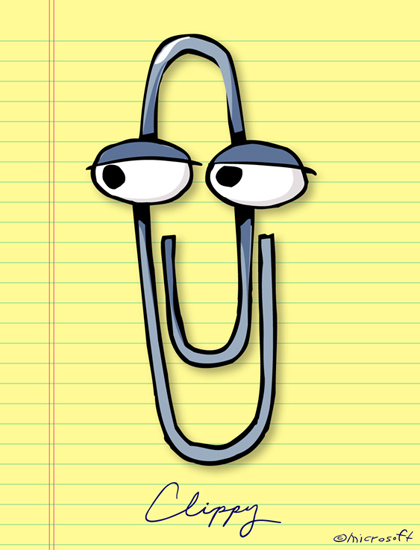
What I do have open to keep me company is Clippy, the Microsoft Word paperclip office assistant who comments on your document. Clippy doesn’t really say much to me as I write (though I do like when he tells me if I’m about to overwrite a file); he just sits in the corner of my document, blinking at me. He’s like a little silent pet, and yes, I have had conversations aloud with Clippy, speaking to him as if he is my silent, electronic therapist. Clippy and I have been through two books together, and he is with me for these next two that I am completing simultaneously.
The Wolvog recently fell in love with Clippy having found out about him through a programming site. I was working on my new computer as he told me about Clippy, and I opened a Microsoft Word document so we could gaze at him.
But Clippy wasn’t there.
I went through every menu, finding the new Microsoft Word exceedingly difficult to use. Finally, I did what any normal person does in 2011 when they can’t find something. Instead of hitting Microsoft’s help menu, I Googled Clippy.
And discovered that Clippy had been… murdered!
Killed by Microsoft Office executives back in 2003.
The computer I use to write on is old enough that it still has Clippy, but he’s missing from my new laptop. And there’s no way to download him: I know because I Googled this too. As we read though site after site about Clippy information, I learned my first truth about the little office assistant. While others agreed with me that he is the solution to the loneliness of the writing life, others wrote that they hate Clippy. Hate him? They don’t even know him. They couldn’t have possibly spent enough time with him because to know Clippy is to love him. Right?
As we panic-Googled our way through Clippy information, we stumbled upon the creator of Clippy, Kevan Atteberry, and my son wrote him a fan letter. By the next morning, he wrote him back and an online friendship formed between the creator (otherwise known as human Clippy) and the computer-obsessed Wolvog. The Wolvog interviewed him for his ‘zine (what, I haven’t told you that the twins have their own ‘zine? The first issue is coming out this winter), and I leapfrogged over the Wolvog to interview Kevan myself (taking advantage of the fact that the Wolvog needs to go to school, and I have unlimited computer time at home).
The early iMacs had a handle, not because the desktops were going to be carried anywhere, but because Steve Jobs wanted the computer to look as though it was alive. Like it could leap off the table (hence the jaunty angle of the screen). Like it is accessible and pick-up-able and friendly. And that’s what the Microsoft Paper Clip is for many writers. In the unfriendly and harsh world of constructing paragraphs, the frustrating world of trying to string together the right words in the right order, Clippy is like a little friendly reminder that writing can be fun. That it isn’t always banging your head against the wall. That writing can be playful; words can blink at you.
I sat down with Kevan Atteberry online to talk about his creation, Clippy.
Melissa: So how did you get involved with the project to design Clippy? Had you previous worked with Microsoft before that point?
Kevan: I was a contractor for Microsoft working on a product called Microsoft Bob, a graphical interface “OS” meant to make computing easy for the uninitiated. This was back in the early 90s and computers were still new to many. Bob offered a variety of environments for your desktop, outer space, log cabin, suburban home, etc. And you also had a choice of animated characters that would offer suggestions and help. This was the nexus to Clippy. Bob under the project leadership of Melinda French (soon to be Melinda Gates) was hugely promoted when it came out and quickly was retired after horrible reviews and performance making it one of the biggest software disappointments to date. But the animated helper technology, which they had spent years and lots of money developing, was ported over to Micorosft Office team. Where we went through some intense and lengthy testing of about 260 different characters before it was narrowed down to Clippy as the default character. I had about 2 characters in the mix and two of them made it to the first shipment. Clippy with the crowning glory of the default.
Melissa: Was his name always Clippy? Did you ever have a different name for him as you designed him, and was Clippy a name given to you by the powers that be at Microsoft or did you bequeath him with the moniker?
Kevan: He was originally called Clippet – Clippy for short. I think in developing him and through the testing, we just referred to him as “the paperclip.” I don’t know who came up with the name Clippet. Or Clippy. But it seems rather obvious, apropos.
Melissa: I think that what made Clippy endearing and seem more lifelike was the use of facial expressions. Did you have a model for all of Clippy’s eyerolls and blinks?
Kevan: No actual model. Just my experience in drawing characters for many years. It was somewhat a challenge having just the eyes and the twisting of the wire to convey some particular expression.
Melissa: I have to admit that I didn’t know that such rage existed against Clippy until I went to look up why he wasn’t on my new computer. Can you talk about what you felt and thought about the visceral reactions people had to Clippy?
Kevan: Oh my, yes. The way people feel about Clippy is either black or white. You love him or hate him. No in between. My reaction has almost always been, “whatever – as long as you know who he is and he evokes emotion one or the other, I’m happy.” He has opened many doors for me in the past and I am thankful for that. And I know Clippy is a likable fellow, just look at him! What people who hate him despise is his functionality. Which can be intrusive and unintentionally condescending. He can be distracting. But the people who love him, I think, love him despite his functionality. Like maybe a dear pet with bad breath.
Melissa: And at the same time, Clippy has a bit of a cult following. How do people usually react to you when they find out that you designed Clippy?
Kevan: People, whether they hate him or love him, have always seemed surprised and genuinely happy to find out they are meeting Clippy’s creator. And the two main responses I get are, 1) “Clippy? No way! I hate that thing!” or, 2) “”Clippy? No way! I LOVE Clippy!” But in each instance it is said with huge smiles and a bit of excitement. I think that even if Clippy irritates or annoys you, there is still some thing kind of cool(?) or interesting(?) about learning he actually has an origin.
Melissa: You’ve done a lot of illustration work – which character keeps you company while you work?
Kevan: I’ve recently moved my studio home from downtown Seattle and I have yet to have it in complete working order. I have more limited wall space now and less space to hang things. But I do have things out that I love. A Calvin and Hobbes cartoon, several pieces with Pogo and his compatriots from Walt Kelly’s wonderful strip. Several characters from children’s books I’ve illustrated are represented (Tickle Monster, Boogie Monster, Frankie Stein.) And then there are a few characters from a personal challenge I recently completed. In October I challenged myself to create from scratch, a Monster-a-Day for the whole month. You can see these on Facebook. Several of these I hope go on to have a life of their own in children’s books I hope to write. And illustrate.
So even the creator of Clippy has illustrations around to keep him company.
Okay, ‘fess up: are you on Team Clippy or Team Anti-Clippy? And what do you keep around to keep you company when you’re alone? Picture? Stuffed animal? Favourite music playing in the background?
Photo Credit: Microsoft.
December 4, 2011 25 Comments