

Posts from — July 2010
DIY MFA: No Agent? Other Paths to Publication (Part Eight)
Welcome back to your Do-it-Yourself MFA program.
Let’s say that you didn’t get an agent, that you’ve been banging your head for a year or several years or several projects and you still don’t have an agent. There are other paths to publication.
Self-publishing is open to everyone. You pay a fee, and they put your manuscript in book form. Prices range from a couple hundred to several thousand. Self-publishing utilizes a system called POD or Print-on-Demand and it’s similar to Cafepress. They do not waste materials until someone wants the book; meaning, the reason you can usually only get self-published books online rather than in a bookstore is that they don’t exist until someone makes a purchase and then they are printed within the day and mailed out.
The writer pays an upfront fee (Booksurge, Amazon’s program, asks for anywhere from $800–$6000 depending on what you need done–and I’m sure there are places that do it for much less, but you also sometimes have lower quality with the lower fee), and then receive back a portion of the book sale–sometimes up to 35%. So … just to explain the math to see if this option is right for you, if a book costs $15, you should receive back $5.25 per book sold. You’ll need to sell a little over 150 copies of the book to break even and after that, you’ll turn a profit. (That is, if you go the cheapest route on Booksurge. You’ll need to sell well over 1,ooo books if you choose a more expensive option.)
Advantages are clear–it is entirely within your control. All you need to do is write the book. And frankly, if you’re not up to enduring a lot of rejection (because even JK Rowling endured rejection), self-publishing is the way to go. It is a sure thing. You also have control from start to finish, deciding what goes in the book as well as the look. Though you have to front the money for the process, if you have a thousand dollars to invest, you can easily turn a profit if you have a decent platform. And for most writers, turning a profit is not the reason they wrote the book: it’s to get the information into the hands of people who need it or would enjoy it. Therefore, self-publishing is the perfect way to make sure that information or a story doesn’t linger unpublished on a Microsoft Word doc on your computer. It is the only way within your control to make sure that it gets sent out into the world.
One other advantage is that some PODs then get picked up by a publisher, though this is uncommon and not something that can be controlled. This scenario is the needle in the haystack and I can only think of one book like this off the top of my head, but the point is that self-publishing does not need to be the end-point. It can also be the starting point to prove the book’s worth.
The disadvantages are clear too–since anyone can publish a POD, there is a big range of quality. POD-dy Mouth used to be the place to go to separate the wheat from the chaff, but with that site closing, it’s really up to you to exercise a buyer beware mentality as a reader. Every book you are purchasing from a publishing house (small or large) has been professionally edited as well as vetted if it is a work of non-fiction, with research notes examined and challenged. Publishing a book is VERY different from writing a book, and self-published books miss out on the whole publishing process.
Having been a freelance editor–sometimes called a book doctor–(as most MFA grad students are at some point in their life) and having been on the receiving end of a publishing house edit, I can tell you that it’s two very different processes where one is receiving a collection of notes (book doctor) and one is participating in a collaborative process with (1) some control over using the notes removed but (2) a keen-eye focused on getting the right message across (a traditional editor at a publishing house). Removing the publisher from the publishing process can remove some credibility depending on the reader. There is much, much more to publishing than slapping a cover on a book, arranging the pages, and getting it listed online, and self-published books miss out on some important steps in the collaborative book birthing process that come with traditional publishing. Self-publishing should actually be called self-printing and not publishing.
The other disadvantage is marketing. You are entirely on your own for marketing with a POD unless, again, you pay for services. If you have a pretty strong platform or the book gets a cult following, this isn’t an issue. But it means that you keep having to take the initiative to get it out there and it can be exhausting (and avenues can quickly be exhausted). Most publishers expect authors to take a certain amount of initiative, so it isn’t as if this disadvantage is unique to PODs, but the difference is that (1) you will not get the foot traffic picking up your unknown book off the shelf at a bookstore because it’s usually only offered online and (2) some traditional reading sources and media outlets will be closed to PODs.
The last disadvantage is that as an author, you think like an author and you can’t see the big picture that someone on the other side of the business can see. Traditional publishers have seen which covers work and which do not. They know where to focus their energies on marketing a book. You know your book best, but they know marketing best. Self-publishing rejects the idea that professional out there might know a thing or two. Sometimes, you’re right. Unfortunately, sometimes you’re also wrong and if you’re wrong, you might be out a lot of money.
And really, at the heart of this, is a central idea that everyone needs to remember — book writing and book publishing are two very different things. You may find that you love the idea of book writing, but hate the actual process of book publishing. If that’s the case, self-publishing may be the best route for you. But some people really want to experience both sides of the process — the writing of the book and then the publishing of the book — and may find that it’s better to leave a document on the computer or choose the route I’ll discuss below instead of self-print the book.
It’s sort of the difference between a veggie burger and a hamburger. They look alike, but a veggie burger is not a hamburger. And if you’re craving a hamburger, you’re probably not going to be fully satisfied with a veggie burger. Though sometimes you just want food and if the veggie burger suffices, eat it.
So, to review about self-publishing–-it’s great if you want control of the process and you want it to just happen without having to jump through hoops. Yes, you need to front the money, but if you can sell between 150–1200 copies, you’ll recoup your investment. And if you have a strong platform, selling 150–1200 copies won’t be a problem. The information will be out there instead of sitting on your hard drive. And there’s always a chance it will hit cult-success or be picked up by a traditional publishing house. I am personally a fan of self-publishing because there’s a lot of good stuff that will never be considered by a publishing house because it doesn’t have marketing potential (remember, a publisher buying a manuscript is essentially making an investment and just as you wouldn’t buy stock in a company that looks like its going nowhere, publishers will not invest in books that they don’t think will make a profit. And publishers need to sell many more than 150 copies to turn a profit).
One thing happening right now is that self-publishing is trying to move away from its earlier title of “vanity press” by renaming itself independent publishing. But something already exists called independent publishing and it’s the smaller presses (non-big six presses) we’re going to talk about below. I know this can be confusing, but when I use “self-publishing,” I mean places you pay to print your book for you (such as BookSurge). I use “independent press” and “small press” interchangeably to mean any publisher that is not a big six publisher, though I tried to stick to the term “small press” to make this clear. Think of the distinction the same way you would (with similar advantages and disadvantages) between a large bookstore chain and an independent bookstore. Both contain books, but the way they market books is different. Big six publishers are the chain bookstores and small publishers are the independent bookstores. Self-publishing is equivalent to the book peddler, with one person selling their one book.
Okay, so now that we’ve established that, the other option is self-representation.
Sort of like applying to college, self-representation is open for everyone to try, but you’ll have to be accepted. Though small press publishers prefer to work with agents, some will accept direct submissions. (Big six publishing houses will not accept submissions that do not come through an agent with few exceptions.) Most small press publishers work with a specific genre or within a specific swath of the population, but if you fit their profile, you may be able to send your work directly to the house and have it considered for publication. If you get accepted, it contains all the advantages with working with a publishing house–you get paid to write the book, you get a professional editor, and you get help in marketing the book. It will appear in bookstores and you will have readings and reviews (hopefully–but even that is not a given these days).
The advantage with self-representation is that you don’t need to first obtain an agent. You can present yourself however you wish, meaning, you can highlight what you think is important rather than having the agent decide what to highlight. In certain cases, you can represent yourself better than an agent, though with few exceptions, an agent always represents the book better (meaning, you know you, but your agent knows books). Personally, I’d trust the agent because you’re not selling yourself per se, you’re selling the book. But there are cases where this is important (for instance, if your book is about social media and you can’t find an agent who is Twitter-proficient and you know of a publisher who would be perfect for the book.)
The big advantage is that unlike self-publishing, you will never have to layout any money to be published–they will pay you. If a publisher asks you to pay for any part of the process beyond mailing your manuscript, you will know it is not a legitimate press. Publishers will not ask you to layout your money because by buying your manuscript, they are essentially making an investment.
Some people who self-represent to get the deal will turn around and get an agent once they have an offer on-hand. They will have the agent look over the contracts and help negotiate things. Personally, I see a lot of advantages and disadvantages to doing this: you get an agent, but you miss out on the reason for having an agent in the first place (more on that in a moment). But I do think it makes sense if you see yourself writing more books or negotiating more contracts (international rights, film, etc) later on.
The disadvantage to self-representation is that fewer and fewer small press publishers will accept unsolicited manuscripts (the term for a manuscript that you want them to read, but they did not ask to read nor did it come from an agent). So on one hand, it’s more immediate than getting an agent, but it’s also harder to have your manuscript read. And once you’ve taken this path, it’s hard (though not impossible) to get an agent to look at your manuscript because it has already been out there. So it’s a path I would only take if you’ve already exhausted searching for an agent or if you’re prepared to either self-represent yourself to the end of the road or self-publish.
The other big disadvantage is that you will always be negotiating (instead of having someone negotiate on your behalf) and you’ll have to be vigilant. I think only those who know what to expect and look for within publishing should take this route. The way it was explained to me in graduate school is the offer you will receive through an agent is so much greater (not just financially, but in retaining rights et al) than what you can receive for the most part on your own, that it’s worth the cut an agent will take from your contract because you’ll still come out ahead.
So, to sum up self-representation, if you’re pretty savvy, have connections in the publishing world, have access to free law advice, or want to try this before self-publishing, it’s a great route. If you are set on publishing with a publishing house, this isn’t a great starting point, but it can be a good finishing point before you throw in the towel.
Okay class, any questions on what was discussed here? Please leave them in the comment section below and I will answer them in the comment section below. Keep in mind that I have a lot of topics to cover so your question may be answered in a future installment (see below). So keep your questions about self-publishing and self-representation.
Heads Up and Looking Back: topics that will be covered in future installments or that were covered in past installments
1. Before You Even Get Started
2. Are You Ready to Be an Author?
3. How to Write a Non-Fiction Book Proposal
7. What Happens Next–Waiting for a Book Sale
8. THIS POST
9. What to Expect After You Sign a Book Deal
10. Be Your Own Publicist
11. A Mishmash of Leftover Questions and Answers
July 25, 2010 2 Comments
298th Friday Blog Roundup
I was going to write an addendum to that last post and then … well … the day got away from me as it seems to have everyday for the last four weeks (and I massively apologize if you are waiting for an email back from me. My goal is to be caught up reading blogs and answering emails by the end of the weekend, but who knows what will happen to my good plans.)
I promise: I am not closing down my blog; it was merely pointing out that many of us have that thought from time to time, and I loved Andrea Ross’s speech about how we really have no sense of our blog’s reach. We have comment numbers and visitor numbers and even emails from a reader from time to time, but like icebergs, most of the real facts are submerged underwater. That everyone goes through frustrating times (and I agree, Vee, I think it’s seasonal too) where they are speaking and getting no feedback. And on the other hand, we all have times where we hit a post out of the park and it gets a lot of attention — and we have no. clue. how. to. repeat. it. again.
Thank you, also, for being with me during the move. When we were driving to my parent’s house for the final time, I was thinking to myself, “I can’t do this.” I really didn’t think I’d be able to walk out the front door; that I’d ever be ready. And suddenly, a Toyota pulls in front of my car with the license plate — UCNDOIT. And like a fucking idiot, I start trying to decipher it, and I’m saying to myself, “University of California … Nursing Department … Or … Internet Technology … no, that doesn’t seem right … University of …”
Seriously.
We drove behind the car for several miles and it felt like my own private message from G-d. So I went into the house thinking to myself that I could do this, I could walk through one more time and then say goodbye. Except it seems like I was right the first time (sorry, Toyota, for wasting your fine message.) I cried walking through the rooms, and finally realized that I simply couldn’t take in the enormity of never seeing the kitchen again, never seeing my room again, never seeing the tiling in the front hall again. And I accepted that I’d never be ready and just had to walk out the door. So I gave my dad a hug and kiss, thanking him for being a wonderful father in this house, and I left Josh and my dad behind to close up our lives there while I took the twins to meet my mum in the new apartment.
By two streets away, we had all stopped crying. And a few exits on the highway and we all commented that we felt fine. And then we moved my parents into their temporary apartment while their new house is being finished. I haven’t watched the video again since the move mid-week. It still doesn’t seem real, and at the same time, it feels wholly okay. So maybe I can do it.
And thank you for the good thoughts on the new book. I am really excited about it and I love, love, love the cover. When I get the final version, I’ll post it here and on the book site.
*******
The loudest vote for celebrating the 300th Friday Blog Roundup seemed to be for cake (or, if you don’t want to bake or purchase a cake, you could take a picture of a cake in a bakery and walk out without tasting a slice, or simply down a few oreos and snap a picture of your cookie orgy. The point is more to celebrate the Roundup and our community and have a built-in excuse to eat sugar.) Which is actually, if you can remember back to June 2007, how we celebrated my first blogoversary. We will hold the videos for the 333, which will be next spring.
Though first, I must admit something highly amusing that just happened as I wrote this. As I did the math and realized that 33 posts later would be nearly 3/4th of a year away, I started wondering how I was hitting 300 Roundups in 4 years. That just wasn’t possible since I started doing this a few weeks after the blog started and with 52 weeks in a year, I should be nearing on the 200th post.
And so I am.
Back in January/February of last year, the numbering jumps from #173 one week to #274 the next week. In other words, I added one more to the first number as I was adding one more to the last number and in the end, aged the Roundup 100 posts. I am not going to renumber the posts because it would be a pain in the ass, so the Roundup will be forever mis-numbered. But this will be actually the 200th post of the Roundup (though it will say 300).
Queue slightly hysterical, overtired laughter.
I’d like to practice today with this new linky tool that Calliope uses for Photo Fridays before the big day. If you have a picture of yourself on your blog (or on your computer) and can help me test this out, please click below and add your headshot with a link to your blog so we can all see how this works and troubleshoot since the actual 300th (well … 200th) Roundup will be during BlogHer and I’m not sure how much I’ll be online.
It seems fairly simple. You (1) click on the link below. (2) Add the url of your blog. (3) Add the name of your blog. (4) Either give the url of the picture as it appears on your blog, OR upload a new image to the Linky Tool that is from your computer (see, it doesn’t even need to go on your blog). That’s it — it should appear below. And this practice list should close on Sunday. So we’ll see if that’s the case.
Thank you to the heads floating above this sentence for helping me test this.
*******
The Weekly What If: What if you could either be given a free netbook or iPad tomorrow — which would you take and why?
Can you tell that I’m still trying to make this decision? I like to hear what other people think are the benefits and drawbacks of each one (as well as opinions if you have either and how you primarily use it) because it helps me consider things from entirely new angles.
*******
And now, the blogs…
Baby Wanted: Apply Within has a post about where they are now, and how she thought life would be back when they started trying to build their family. It is a simple, straightforward post, but I found it incredibly moving: the thought of what you don’t know and simply can’t imagine when you start down this road.
Impersonating Normal (formerly, Infertility Rocks!) has a post about faking a birthday wish for the sake of others. She contrasts this current birthday with the one she celebrated last year, back when she was starting her lupron shots and had no idea how the year would unfold. Again, it is a reminder of what we can’t possibly know about our future and how that fact makes us look back on past events with wonder and sometimes bittersweet sadness with what that earlier version of ourselves doesn’t know.
Lastly, Nuts in May asks at the end of a post this week: “So really, are any fertile people reading this? Who have read this far? Have I really pissed people off now?” The discussion in the comment section is equally as interesting as the post. Go jump in with your thoughts.
The roundup to the Roundup: This has been a crazy week (I’m not sure I could say it more succinctly than that.) Celebrate with cake in two weeks for the 200th/300th post of the Roundup AND please help me test this linky tool today. Answer the Weekly What If. And lots of great posts to read.
July 23, 2010 15 Comments
If You’ve Ever Wondered If You Should Keep Writing Your Blog…
We have all thought about simply deleting these spaces we create. It’s not even in a particularly terrible moment, where the desire to walk away from blogging is understandable. It comes in quiet moments, where we wonder what the point is of posting our thoughts online and taking that risk, using that time, plugging into that community. We could just as easily write in a private journal. Which would mean that we could record our life without considering how often we’re posting, or looking at our stats.
I think about it sometimes, so I know that you think about it sometimes. And some of us do it; simply walk away from the blog and leave it collecting dust, or delete it, or shut it down to invite-only and then never give anyone beyond ourselves the ability to read. We’ve thought about doing it ourselves and we’ve had it happen to us: that blog you loved reading that suddenly disappeared or the writer who stopped posting.
And we know how it feels when it happens to us, so we try not to do it to anyone else.
Of course, sometimes that reasoning simply isn’t enough.
I love Andrea Ross’s thoughts on what we believe to be irrelevance when it comes to blogs. I got to participate in her project a few years ago, and though I didn’t tell her at the time, because I’m not sure I even realized it consciously at the time, is that speaking about Norton Juster’s book connected me to why I wrote. It is perhaps what gets me over those thoughts when I consider walking away from this space. This was my contribution to Just One More Book Please:
[audio:https://www.stirrup-queens.com/wp-content/uploads/2010/07/just.mp3]
And Andrea Ross contesting irrelevance.
I put this up because it reminded me how we need to tell people how much their blog means–and we don’t even need to do this directly; we can do this through our actions of reading and commenting and linking. All of it gets the point across. Because the reality is that no blog is irrelevant, just as no life is irrelavant. The entire blogosphere changes any time a new blog enters or an old blog leaves. And my life is a better place because I’m connected to all of you through words.
July 21, 2010 49 Comments
Endings and Beginnings
I’m in the heart of my parent’s move from my childhood home right now, both physically and emotionally. This is the last day I will get to stand in my old bedroom and look at the wallpaper and carpet I chose as my Bat Mitzvah present (hey, wait a second, these people buying the house get MY Bat Mitzvah present?)
It feels a little bit like losing my grandmother, when I realized that I had to ask her all the questions I may possibly want to know in my life time because she wasn’t going to be here down the road. And while I had this realization and it kept me up at night, wracking my brain for questions to ask, I also knew that there was no way to predict what I’d want to possibly know or how many times I’d wish I could be in touch with her again.
And at the same time, this is nothing like losing my grandmother. A house is a static place, not a living, breathing human. I walked through the rooms with a video camera and Josh set the 12 minutes of footage to music. I loaded it on my iTouch, a virtual tour of my childhood.
I am trying to remember the layout of the rooms and the places where we were standing when certain announcements were given. I told my parents I was pregnant in that kitchen. I found out my great-grandfather died when walking through that door. I took my engagement photos on that deck. And yet I know that moments will pop up in the future when I can’t remember the colour of the flowers on the wallpaper or the size of a room and it won’t be on the video because I didn’t think to train the camera on the space in question. And I’ll have to simply let it go and understand that there is no way to return to the past. This is, obviously, much less about the house and more about saying goodbye to all the spaces that hold reminders of past people and events.
There is a small hiding space that creates a bubble between three rooms: the guest room, my parent’s room, and the laundry room. This space is tiny–probably under three feet by six feet–and it is usually empty except for drying laundry hanging from a hook. I used to bring my guitar into this space and sit on top of my foot stool (back when my ass was small enough to balance on top of a guitar foot stool). It was my crying space. I don’t know what it means if the first thing I think about is that I’m going to miss the sad places in the house.
I will also miss the happy places: the kitchen table, the living room, the space behind the sofa, my bedroom closet. How I once stood at my bedroom window and watched a boy I liked show up for a date an hour early and just ride his bike around the cul de sac, waiting for the right time to knock on our door. Our old television that I could turn on and off by screaming at the right pitch. The time we threw disappearing ink on my cousin as he came down the steps, dressed for an interview at a law firm. Meetings with my sister in our bathroom.
I am saying goodbye to a house.
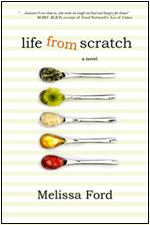
I am also saying hello to the new book. But wait, you think, Life from Scratch isn’t coming out until December 1, 2010. Isn’t this a little early to be saying hello to the new book? Well, life has sort of been in high gear for the last few weeks because my book was chosen by Mediabistro for its book club.
Which means an event in New York on August 17th and a reading and new galleys printed. Which means creating the book site and throwing out ideas for the cover design and edits and tweaks and all sort of loose ends.
Which is 2000 kinds of cool, but also a little crazy because it was unexpected. Calliope received an email from me in the morning, and by evening, we had built this site together over the phone. Seriously, this woman is amazing and brilliant, and as Lindsay did for building Stirrup Queens, Calliope held my hand through the whole thing and didn’t even laugh at me when I started panting that building a website was too hard. If you ever need website help (especially headers), you should hire her. It’s worth every penny to not have to bang your head against the wall.
And if you were wondering what the hell my book is even about (and you can go on the book site and read an excerpt right now), from the blurb on Galleycat:
Nine months after Rachel Goldman’s divorce, she gives birth to a cooking project as well as a blog that helps her find her voice that was missing during her married years. Life from Scratch is an enjoyable read about not only learning how to grab your own happiness, but also, how to fry your own egg. An amateur chef and popular blogger herself, Ford is the author of the award-winning website, Stirrup Queens. Her blog has been recognized by the Wall Street Journal as one of the top ten motherhood blogs.
The reading is open to the public as long as you RSVP and I believe you will go home with a copy of the uncorrected galleys. A collectors item! You can RSVP for the event here. And then let me know you’re coming.
So…goodbye and hello.
July 20, 2010 48 Comments
The Anxious Bartender: New York Edition
 There was no weekend to my weekend. Just a blur of work and tasks from the week before blending into the work and tasks of the weekend which is currently blending into the work and tasks of this current week.
And always, like the thumping base that drives dance music, there is the worry: who the hell is planning this Sunday get together in New York?
No, seriously, what are we doing? Because currently, there is no plan in place.
Though a series of questions have been asked: who is welcome to come? Obviously, anyone in the ALI community. Is everyone cool if people bring partners in tow? I’m assuming yes? Okay, well, what about kids? This is the sticky question and there isn’t going to be an answer that works for everyone. Perhaps someone can take a vote?
And pick a spot that is not dependent on weather, that can accommodate 20+ people, and be inexpensive. Because the bartender is drowning.
Wait, the other thing, please yank up a chair and tell us how you’ve been this past month. Especially since not everyone is meeting up in NY this summer. We can still meet up online right here.
As always, it has been about a month since we met, bitched, cried, comforted, and caught up each other on our cycles and lives. Pull up a seat and I’ll pour you a drink. Let everyone know what is happening in your life. The good, the bad, the ugly. My only request is that if a story catches your eye, you follow it back to the person’s blog and start reading their posts. Give some love, give some support, or laugh with someone until your drink comes out of your nose.
I have a ton of assvice in my back pocket and as a virtual bartender, I will give it to you unless you specifically tell me that this is simply a vent and you do not want to receive anything more than a hug.
So if you have been a lurker for a while (or if this is your first open bar), sit down and tell us about yourself. Remember to provide a link or a way for people to continue reading your story (or if you don’t have a blog–gasp!–you can always leave an email address if you’re looking for advice or support. If not, people can leave messages for that person here in the comments section too). If you’re a regular at the bar, I’ll get out your engraved martini glass while you make yourself comfortable. And anyone new, welcome. I’m glad you found this virtual bar.
For those who have no clue what I’m talking about when I say that the bar is open, click here to catch up and then jump into the conversation back on this current post.
So have an imaginary cocktail and tell us what is up with your life.
July 19, 2010 34 Comments